
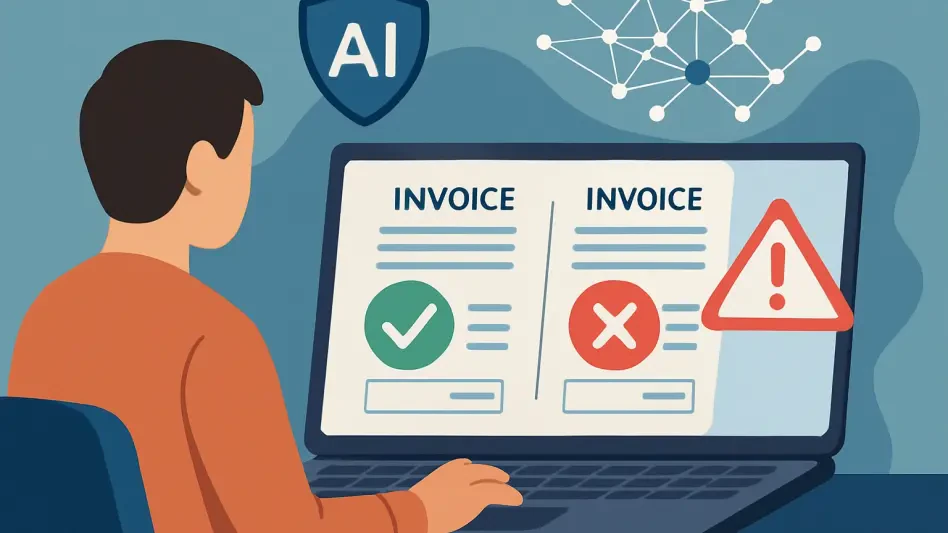
Fraudulent requests often originate from compromised but legitimate email accounts or involve near-perfect imitations of a trusted vendor’s established communication style, fundamentally altering the security landscape for corporate finance departments as traditional verification methods struggle to keep pace with digitally savvy attackers. According to the Association for Financial Professionals’ 2026 Payments Fraud and Control Survey, nearly 76% of organizations in the United States encountered some form of attempted or actual payment fraud over the past year. Invoice fraud has emerged as a major vulnerability because these schemes are designed to mirror legitimate business activities with alarming precision. When a company manages thousands of monthly transactions, the volume of data makes it nearly impossible for humans to spot every discrepancy. Malicious actors exploit these gaps by inserting fraudulent requests into high-volume workflows where they are likely to be approved without a second glance.
Mechanisms of Deception
Sophisticated Fraud Tactics
Modern invoice fraud typically involves the submission of entirely fabricated invoices, the impersonation of established suppliers, or the unauthorized modification of banking details on legitimate documents. These tactics are increasingly sophisticated, often leveraging internal data stolen during prior data breaches to ensure that purchase order numbers, line items, and pricing structures appear perfectly accurate to the casual observer. The most dangerous attacks are those that come from within a hijacked email thread, where a criminal monitors a conversation and interjects at the exact moment a payment is due. By providing updated wire instructions under the guise of an administrative change, they trick finance personnel into rerouting funds to a fraudulent account. This method succeeds because it relies on the pre-existing trust between two business partners, making the request seem like a routine update rather than a targeted heist that could potentially cost the firm millions of dollars.
Psychological Triggers in Business
Beyond technical trickery, fraudsters utilize sophisticated psychological triggers to bypass standard internal controls and force expedited approvals from finance teams. They often create a sense of artificial urgency, claiming that a shipment will be delayed or a vital service will be disconnected if a payment is not processed immediately. This pressure is intended to discourage staff from following the necessary verification steps, such as calling the vendor to confirm a change in bank details. Furthermore, attackers often target junior employees or those who are temporarily covering for colleagues, betting that a lack of familiarity with a specific supplier’s history will lead to oversight. In 2026, the prevalence of Business Email Compromise has made it clear that social engineering is just as critical as technical hacking in the success of invoice fraud. Without a robust system to flag these requests, even the most diligent employees can fall victim to these carefully crafted deceptions.
The Role of Anomaly Detection
Establishing Behavioral Baselines
Artificial Intelligence is revolutionizing fraud prevention by moving beyond static, rule-based checks toward dynamic anomaly detection that understands the context of a business relationship. These systems analyze years of historical transaction data to build a comprehensive profile for every vendor, capturing nuances such as typical billing cycles, average invoice amounts, and standard communication metadata. Instead of searching for a list of known bad indicators, the AI looks for anything that deviates from the established normal baseline. For instance, if a long-term supplier who usually bills in the middle of the month suddenly submits a request on a Friday evening from an unfamiliar IP address, the system flags it for review. This proactive approach allows organizations to identify potential threats in real-time, long before any money is authorized for transfer, shifting the role of the accounts payable department from a reactive unit to a proactive security asset.
Human and Machine Synergy
While AI provides the initial alert, the final decision-making process must remain a collaborative effort between technology and human expertise to ensure operational continuity. Anomaly detection serves as a filtering mechanism that isolates high-risk invoices, but an alert does not always equate to fraudulent activity; it simply highlights a deviation that requires investigation. Finance professionals are tasked with interpreting these alerts within the broader context of the company’s current projects and contractual obligations. When the system identifies a mismatch, the staff must cross-reference the flagged document against existing purchase orders or delivery receipts to confirm its validity. This hybrid approach ensures that the organization benefits from the speed and scale of machine learning while maintaining the nuanced judgment that only a seasoned human professional can provide. It creates a multi-layered defense strategy where technology and people work together to secure assets.
Strategic Outcomes
The integration of AI-driven anomaly detection marked a significant turning point in the fight against corporate payment fraud by providing an early warning system that was previously unattainable. Organizations that successfully deployed these technologies reported a substantial decrease in successful fraud attempts, as the system caught discrepancies that had historically slipped through manual reviews. These businesses recognized that the value of AI lay not in the complete automation of the process, but in its ability to highlight meaningful risks for human investigation. By establishing clear verification protocols and maintaining high standards for data integrity, finance teams shifted their focus from routine administration to strategic risk management. The ultimate success of these initiatives was measured by the prevention of major financial losses and the strengthening of trust between organizations and their legitimate vendors. Looking forward, the focus remained on refining these human-machine synergies for better organizational safety.