The discovery of the BONESAW toolkit highlights how attackers successfully exfiltrated SAML signing material to maintain persistent access after initial entry. This sophisticated intrusion method underscores a major shift in how state-sponsored actors are targeting core virtualization infrastructure to bypass standard security controls like multi-factor authentication. In the current landscape of 2026, the vulnerability known as CVE-2026-123890 has emerged as one of the most significant threats to enterprise stability, specifically because it targets the VMware Directory Service within the vCenter Server. With a critical CVSS score of 9.8, the flaw provides an unauthenticated path for any actor with network-level access to gain total control over the management plane. This allows for the subsequent compromise of every virtual machine, snapshot, and backup managed by the affected instance, making it a “crown jewel” target for espionage operations. The severity of the situation is compounded by the fact that exploitation began as a zero-day operation long before Broadcom could release the necessary security updates in mid-November.
1. Critical Bypass Overview: Technical Realities
The technical core of CVE-2026-123890 lies within the VMware Directory Service, which acts as the central repository for identity and authorization data across the vSphere ecosystem. By exploiting an authentication bypass flaw, an attacker does not need a valid set of credentials or a hijacked session to initiate administrative actions. Instead, a maliciously crafted network request can trick the service into granting high-level privileges. This lack of required user interaction and the low complexity of the attack vector are what drove the CVSSv3 base score to a nearly perfect 9.8. From a defender’s perspective, this means that any vCenter instance exposed to a compromised internal segment or, in rarer and more dangerous cases, the public internet, is essentially an open door for an adversary who knows how to format the exploit payload.
Beyond the immediate bypass, the vulnerability opens the door to a full takeover of the virtualized environment. Once an attacker circumvents the initial authentication barrier, they gain the ability to manipulate user roles, modify permissions, and access the underlying database that stores sensitive configuration data. This specific flaw is part of a larger advisory, VMSA-2026-0009, which also addresses significant issues in SDDC Manager and VMware Tools. While the vCenter bypass is the most critical element due to its unauthenticated nature, the secondary bugs involve SQL injection and authenticated command injection, which could be chained together by a persistent actor to deepen their foothold within the software-defined data center. The breadth of this advisory suggests that the entire management stack has been under intense scrutiny by sophisticated threat actors looking for systemic weaknesses.
2. Timeline of Events: A Window of Unfettered Access
The timeline of this campaign reveals a significant gap between the initial breach and eventual remediation—a period during which defenders were essentially flying blind. According to intelligence reports from Google and Mandiant, the China-nexus group identified as Armory Castle began exploiting CVE-2026-123890 as a zero-day in early September 2026. This activity continued undetected for over two months, allowing the actors to establish deep persistence within targeted networks. It was not until November 19, 2026, that Broadcom published the official security advisory and released the necessary patches across its primary product branches. This two-month window provided ample time for the attackers to exfiltrate massive amounts of data and install secondary backdoors that remained active even after the initial vulnerability was closed by the patch.
Following the release of the patch, the administrative response accelerated due to the high risk of ongoing exploitation. On November 20, 2026, the Cybersecurity and Infrastructure Security Agency officially added the flaw to its Known Exploited Vulnerabilities catalog. This move triggered a mandatory remediation deadline for U.S. federal agencies, set for November 23, 2026. Such a short turnaround—just three days, including a weekend—highlights the extreme urgency of the situation. For the private sector, this timeline served as a stark warning that any vCenter server exposed between September and November should be treated as a potential site of a completed breach. The speed at which the vulnerability moved from a private zero-day to a mandatory federal priority reflects the evolving threat landscape, where critical infrastructure must be defended in real time.
3. Identity of Armory Castle: The Espionage Profile
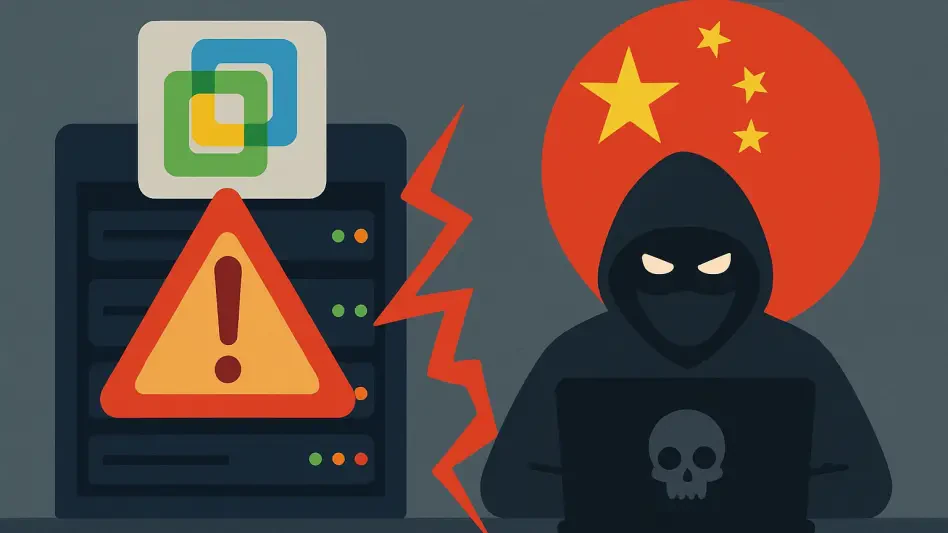
Armory Castle is a threat intelligence designation for a highly disciplined threat cluster with strong ties to the People’s Republic of China. This group, which was previously tracked under the moniker UNC5221 and is sometimes associated with the alias Warp Panda, specializes in long-term espionage rather than the quick financial gains sought by ransomware gangs. Their operational playbook involves the systematic targeting of edge devices, remote-access appliances, and virtualization management suites to gain a silent foothold. Unlike noisier attackers, Armory Castle focuses on maintaining stealthy access to an organization’s identity layer. By compromising the systems that manage user permissions and authentication tokens, they can move through a network while appearing as legitimate administrators, making detection through traditional signature-based security tools nearly impossible.
The group’s focus on the management plane of virtualization environments is a strategic choice designed to maximize the impact of its intrusions. In a modern enterprise, the hypervisor management layer is the intersection of all business logic, data storage, and network communication. By controlling vCenter, Armory Castle gains a vantage point from which it can observe every aspect of a victim’s operations, from confidential communications to proprietary research and development data. This level of access is particularly valuable for state-sponsored espionage, as it allows for the exfiltration of high-value intelligence over an extended period. The renaming of the group from UNC5221 to Armory Castle marks a point of maturation in the tracking of its activities, as security researchers have linked various distinct campaigns back to a single, coordinated set of objectives and tools.
4. BONESAW and the SAML Identity Crisis: Post-Exploitation Danger
The most alarming aspect of the Armory Castle campaign is the use of the BONESAW toolkit, a custom utility written in the Go programming language. BONESAW is specifically designed to interact with the internal mechanisms of vCenter, such as the LMDB database that stores directory information. Once the initial authentication bypass is successful, the tool is used to copy this database and extract Security Assertion Markup Language signing material. These signing keys are the “keys to the kingdom” for any modern identity architecture. If an attacker possesses the SAML signing certificate, they can generate forged authentication assertions that the rest of the network will accept as valid. This allows them to create rogue single sign-on administrator accounts that operate outside the normal visibility of the IT department, effectively granting them a permanent backdoor.
The theft of identity materials creates a crisis that a simple software patch cannot resolve. Because stolen SAML keys allow attackers to bypass multi-factor authentication, they can re-enter the environment even after the original vulnerability has been patched. Reports on this campaign also identify secondary malware components such as SLIMSAVAGE and SAWSNAKE, which further facilitate the persistence and movement of these actors. The use of Golang for these tools is a common trend among sophisticated actors because it allows for easy cross-platform deployment and can be more difficult to reverse-engineer than traditional binaries. Defenders must recognize that the presence of these tools indicates a level of compromise that requires a complete reset of the identity trust chain, moving far beyond a routine maintenance update.
5. The BeyondTrust Association: Complex Attack Chains
Analysis of recent intrusions suggests that vCenter exploitation was often the second or third stage of a broader, more complex attack chain. Intelligence reports indicate a significant link between this campaign and the exploitation of a BeyondTrust Remote Support zero-day, tracked as CVE-2026-102764. In these scenarios, attackers initially gained access to the network through the remote support appliance in late August 2026. From that initial entry point, they moved laterally through internal Linux systems until they reached the virtualization management segment in early September. This multi-stage approach is a hallmark of advanced persistent threats, as it utilizes a chain of trust where one compromised tool provides the necessary network proximity to exploit the next target.
The association between these two major vulnerabilities highlights the susceptibility of the modern “support stack” that IT departments use to manage global operations. Remote-access tools and hypervisor managers are highly trusted components that often have broad permissions across multiple network zones. By targeting these specific links in the chain, Armory Castle effectively bypassed the perimeter defenses that many organizations rely on. While BeyondTrust has released its own set of mitigations and updates to address file-operation flaws and other critical issues in its products, the overlap between these incidents proves that defenders cannot monitor systems in isolation. A breach in a remote-access appliance must be treated as a likely precursor to an attack on the virtualization layer, necessitating a unified response that spans multiple vendor platforms and security disciplines.
6. Remediation Requirements: Patching Across the Ecosystem
Broadcom has provided a comprehensive set of updates to address the vulnerabilities listed in VMSA-2026-0009, covering several major versions of its software. For organizations running the newest deployments, vCenter 9.x should be updated to version 9.1.1.0200 or 9.0.2.0200 to resolve the authentication bypass vulnerability. Those utilizing the vCenter 8.0 branch must upgrade to 8.0 Update 3m, which includes the necessary fixes for the directory service flaw. Additionally, users of the VMware Cloud Foundation 5.x stack are required to update to version 5.2.5. These updates are critical not only for closing the 9.8-rated bypass but also for addressing the secondary SQL injection and command injection issues that could be leveraged by an attacker who has already gained a foothold in the environment.
The situation for older environments is more complicated, particularly for those still running vCenter 7.0. Broadcom’s advisory does not list a generally available patch for this version; instead, it instructs organizations with extended-support contracts to contact technical support for specialized fixes. For those without such contracts, the only viable paths are a rapid upgrade to a supported 8.x or 9.x version or the complete isolation of the management interface from any potential attack path. This lack of a public patch for 7.0 serves as a powerful incentive for organizations to move away from legacy software that no longer receives routine security updates. Given the active exploitation of these flaws, maintaining an unpatched 7.0 instance represents an unacceptable level of risk for any organization concerned with data integrity and operational continuity.
7. Post-Patch Forensics: Hunting for the Stealthy Adversary
Applying the security update is a necessary first step, but because exploitation has been active since September, it cannot be the only step. Security teams must engage in an active hunting phase to determine if their systems were compromised during the two-month zero-day window. This process begins with an audit of Single Sign-On administrator groups. Defenders should look for any account creations after August 2026 that cannot be tied to a documented internal change request. Furthermore, unusual SAML token-signing activity or modifications to identity provider configurations should be treated as high-fidelity indicators of an active Armory Castle presence. Monitoring API session logs for excessive or unusual automation activity can also help identify where an attacker might be using programmatic access to manipulate the environment.
Forensic investigations should also search for specific file artifacts associated with the BONESAW toolkit and its related components, SLIMSAVAGE and SAWSNAKE. These Go-based binaries may be hidden in temporary directories or disguised as legitimate system utilities. Beyond searching for filenames, teams should look for evidence of large-scale directory database exfiltration, such as unusual outbound network traffic from the vCenter appliance or the unexpected mounting of sensitive volumes. If evidence of a compromise is discovered, the response must go beyond simple remediation. It requires rotating all administrative credentials and, most importantly, regenerating the SAML signing certificates. Failure to rotate these secrets means an attacker could retain access to the environment even if the software is fully patched and the original malware is removed.
8. Monday Triage Protocol: A Step-by-Step Defense
For organizations facing the immediate pressure of the CISA KEV deadline or general security concerns, a structured triage protocol is essential. The first phase involves cataloging every vCenter and SDDC Manager installation to ensure no shadow infrastructure remains vulnerable. Once the inventory is complete, administrators must immediately limit the network reach of these management interfaces. By restricting access to a hardened list of jump hosts or administrative subnets, the attack surface is significantly reduced while the patching process is prepared. Before running the updates, it is vital to take full snapshots of the system state and logs. These snapshots serve as a forensic gold mine, allowing incident responders to analyze the system’s history without the risk of the patch overwriting evidence of prior exploitation.
The second phase of the protocol focuses on installing security updates, followed by a deep dive into the identity layer. After upgrading to fixed software builds, such as 8.0 Update 3m or 9.1.1.0200, the focus shifts to auditing SSO configurations. This involves manually verifying all identity provider settings to ensure that no unauthorized trust relationships have been established. Following the audit, a comprehensive refresh of all secrets is mandatory; this includes changing administrative passwords and rotating SAML signing material to invalidate any tokens that may have been stolen by the BONESAW toolkit. Finally, the entry points that allowed lateral movement, such as remote-access tools, must be secured and reviewed. By addressing both the vulnerability and potential post-exploitation artifacts, organizations can move toward a more resilient security posture that accounts for the reality of a long-term adversary presence.
9. Strategic Outcomes: Future Considerations for Virtualization
The widespread exploitation of the vCenter management plane signaled a turning point in how organizations viewed the security of their internal core services. Throughout the final months of 2026, it became clear that the traditional model of perimeter defense was no longer sufficient to protect against sophisticated state-sponsored actors who targeted the very tools meant to maintain the network. The focus shifted toward identity-centric security and the hardening of management networks, as these were the primary areas where the Armory Castle group found success. Administrators realized that the hypervisor was not just a utility for running workloads, but a highly sensitive target that required the same level of monitoring and isolation as a financial database or a primary domain controller.
In the aftermath of the November remediation push, many security teams implemented new protocols for monitoring SAML assertions and directory service modifications in real time. The industry moved toward a more aggressive stance on legacy software, as the difficulties in patching vCenter 7.0 highlighted the dangers of technical debt. Organizations that successfully weathered the storm were those that maintained clear visibility into their identity trust chains and had pre-established incident response plans for virtualization compromises. These actions served to invalidate the stolen material and close the backdoors left by the BONESAW toolkit. By treating the management plane as a zero-trust zone, the community began to build a more robust defense against the next generation of espionage tools, ensuring that a single bypass could no longer lead to the total collapse of the digital infrastructure.