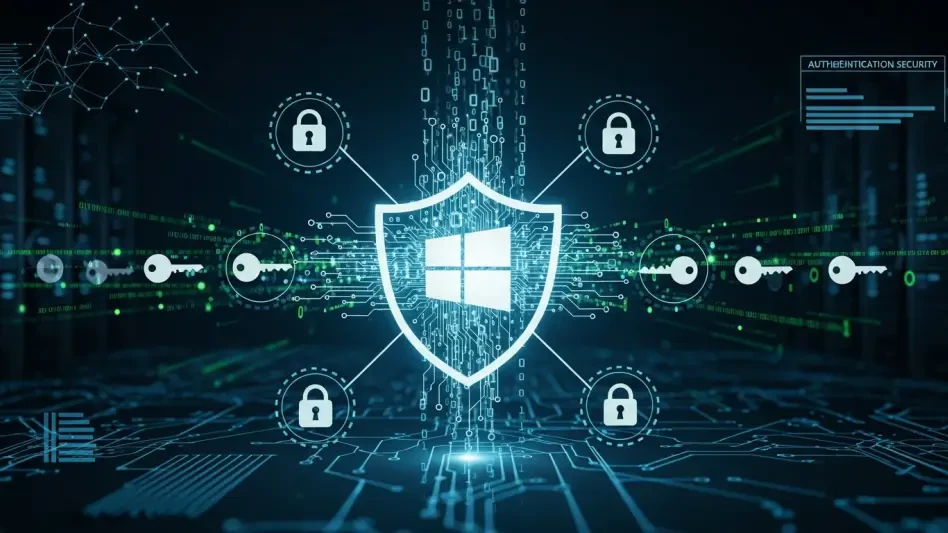
Establishing a robust perimeter in the high-stakes environment of global enterprise networking requires the silent heartbeat of every login and resource request to remain a complex, often misunderstood architecture of trust. This framework does not merely serve as a gatekeeper for individual users but functions as the foundational layer upon which every subsequent permission and data access event is built. In the modern landscape, where decentralized workforces and hybrid cloud environments are the norm, the mechanisms governing identity verification have transitioned from simple password checks to sophisticated, multi-layered cryptographic exchanges. This evolution reflects a broader shift toward treating identity as the primary security boundary, effectively replacing the traditional physical network perimeter.
As organizations navigate this shift, the reliance on established systems like Active Directory persists, anchoring more than ninety percent of the corporate world to a specific set of protocols. The relevance of this technology is underscored by its ubiquity; it is the common language spoken by servers, workstations, and applications across nearly every industry. However, the maturity of this landscape brings a paradox where the very systems designed to ensure stability often harbor legacy weaknesses. Understanding the interplay between these components is essential for any professional tasked with defending an infrastructure that must remain accessible to legitimate users while being impenetrable to sophisticated adversaries.
The Foundation of Enterprise Identity Management
Modern enterprise identity management operates on the principle that a single, centralized authority should verify the identity of every entity attempting to interact with the network. This centralized model, most commonly realized through Microsoft Active Directory, allows for the efficient management of thousands of users and devices from a unified console. By providing a single sign-on experience, the system reduces the friction inherent in modern workflows, allowing a user to authenticate once and gain access to a vast array of authorized resources. This efficiency is not merely a convenience but a strategic necessity in an age where the volume of digital interactions grows exponentially.
The context of this technology’s evolution is rooted in the transition from isolated workstations to interconnected domains. As organizations grew, the need for a scalable way to manage permissions led to the development of sophisticated directory services that could store and distribute security policies globally. This architecture has proven remarkably resilient, adapting to incorporate multi-factor authentication and cloud-based extensions. Yet, its core principles remain tied to the concept of a domain controller—a trusted server that acts as the final arbiter of truth for every identity claim made within the organizational boundaries.
Core Mechanisms of Windows Authentication
The NTLM Challenge-Response Architecture
The New Technology LAN Manager, or NTLM, functions through a classic challenge-response mechanism that has survived decades of technological turnover. When a client attempts to access a resource, the server sends a random challenge, which the client then encrypts using a hash derived from the user’s password before returning it. This process allows the server to verify that the client possesses the correct credentials without the password ever being transmitted across the wire in cleartext. While this was a revolutionary advancement during its inception, the simplicity of the exchange is precisely what makes it a target in the contemporary security environment.
The significance of NTLM today lies primarily in its role as a universal fallback. Despite the availability of more secure alternatives, many legacy applications and older hardware devices lack the sophistication to handle modern ticket-based systems, forcing a downgrade to NTLM to maintain functionality. This creates a persistent vulnerability where an attacker can exploit the known weaknesses of the protocol—such as its susceptibility to relay attacks—to gain a foothold in an otherwise modern network. The performance of NTLM remains high due to its low computational overhead, but this efficiency comes at the cost of cryptographic strength.
The Kerberos Ticket-Based System
Kerberos represents a more advanced approach to security, utilizing a ticket-granting architecture that introduces a trusted third party to the authentication process. Instead of a direct challenge between client and server, Kerberos relies on a Key Distribution Center to issue time-limited tickets that prove a user’s identity. This system provides mutual authentication, meaning the client verifies the server’s identity just as the server verifies the client’s. This bidirectional trust effectively eliminates many of the interception risks associated with older protocols, ensuring that both parties in a transaction are who they claim to be.
The technical performance of Kerberos is characterized by its use of symmetric key cryptography and its ability to minimize the transmission of sensitive data. Once a user receives a Ticket Granting Ticket, they can request specific service tickets for various resources without needing to re-enter their credentials, significantly enhancing both security and user experience. In a real-world enterprise setting, this allows for the seamless orchestration of permissions across vast networks. However, the complexity of managing a Kerberos environment is higher, requiring precise time synchronization between all devices, as even a small discrepancy in system clocks can lead to total authentication failure.
Evolution of the Authentication Landscape
The trajectory of authentication technology is currently defined by the aggressive push toward cloud-native and hybrid models. In this environment, the traditional domain boundary is blurring as organizations integrate on-premises systems with cloud identity providers. This shift is driving the adoption of more modern protocols like OpenID Connect and SAML, which are designed for the web-based, API-driven nature of current software. These innovations provide a bridge between the old and the new, allowing legacy Windows environments to participate in the broader ecosystem of modern software-as-a-service applications.
Furthermore, there is a distinct move toward eliminating the human element as a primary point of failure through passwordless technologies. By leveraging biometrics, hardware security keys, and device-based certificates, the industry is attempting to move away from the “something you know” factor, which is easily stolen or guessed. This trend is not just a technological upgrade but a fundamental shift in user behavior, as people increasingly expect their professional logins to mirror the seamless biometric experiences found on their personal smartphones. The impact on industry behavior is profound, with security teams now focusing more on device health and behavioral analytics than on simple credential validation.
Practical Implementation in Modern Environments
In the financial and healthcare sectors, the implementation of these authentication protocols is dictated by stringent regulatory requirements for data privacy and auditability. These industries utilize the granular logging capabilities of Windows authentication to maintain a detailed trail of every resource access, which is critical for compliance with laws like HIPAA or GDPR. For instance, a hospital might use Kerberos to ensure that a physician accessing sensitive patient records is authenticated against a secure central database, while simultaneously using NTLM for legacy medical imaging equipment that cannot be easily updated.
Beyond traditional industries, modern manufacturing and logistics are deploying these technologies to secure the convergence of operational technology and traditional IT. As factory floor devices become more connected, the ability to extend a unified identity framework to these endpoints is vital. Unique use cases involve using identity as a micro-segmentation tool, where access to specific industrial controllers is granted only after a successful multi-factor authentication event. This deployment demonstrates that Windows authentication is no longer just about logging into a laptop; it is about securing the physical infrastructure that keeps the modern world functioning.
Critical Vulnerabilities and Technical Hurdles
Despite the sophistication of these systems, they face significant hurdles, most notably the persistence of credential theft techniques like Pass-the-Hash and Kerberoasting. These attacks exploit the way hashes and tickets are stored in memory, allowing an adversary who has gained local administrative rights to “harvest” these artifacts and use them to impersonate users across the network. The technical hurdle here is fundamental; the system must store some form of credential to provide a seamless user experience, but that very storage creates a target for attackers. Mitigating these risks requires the implementation of advanced features like Credential Guard, which uses virtualization-based security to isolate sensitive secrets.
Another major obstacle is the logistical nightmare of “decommissioning” insecure protocols. Many large enterprises have thousands of legacy dependencies that would break if NTLM were simply disabled, leading to a state of perpetual risk. This market obstacle prevents many organizations from achieving a true Zero Trust posture. Ongoing development efforts are focused on providing better visibility into where these legacy protocols are being used, allowing administrators to systematically upgrade or isolate them. However, the trade-off between absolute security and operational uptime remains a delicate balance that many struggle to maintain.
The Future of Secure Identity Verification
Looking ahead, the verification of identity will likely shift toward a continuous, risk-based model rather than a single point-in-time event. This future development involves the use of artificial intelligence to monitor user behavior and device health in real-time, adjusting access levels dynamically based on the current threat context. If a user’s behavior deviates from their established pattern or if their device shows signs of compromise, the system can automatically revoke access or demand additional verification. This transition toward “identity as a service” will further decouple authentication from specific on-premises hardware, making it more resilient and flexible.
Potential breakthroughs in quantum-resistant cryptography are also on the horizon, as current encryption methods used in Kerberos and NTLM may eventually become vulnerable to future computing power. The long-term impact on society will be a significantly higher level of trust in digital interactions, reducing the prevalence of identity-related fraud. As these technologies mature, the concept of a “login” may become invisible to the user, with authentication happening silently and securely in the background. This evolution will solidify the role of secure identity as the most critical asset in the digital economy.
Summary and Final Assessment
The review of Windows authentication mechanisms demonstrated that the framework remained a critical yet complex component of the enterprise security stack. The analysis showed that while Kerberos provided a robust and cryptographically sound foundation for modern identity management, the persistent reliance on NTLM created significant gaps that attackers continued to exploit. The investigation highlighted that the transition toward cloud-integrated and passwordless environments was accelerating, yet the legacy infrastructure in many sectors acted as a tether, preventing a full departure from older, more vulnerable protocols.
The overall assessment indicated that the state of Windows authentication was one of transition, where the balance between compatibility and security was constantly being renegotiated. The evidence suggested that organizations that prioritized the hardening of their Active Directory environments and the systematic reduction of their NTLM footprint achieved a much higher level of resilience. Ultimately, the findings pointed toward a future where identity verification would become more automated and behavioral, though the technical hurdles of legacy support would likely persist for several years. Successful implementation required a proactive approach to protocol management and a deep understanding of the underlying cryptographic exchanges.