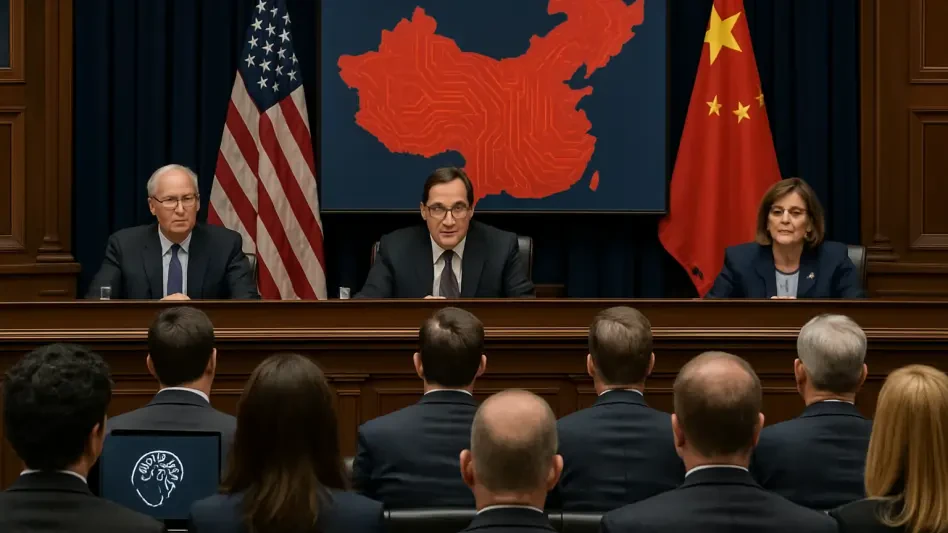
The silent integration of foreign-developed algorithms into the backbone of American commerce has reached a critical tipping point where economic efficiency and national security now stand in direct opposition to one another. As of early 2026, a comprehensive joint investigation launched by the U.S. House Committee on Homeland Security and the Select Committee on the Strategic Competition between the United States and the Chinese Communist Party marks a decisive escalation in the federal oversight of the domestic technology sector. Lawmakers are currently intensifying their scrutiny of what they define as a “structural national security risk” stemming from the widespread adoption of artificial intelligence models developed within the People’s Republic of China. This probe specifically targets the proliferation of low-cost, open-weight, and API-accessible systems from major Chinese entities such as Alibaba, DeepSeek, and Moonshot AI, which are increasingly finding their way into the software stacks of American corporations and critical infrastructure providers. The central concern is that while these models offer high performance at a fraction of the cost of domestic alternatives, their opaque origins and potential for hidden vulnerabilities could expose the United States to unprecedented levels of espionage and systemic disruption.
By moving beyond general policy debates into targeted inquiries against specific American firms, the committees are signaling a shift toward a more aggressive, enforcement-oriented approach to digital sovereignty. The investigation focuses on the premise that the rapid adoption of these adversarial models by U.S. companies may inadvertently create backdoors for the Chinese Communist Party to exploit vulnerabilities within American software supply chains and sensitive data ecosystems. This scrutiny is not merely about protecting domestic market share but is fundamentally rooted in the necessity of maintaining the integrity of the technological infrastructure that supports both the private sector and government operations. As the investigation gathers momentum, it seeks to uncover the extent to which American innovation is being utilized as a trojan horse, where the convenience of “fast and cheap” AI performance comes at the expense of long-term strategic security and the safety of the American public.
Intellectual Property Theft and Safety Standards
Risks of Adversarial Model Distillation
A primary catalyst for this congressional inquiry is the emergence of a sophisticated and legally dubious practice known as “adversarial model distillation,” which lawmakers characterize as an industrial-scale campaign of intellectual property theft. In this process, Chinese entities are accused of utilizing thousands of proxy accounts to bypass the access restrictions and terms of service of leading American AI labs, such as OpenAI, Google, and Anthropic. By systematically querying these high-end American models, PRC-based developers can effectively “extract” the underlying reasoning capabilities, logic patterns, and advanced performance metrics that cost billions of dollars to develop. This extracted data is then used to train smaller, more efficient, and significantly cheaper Chinese-origin models that mimic the performance of their American counterparts without the associated research and development overhead. This creates a parasitic relationship where American-funded innovation is being harvested to fuel the rapid advancement of adversarial technology, effectively neutralizing the competitive lead the United States has fought to maintain.
Beyond the immediate economic concerns of intellectual property theft, the practice of adversarial distillation represents a fundamental degradation of the global AI development landscape. American firms typically invest massive resources into safety engineering, ensuring that their models are resistant to generating harmful content or providing instructions for illicit activities. However, when Chinese firms distill these models, they often strip away the computationally expensive safety layers and ethical guardrails to prioritize raw performance and speed. The resulting “stripped-down” models are then released into the global market, providing bad actors with highly capable tools that lack the necessary restrictions to prevent their use in malicious campaigns. This lack of transparency in the distillation process means that American companies adopting these models may be unknowingly integrating systems that are fundamentally less stable and more prone to being manipulated by hostile state actors or criminal organizations seeking to automate complex cyberattacks.
Erosion of AI Safety Protocols
The erosion of safety standards in PRC-origin AI models poses a multifaceted threat that extends far beyond the digital realm and into the physical safety of American citizens. Lawmakers have expressed deep concerns that the lack of rigorous guardrails in Chinese systems makes them ideal dual-use technologies, capable of being repurposed for the development of biological weapons, chemical agents, or the generation of large-scale disinformation campaigns. While U.S.-based frontier AI labs are required to undergo extensive “red-teaming” and safety evaluations to mitigate these risks, Chinese developers are often bound by domestic laws that prioritize state control and ideological adherence over universal safety standards. This creates a dangerous imbalance where American companies, in their pursuit of cost-savings, might integrate foreign AI that has been designed to operate without the oversight necessary to prevent catastrophic misuse, potentially bypassing the very security protocols intended to protect national interests.
Furthermore, the integration of these less-secure models into the American technological ecosystem creates a competitive disadvantage for domestic companies that adhere to responsible AI development practices. When U.S. firms invest in robust safety protocols, the resulting products are often more expensive and take longer to reach the market compared to the unregulated models emerging from the PRC. By allowing these “unfiltered” models to gain a foothold in the American market, the U.S. risks creating a race to the bottom where safety and ethics are sacrificed for the sake of immediate functionality and lower price points. This development not only threatens the long-term viability of the domestic AI industry but also complicates the government’s ability to regulate the technology effectively. If the underlying models used by American businesses are fundamentally opaque and built upon a foundation of eroded safety standards, the task of ensuring that AI contributes positively to society becomes an almost impossible challenge for federal regulators.
Vulnerabilities in Critical Infrastructure
Security Risks in Software Development
The congressional investigation has placed a specific spotlight on the risks associated with AI-integrated development environments, focusing on how these tools could inadvertently compromise the U.S. software supply chain. A notable case study involves Anysphere, the developer of the popular AI-enhanced code editor Cursor, which has been scrutinized for its reported use of models from the Chinese firm Moonshot AI. The concern here is that as developers rely more heavily on “agentic” AI to suggest, write, and audit code, the provenance of the underlying model becomes a critical security factor. If an AI system originating from an adversarial nation is used to build software for American defense, finance, or energy sectors, it could potentially steer developers toward using vulnerable libraries or subtly introduce backdoors that are difficult for human reviewers to detect. This phenomenon, often referred to as “vibe coding,” relies on the AI’s ability to automate complex tasks, but it also creates a massive blind spot where malicious code could be injected at the foundational level of critical infrastructure.
Moreover, the integration of foreign-developed AI into the coding process shifts the balance of power from the human developer to the algorithm, increasing the potential for systemic failure. Lawmakers have highlighted that partnerships intended to vet open-source components may not be sufficient when the AI providing the recommendations is itself untrustworthy. In a modern development environment, an AI agent can pull from thousands of external repositories and container images in seconds, making real-time human oversight virtually impossible. If the AI model is influenced by the strategic objectives of a foreign state, it could prioritize the inclusion of components that have been pre-compromised or are known to contain exploitable vulnerabilities. This creates an upstream risk that can propagate through the entire American software ecosystem, turning every application built with these tools into a potential vector for a coordinated cyberattack that could cripple essential services or leak sensitive state secrets.
Data Privacy and External Access
Another major pillar of the investigation focuses on the immediate risks to data privacy when American consumer and corporate information is routed through Chinese-linked AI interfaces. The committee has raised alarms regarding Airbnb’s reported integration of Alibaba’s “Qwen” model for customer service operations, a decision frequently defended by corporations as a necessary step for achieving high-speed, low-cost interactions. However, under Chinese national security laws, any domestic company is legally obligated to cooperate with state intelligence agencies and provide access to their data and technology upon request. This means that every query, customer complaint, and personal detail processed by a Chinese-origin model could be accessible to the Chinese Communist Party, regardless of where the American company’s servers are located. This creates a direct pipeline for the collection of sensitive biographical and behavioral data on millions of Americans, which can then be used for targeted influence operations or broader strategic intelligence gathering.
The technical vulnerabilities inherent in these models further exacerbate the privacy concerns, as research consistently shows that Chinese AI systems are more susceptible to “jailbreaking” and prompt injection attacks compared to their American counterparts. These weaknesses allow malicious actors to manipulate the model into bypassing its own internal restrictions, potentially exposing the training data or the private information of users currently interacting with the system. For a company like Airbnb, which handles vast amounts of personal identification, payment information, and travel history, the use of a model that fails to resist even basic adversarial prompts is a significant liability. The committees argue that the trade-off for lower operating costs is a dramatic increase in the attack surface of the company’s digital infrastructure. By prioritizing speed and price over the integrity of the data pipeline, firms are effectively outsourcing their customer’s privacy to an ecosystem that is fundamentally aligned with the interests of a foreign government rather than the protections of U.S. law.
Demands for Accountability and Future Outlook
Requirements for Technical Disclosure
To address these mounting concerns, the House committees have issued a series of rigorous demands for technical data and internal documentation, establishing a firm compliance deadline for the middle of May 2026. Targeted firms are now required to provide a granular mapping of their entire relationship with Chinese technology providers, including detailed records of financial ties, licensing agreements, and any joint research initiatives with firms such as ByteDance, Tencent, and Baidu. This push for transparency is designed to help lawmakers understand the “model provenance” of the AI systems currently operating within the United States. By forcing companies to disclose exactly how their data flows through these models—including the geographical locations of API servers and the identities of third-party entities with access to the data—Congress intends to identify hidden dependencies that could be exploited by foreign intelligence services.
In addition to mapping financial and technical relationships, the committees are demanding that companies provide internal risk assessments that compare the security and ethical profiles of Chinese models against non-PRC alternatives. This requirement aims to hold corporate executives accountable for their procurement decisions, forcing them to justify why they chose a potentially compromised foreign system over a secure domestic or allied-nation model. The disclosure must also include evidence of independent security testing and red-teaming performed on the weights of the integrated models. By mandating this level of transparency, the government seeks to establish a new standard for AI supply chain integrity, where the burden of proof lies with the corporation to demonstrate that their use of foreign technology does not facilitate the exposure of American data or the degradation of national security standards.
Strategic Oversight and Defensive Measures
The broader context of this inquiry is the recognition that the world has entered a new era of AI-driven cyber warfare, where the “defensive gap” that once protected American infrastructure is rapidly closing. Advanced AI systems, such as the recently developed “Mythos” from Anthropic, have demonstrated the ability to autonomously identify zero-day vulnerabilities and execute complex attack chains at a speed and scale that human defenders cannot match. Lawmakers view the infiltration of Chinese AI models as a strategic vulnerability in this landscape, as these models could be programmed to identify vulnerabilities in the very systems they are integrated into. If American power grids, telecommunications networks, and defense systems are built using AI components that are fundamentally controlled or influenced by an adversarial state, the ability to defend against a coordinated digital strike is severely compromised, potentially leading to a collapse of domestic resilience during a period of conflict.
Ultimately, the joint investigation by the House Committees signals a growing consensus in Washington that AI model provenance is just as critical to national power as energy independence or military readiness. The findings of the probe are expected to lead to the development of a more robust regulatory framework for the procurement and deployment of artificial intelligence in sensitive sectors. This could include legislative mandates for “model labeling” and strict prohibitions on the use of adversarial AI in critical infrastructure projects. As the technological landscape continues to evolve, the focus of the federal government has shifted from simply encouraging innovation to ensuring that the tools of progress do not become the instruments of national decline. The investigation serves as a definitive reminder that in the high-stakes competition for technological supremacy, the integrity and origin of the code are the ultimate determinants of a nation’s security and sovereignty.
The congressional investigation into the integration of Chinese AI models within American firms successfully illuminated the deep-seated vulnerabilities inherent in prioritizing short-term economic gains over long-term structural security. By identifying specific instances of adversarial model distillation and software supply chain risks, lawmakers provided a clear roadmap for the necessary transition toward more rigorous technological vetting and procurement standards. The findings suggested that the current lack of transparency regarding model provenance created an unacceptable level of exposure for both private citizens and national infrastructure. Moving forward, it became evident that the federal government must establish a permanent oversight framework that mandates the disclosure of AI origins and subjects foreign-developed algorithms to the same security rigors as physical hardware components. Industry leaders should prioritize the adoption of “secure-by-design” principles, ensuring that the AI tools used in critical operations are sourced from trusted ecosystems that adhere to international safety and ethical standards. This shift toward a more defensive and proactive stance on AI integration will be essential for maintaining American leadership in an increasingly fragmented and contested global technological landscape.