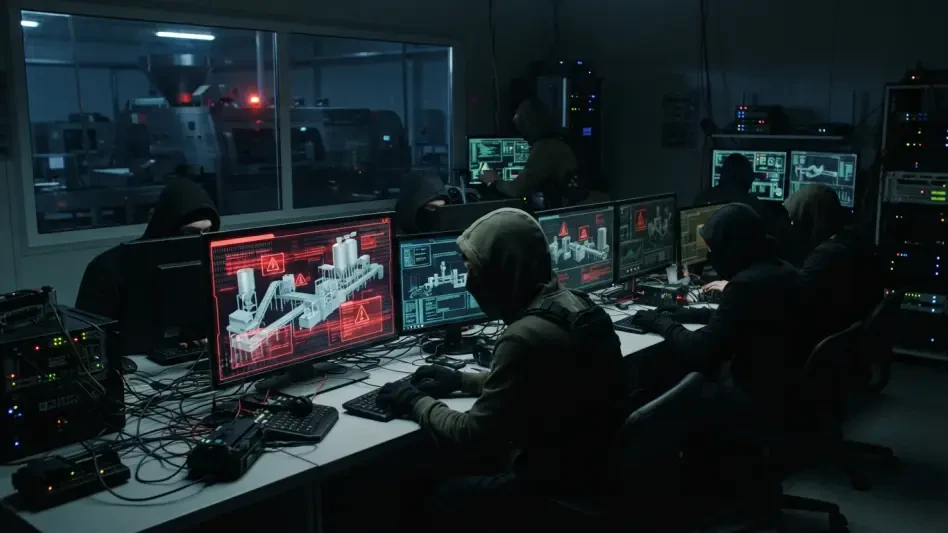
The exploitation of weak passwords in industrial cooling systems reveals a dangerous gap between operational technology and national cybersecurity standards. This vulnerability became a stark reality during a recent sophisticated operation that targeted the refrigeration units of hundreds of supermarkets across Europe. By remotely manipulating digital controllers, anonymous actors triggered constant defrost cycles, resulting in the spoilage of massive food quantities and significant economic loss. This specific event marks a definitive shift away from the traditional security paradigms established in the mid-20th century. While historical warfare relied on physical incursions and the movement of ground troops, modern strategic disruption occurs within a digital gray zone where essential services are the primary targets. The fact that such a large-scale disruption could be executed without crossing a physical border or firing a single shot underscores the reality that digital interconnection has created a new frontier for asymmetric conflict.
The Gap in Global Defense and Legal Frameworks
A primary obstacle in addressing these modern threats lies within the current international legal framework, particularly Article 51 of the United Nations Charter. Historically, the legal definition of an armed attack required physical destruction or immediate loss of life to justify a proportional military or diplomatic response. However, tampering with food refrigeration systems currently falls under the legal classification of cybercrime or simple property damage. This creates a significant legal vacuum where hostile actors can inflict massive economic devastation and social instability while remaining below the threshold that would trigger a formal state of war. Because the damage is indirect and psychological rather than immediately kinetic, nations find themselves unable to leverage traditional defense treaties or international law to deter attackers. This ambiguity provides a low-risk environment for states and their proxies to use technological coercion as a potent tool of statecraft without facing the consequences of conventional warfare.
Strategic Disruption: Reconnaissance and Attribution
The absence of ransom demands or public claims of responsibility during the European supermarket hacks suggests a motivation far beyond simple financial gain or common cybercrime. Intelligence analysts argue that these non-ransom operations serve as advanced reconnaissance missions designed to probe the logistical vulnerabilities of a target nation. By identifying how a society reacts to a sudden disruption in its food supply, attackers gather critical data on the resilience of national supply chains and the efficiency of emergency response protocols. Furthermore, the shared digital architecture between grocery logistics and other critical sectors means that information gained in one area can be applied elsewhere. Because the software used in industrial cooling is often identical to systems managing water treatment or electrical grids, a breach in one facility provides a blueprint for paralyzing multiple essential services simultaneously. These operations represent a calculated effort to map the digital-physical dependencies that sustain modern civilization.
Operational Vulnerabilities: The Risk of Legacy Systems
Technical post-mortems of infrastructure breaches often point toward fundamental security failures, including the widespread use of default or weak passwords on industrial hardware. For years, there has been a pervasive but dangerous assumption that operational technology exists in an isolated environment, separated from the risks of the public internet. This perceived air gap is frequently a myth, as modern industrial controllers are increasingly connected to corporate networks for remote monitoring and efficiency. In several documented cases involving Danfoss refrigeration controllers, the lack of robust authentication protocols allowed attackers to bypass security measures with ease. These legacy systems were originally designed for reliability and mechanical performance rather than cybersecurity, making them easy targets for even moderately skilled hackers. As these devices are integrated into broader smart-grid ecosystems, the failure to update basic credential management protocols creates a direct path for hostile actors to manipulate the physical world through digital means.
Strengthening National Resilience and Future Readiness
Legislation such as the European Union’s Cyber Resilience Act represents a significant step toward mandating higher security standards, but it faces the persistent challenge of technological obsolescence. While new regulations require manufacturers to provide vulnerability support for several years, industrial equipment like cooling chillers and water pumps often remains in active service for decades. This creates a dangerous gap between modern security mandates and the aging infrastructure that actually powers daily life. Once a manufacturer ceases to provide firmware updates for an older model, that hardware becomes a permanent vulnerability that cannot be easily patched. Moreover, the responsibility for maintaining these systems is often fragmented between equipment manufacturers, third-party service providers, and individual facility owners. Without a unified mandate for long-term authentication and security maintenance, the commercial sector remains a prime target for strategic disruption. Bridging this gap requires a fundamental shift in how societies value the security of industrial hardware over its full operational lifespan.
National Security Models: The Shift to Resilience
To counter these evolving threats, nations with vast industrial and retail networks must transition toward a resilience-oriented security model. This approach moves beyond the protection of specific governmental or military institutions and focuses on the continuity of society as a whole. A critical first step involves a comprehensive national assessment to map every internet-exposed industrial system and identify the most vulnerable points in the logistics chain. Close coordination between cybersecurity agencies and sector regulators is essential to ensure that infrastructure operators maintain accurate equipment inventories and conduct regular, independent vulnerability audits. By establishing a clear baseline of security requirements for private sector entities that manage essential services, a country can harden its infrastructure against opportunistic attacks. This proactive stance ensures that the state remains capable of identifying and neutralizing digital threats before they can escalate into physical disruptions. Resilience is not just about preventing every breach; it is about ensuring the system remains functional under duress.
Cognitive Security: Safeguarding Public Trust
A sophisticated aspect of modern infrastructure warfare is the manipulation of cognitive security, which targets the public’s perception of safety and the integrity of the social contract. When citizens lose confidence in the reliability of their food supply or the government’s ability to protect basic services, the foundational trust that stabilizes a nation begins to erode. Attackers recognize that creating a sense of persistent uncertainty and vulnerability can be as effective as physical destruction. By disrupting the flow of essential goods, digital actors can exert coercive power and influence political decisions from within. This psychological theater of conflict operates in the individual’s consciousness, where the fear of an invisible threat creates social friction and domestic instability. Protecting a nation now requires more than just firewalls; it requires maintaining the clarity of information and the psychological resilience of the population. Ensuring that people feel secure in their daily routines is a strategic necessity, as the perception of weakness often invites further aggression from opportunistic adversaries.
Technological Evolution: AI and Narrative Warfare
As we progress through 2026, the integration of Artificial Intelligence into offensive cyber operations has introduced new layers of complexity to infrastructure defense. Automated algorithms can now scan for vulnerabilities across thousands of industrial controllers simultaneously, executing coordinated strikes with a speed that human defenders cannot match. When these physical disruptions are combined with AI-generated disinformation or deepfake campaigns, the potential for societal chaos increases exponentially. For instance, a localized disruption in a food distribution center could be amplified by a coordinated narrative campaign that falsely claims a nationwide shortage, leading to panic buying and civil unrest. This hybrid approach to warfare makes it increasingly difficult for citizens and policymakers to distinguish between a technical failure and a deliberate act of aggression. The ability to automate physical interference while simultaneously manipulating the public narrative represents the ultimate tool for strategic disruption. In this environment, the defense of critical infrastructure must be as dynamic and technologically advanced as the threats it seeks to mitigate.
Future Strategies: Human-Centric Infrastructure Defense
The recent wave of infrastructure attacks established a clear precedent for the future of strategic competition. It was demonstrated that the digital-physical reality of modern life required a fundamental reevaluation of what constitutes a national security priority. Analysts concluded that protecting the food supply and other essential civilian services was no longer a matter of simple commercial interest, but a cornerstone of national defense. Moving forward, the international community recognized the urgent need for a new framework that categorized digital interference with basic survival resources as a violation of global norms. Governments prioritized the development of isolated backup systems and human-in-the-loop protocols to ensure that automated attacks could not bypass human oversight. By investing in resilient logistics and fostering a culture of cybersecurity awareness among private sector operators, societies began to close the gaps exploited by hostile actors. The ultimate takeaway remained clear: maintaining the integrity of human judgment and public trust was the only effective defense against the era of invisible warfare.