
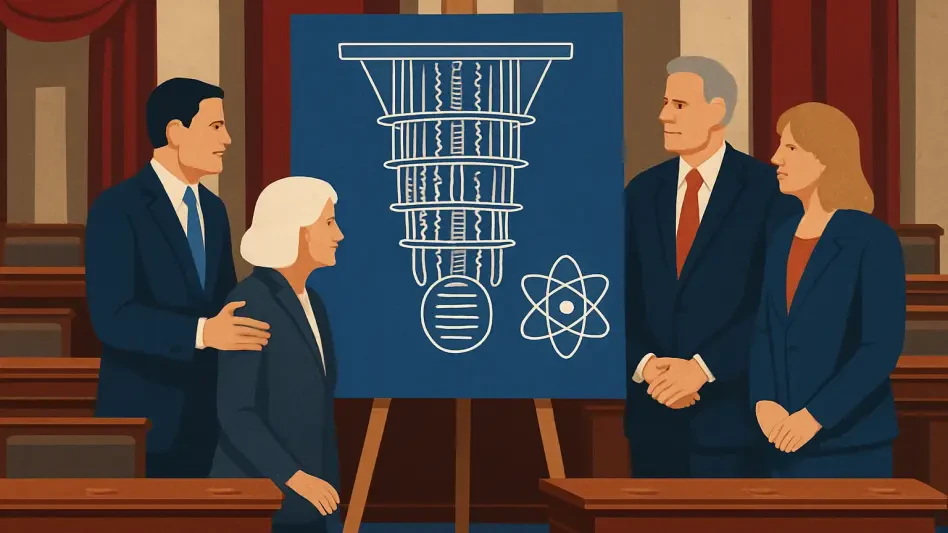
Transitioning to post-quantum cryptography has become a matter of national interest to prevent a future security crisis where digital defenses are rendered obsolete. The National Quantum Initiative Reauthorization Act, known as S. 3597, represents a critical legislative effort designed to sustain and enhance the leadership of the United States in the highly competitive field of quantum research and development. Introduced with significant bipartisan support, the bill seeks to extend the foundational framework that was established by the original 2018 legislation, ensuring continuity and federal oversight through the end of 2034. This extension is far from a simple bureaucratic renewal; it marks a strategic pivot from purely theoretical exploration toward a more integrated approach that encompasses engineering and practical technology. By broadening the national scope, lawmakers are acknowledging that quantum systems are rapidly moving out of the laboratory and toward real-world applications in secure communications and national security.
Federal Agency Mandates and Workforce Development
Central to this legislative push is the authorization of substantial financial resources and the assignment of clear, actionable mandates to key federal agencies. Specifically, the bill authorizes $85 million annually for the National Institute of Standards and Technology to conduct advanced research and related operational activities. This funding ensures that NIST remains at the forefront of establishing the technical benchmarks required for the next generation of computing. Beyond mere laboratory work, the mandate encourages the agency to develop standards that will facilitate the commercialization of quantum sensors and clocks, which are essential for precision navigation and timing in modern defense systems. By providing a stable budgetary environment, the legislation allows for long-term planning that classical computing frameworks cannot support. This commitment signals to the global market that the American government is dedicated to providing the necessary infrastructure for a thriving quantum industrial base.
Alongside standardized research, the legislation directs the National Science Foundation and the National Aeronautics and Space Administration to prioritize the cultivation of a specialized workforce. The global race for technological supremacy requires a new generation of scientists and engineers who are capable of building, maintaining, and operating these highly complex systems. The bill envisions a collaborative ecosystem where government researchers, academic institutions, and private industry partners work in tandem to overcome significant technical hurdles, such as error correction and qubit stability. By fostering these partnerships, the United States aims to ensure that its technological supply chain remains resilient and independent of foreign interference. Building this human capital is just as vital as building the hardware itself, as the talent gap currently represents one of the largest bottlenecks in scaling quantum solutions. This integrated strategy ensures that the nation possesses the expertise to manage these systems effectively across various sectors.
National Cybersecurity Strategy and Global Leadership
Perhaps the most urgent operational aspect of the act is its focus on “quantum-proofing” the national digital infrastructure through the establishment of a National Quantum Cybersecurity Upgrade Strategy. This initiative is specifically designed to prepare federal agencies and operators of critical infrastructure for the eventual emergence of “cryptographically relevant” quantum computers. These powerful machines are theorized to possess the capability to crack many of the encryption methods currently used to protect sensitive government data, financial transactions, and proprietary health records. To mitigate this looming threat, the strategy actively supports an accelerated transition to post-quantum cryptography. These new encryption standards are engineered to be secure against both conventional and future quantum-based mathematical attacks. By formalizing this transition now, the legislation creates a structured timeline for federal departments to audit their existing systems and begin the complex process of migrating to more secure foundations.
Bridging the gap between experimental research and commercialized technology is the final priority for policymakers seeking to secure the nation’s economic future. The transition from laboratory prototypes to market-ready applications requires a robust framework that supports both basic science and late-stage development. To ensure long-term stability, stakeholders are prioritizing the immediate implementation of the National Quantum Cybersecurity Upgrade Strategy to protect legacy data from emerging threats. Industry leaders are aligning their research agendas with the priorities established by the newly authorized NIST and NSF programs to ensure a cohesive national effort. Federal agencies are taking the lead in establishing these collaborative networks, providing the necessary guidance for private firms to invest in domestic manufacturing capabilities. By prioritizing the recruitment of specialized talent and the hardening of digital infrastructure, the United States is positioning itself to lead the global quantum economy through the next decade.