
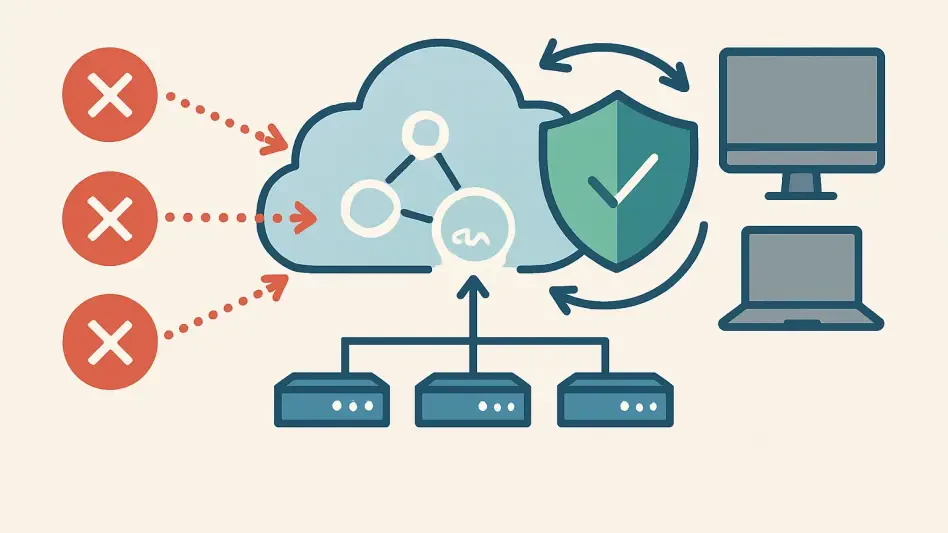
The system uses a semantic cross-reference approach to prevent flash crowds from being incorrectly identified as malicious attacks by correlating mathematical flags with diagnostic system logs. In 2026, the widespread adoption of Software-Defined Networking (SDN) has fundamentally changed how enterprises manage their digital traffic, yet it has also concentrated risks within the centralized control plane. By decoupling packet-forwarding hardware from the software that dictates routing logic, SDN provides unmatched flexibility, but it creates a single point of failure that is increasingly targeted by sophisticated cybercriminals. When an attacker launches a volumetric Distributed Denial-of-Service (DDoS) attack, the central controller is often overwhelmed by a surge of requests, leading to widespread network paralysis. To solve this, researchers Swarnajit Bhattacharya, Asit Kumar Nayek, and Mrinmoy Sen have introduced a Log Analysis Subsystem (LAS) that identifies threats without the massive computational overhead typical of earlier intrusion detection systems. This framework allows for high-precision monitoring that protects the network’s core while maintaining the agility required by modern cloud infrastructures and large-scale data processing environments.
Addressing the Vulnerabilities of Centralized Control Planes
The primary threat to any SDN architecture lies in its reliance on the central controller to manage all operational flow rules across the entire environment. In a typical scenario, when a switch receives a packet it does not recognize, it sends a “packet-in” message to the controller, requesting instructions on how to handle the data. Malicious actors exploit this mechanism by flooding the network with massive quantities of spoofed requests, effectively forcing the controller to exhaust its finite computational bandwidth and memory resources. Because the controller is responsible for the global network topology, its failure triggers a cascading collapse where individual server nodes lose connectivity, rendering the entire infrastructure useless. Traditional perimeter defenses, designed for static legacy networks, often fail to adapt to the dynamic and programmatic nature of SDN flow entries, leaving the control plane dangerously exposed to these volumetric exhaustion tactics.
To combat these evolving threats, the researchers designed the Log Analysis Subsystem to function as a responsive and lightweight secondary defense layer. Unlike conventional intrusion detection systems that struggle with input-output latency by reading raw logs from physical storage drives, this framework utilizes an in-memory database storage pipeline. By integrating high-performance caching engines like Redis or Memcached, the system can ingest incoming session headers and chronological timestamps directly into the system’s RAM. This architectural choice allows for real-time statistical inspections to occur across discrete five-second operational intervals without causing any measurable lag in the primary network forwarding services. This dual-stream approach ensures that the controller remains protected by a vigilant monitoring agent that operates in parallel, rather than as a bottleneck, ensuring that security measures do not compromise the performance the SDN was built to provide.
Initial Traffic Screening with Shannon Entropy
The first stage of this innovative defense framework utilizes Shannon entropy to provide a high-speed, coarse-grained filter for all incoming network traffic. Shannon entropy serves as an ideal mathematical tool for initial screening because it measures the degree of randomness or distribution across specific flow attributes, such as destination IP addresses and client source ports. Under standard operational conditions, network traffic typically exhibits a high degree of diversity and a balanced distribution across various nodes, resulting in stable and predictable entropy baselines. However, during a targeted flooding episode like a TCP synchronization attack, the distribution shifts dramatically as immense packet volumes are concentrated toward a single, isolated server destination. This sudden lack of randomness causes a measurable drop in destination entropy, providing an immediate and clear signal that the network may be under a coordinated assault.
To ensure accuracy, the system compares these real-time entropy measurements against dynamic “three-sigma” statistical thresholds derived from the network’s established baseline operational phases. This stage is particularly effective because it operates with linear computational complexity, allowing it to process vast amounts of data at wire speed without stalling the primary controller’s decision-making processes. By acting as a high-speed gatekeeper, the entropy module can allow the vast majority of legitimate traffic to pass through unhindered while flagging only the most suspicious subsets for further investigation. This tiered approach prevents the system from becoming bogged down by complex calculations for every single packet, focusing its analytical power only where it is truly needed. It represents a significant shift from traditional “all-or-nothing” security models that often struggle to keep pace with the high-bandwidth demands of contemporary enterprise networks.
Detailed Verification via Kullback-Leibler Divergence
Traffic that exceeds the statistical thresholds set in the initial entropy stage is immediately passed to the second phase of the framework for more rigorous verification. This stage employs Kullback-Leibler (KL) divergence, a sophisticated mathematical calculation that evaluates the distributional shifts between empirical, live traffic and established baseline probability models. While the initial Shannon entropy stage can identify that a distribution has become less random, KL divergence provides a more granular assessment by quantifying exactly how far the current traffic pattern has strayed from a “healthy” or “normal” state. By specifically computing the divergence across session duration profiles and targeted address frequencies, the subsystem can corroborate the presence of a genuine attack with an extremely high degree of mathematical confidence, drastically reducing the likelihood of errors.
The staged arrangement of these two mathematical tools is a masterstroke of administrative efficiency within the SDN context. By restricting the more computationally demanding KL divergence calculations exclusively to those traffic subsets that have already been deemed suspicious by the entropy filter, the overall processing overhead remains linearly manageable even as the network’s total transmission load expands. This precision is vital for distinguishing between malicious threats and “flash crowds,” which are sudden but legitimate spikes in traffic caused by events like breaking news or product launches. While a flash crowd might trigger a simple entropy alert due to a surge in volume, the KL divergence analysis can recognize the underlying legitimacy of the traffic based on historical probability models, ensuring that important users are not accidentally disconnected during periods of peak activity.
Semantic Correlation within Unstructured Diagnostic Logs
A unique characteristic of this framework is its ability to parse and analyze unstructured controller logs in tandem with its mathematical models. During the height of a DDoS attack, network infrastructure components frequently generate narrative text streams that include diagnostic error signatures, such as connection timeout records, link failure notices, and buffer saturation warnings. While most automated detection systems ignore these text-based events in favor of raw numerical data, the LAS framework utilizes an independent text-parsing pipeline to monitor these narrative logs for signs of systemic stress. This approach provides a semantic cross-reference that allows the defense system to understand the actual operational impact of the traffic it is observing, rather than relying solely on abstract statistical probabilities.
This integration of unstructured log analysis acts as a vital safety net that significantly enhances the system’s overall detection capabilities. If the mathematical models flag a potential anomaly and the diagnostic logs simultaneously show evidence of resource exhaustion, the framework can move immediately to quarantine the malicious identifiers with total certainty. Conversely, if the mathematical data is ambiguous but the logs show no signs of system distress, the framework can exercise caution and avoid a false positive. This multi-format inspection ensures that no diagnostic evidence of an attack is overlooked, regardless of whether that evidence is hidden within a packet header or a narrative system message. By bridging the gap between numerical statistics and operational linguistics, the researchers have created a more holistic and resilient defense posture for modern SDN environments.
Experimental Validation through Robust Performance Metrics
To prove the efficacy of their dual-stage framework, the researchers conducted extensive testing within a virtualized SDN testbed utilizing Mininet, an OpenDaylight control node, and multiple OpenFlow switches. The experimental environment was designed to simulate both standard background communications, such as video streaming and file transfers, and hostile scenarios including TCP SYN floods and address randomization sweeps. The empirical findings were remarkably consistent, as the hybrid approach achieved a true positive rate of 98.5% against synchronization floods. This performance level represented a significant improvement over simple entropy-only mechanisms, which typically struggle to maintain accuracy when faced with sophisticated spoofing techniques. Furthermore, the system successfully suppressed the false positive rate to a mere 1.5%, ensuring that legitimate network operations remained uninterrupted during active defense.
Beyond its detection accuracy, the system demonstrated exceptional efficiency in terms of operational overhead and speed. The average detection latency was recorded at approximately 210 milliseconds, which marked a reduction of over 100 milliseconds compared to many baseline intrusion detection approaches. The CPU overhead on the centralized controller rose by only a negligible amount, proving that the granular mathematical tracking and log parsing could be implemented without paralyzing the very control plane they were designed to protect. To further validate these results, the team replayed realistic network trace captures from the CIC-DDoS2019 dataset into their testbed. The framework maintained its high accuracy rate, matching the performance of resource-heavy deep learning models while decisively outperforming them in terms of execution speed and computational economy, making it a viable solution for real-world deployment.
Automated Mitigation Strategies and Future Development
The ultimate goal of the LAS framework was the transition from passive detection to active, automated remediation. Once the system definitively confirmed an attack through its dual-stage process, it automatically cataloged the flagged source addresses in a quarantine repository and dispatched immediate instructions to the SDN controller. The controller then programmatically installed new OpenFlow flow-table entries that blocked or isolated the malicious sessions at the ingress switches. This effectively stopped the attack at the network’s “front door” before it could penetrate deeply enough to exhaust internal server resources or disrupt the centralized controller’s ability to manage legitimate traffic. This closed-loop defense cycle allowed the network to heal itself in real-time, significantly reducing the burden on human administrators during high-stress security incidents.
The researchers identified several key areas for future development to ensure the framework remains effective against evolving threat landscapes. They concluded that developing dynamic baseline adaptation algorithms would be necessary to allow the system to evolve continuously as enterprise traffic trends shift over time, moving away from fixed profiling intervals. There were also strategic plans to integrate advanced Natural Language Processing into the unstructured text analysis module, which would allow the system to interpret raw system messages with even greater nuance and granularity. Furthermore, the team explored the possibility of transitioning from binary blocking to more sophisticated responses, such as graduated traffic shaping and rate-limiting. These advancements were intended to provide a more flexible and resilient infrastructure capable of preserving the integrity of critical networks in an increasingly hostile and complex digital world.