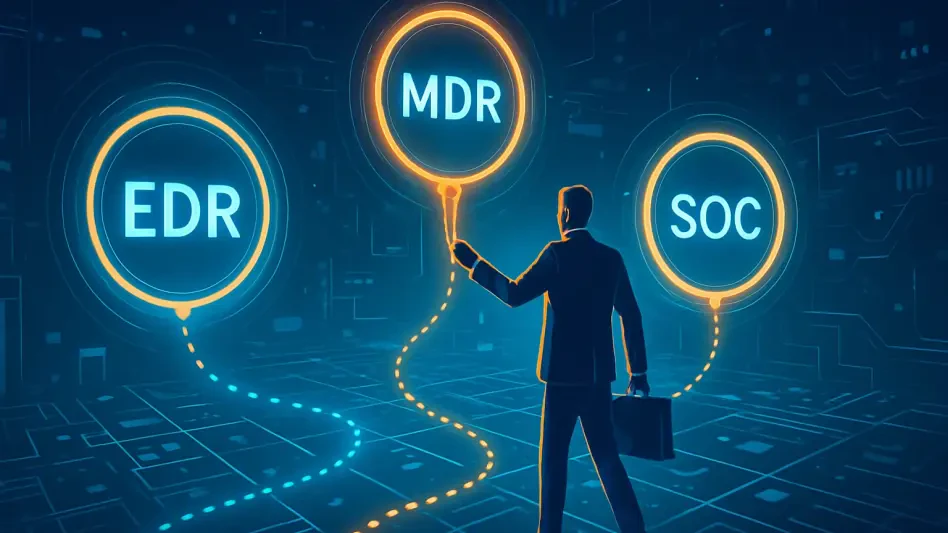
The rapid evolution of global digital infrastructure has forced a fundamental transition from simple firewall maintenance toward a comprehensive strategy centered on human expertise and behavioral intelligence. In the current landscape of 2026, cybersecurity is no longer viewed as a peripheral IT concern but as a fundamental pillar of business continuity. As threats become more sophisticated and regulatory pressures mount, organizations are moving away from simply installing software toward a process-centric approach that emphasizes human expertise and rapid response. This guide explores the critical distinctions between Endpoint Detection and Response (EDR), Managed Detection and Response (MDR), and the Security Operations Center (SOC) to help businesses navigate the modern risk landscape with confidence.
The Shift Toward Process-Centric Digital Defense
Cybersecurity today is defined by the recognition that technology is only as effective as the processes surrounding it. While the previous decade focused on building perimeter walls, the focus in 2026 is on internal visibility and the ability to detect anomalies that have already bypassed initial defenses. This shift requires a deep understanding of how different security layers interact to create a cohesive shield. Organizations that prioritize a process-centric defense are better equipped to handle the nuances of modern attacks, which often use legitimate administrative tools to carry out malicious activities.
Furthermore, the integration of these processes ensures that security teams are not just reacting to alerts but are actively hunting for threats. By emphasizing human expertise, companies can interpret the context behind data points, distinguishing between a developer’s heavy resource usage and a sophisticated data exfiltration attempt. This nuanced approach reduces the likelihood of catastrophic failures and ensures that security investments translate into actual protection rather than just a collection of disconnected software licenses.
Why Strategic Security Integration Is Essential in 2026
Adopting a structured approach to EDR, MDR, and SOC is no longer an optional upgrade for growing companies; it is a requirement for operational viability. Following these best practices ensures that an organization’s defense strategy aligns with contemporary threat levels and legal mandates. Without a strategic framework, businesses often find themselves overwhelmed by a sea of data, unable to identify the signal within the noise, which leads to increased vulnerability and slower response times during a crisis.
Enhancing Security Maturity and Operational Efficiency
By clearly defining the roles of EDR, MDR, and SOC, organizations can eliminate redundancies and ensure comprehensive coverage across their entire digital estate. This strategic alignment leads to faster incident mitigation and significantly reduced downtime. When every component of the security stack has a defined purpose, the time from detection to remediation shrinks from days to minutes, preventing minor intrusions from escalating into major operational shutdowns.
Moreover, this clarity contributes to significant long-term cost savings by avoiding the catastrophic financial impact of data breaches and subsequent legal battles. Efficiency in security operations also means that internal IT teams are no longer burdened with constant alert fatigue. Instead, they can focus on core business objectives while knowing that the security infrastructure is functioning as a synchronized unit designed to protect the organization’s most valuable digital assets.
Meeting Rigorous Compliance Standards
With the full implementation of CMMC 2.0 and other global frameworks, businesses must prove they have active, professional oversight of their environments. Transitioning from basic tools to managed services or centralized operations is often the only way to satisfy third-party auditors and secure high-level contracts. Organizations handling sensitive data are now required to demonstrate not just the presence of security software, but the existence of a verifiable response plan and continuous monitoring.
Compliance is no longer a “check-the-box” exercise but a continuous state of readiness that requires documented evidence of threat hunting and incident management. This regulatory environment has made MDR and SOC services essential for mid-market companies that wish to remain competitive in government and defense supply chains. Failing to meet these rigorous standards often results in the immediate disqualification from lucrative contracts, making security maturity a direct driver of revenue and market access.
Best Practices for Navigating Modern Security Architectures
To build a resilient defense, organizations must understand what they are actually buying and how to implement these layers effectively within their existing infrastructure. The goal is to move beyond the superficial installation of tools and toward a model where every technical capability is backed by an actionable protocol.
Implementing EDR as a Foundation for Visibility
Endpoint Detection and Response should be treated as the technological bedrock of a security stack, focusing on behavioral analysis rather than simple signature matching. This technology provides the necessary visibility into the activities occurring on workstations and servers, allowing for the detection of “living off the land” techniques. For example, a mid-sized manufacturing firm recently utilized EDR to detect a sophisticated zero-day attack that bypassed traditional antivirus software. Because the EDR monitored for anomalous behavior, it flagged a suspicious process attempting to encrypt files, allowing the internal team to isolate the affected workstation before the ransomware could spread across the network.
Leveraging MDR to Bridge the Expertise Gap
Managed Detection and Response is the ideal solution for organizations that require 24/7 professional oversight but lack the resources to maintain an expansive internal security department. By outsourcing the monitoring of EDR alerts to a specialized provider, companies gain access to a team of elite analysts who can remediate threats in real-time. A regional healthcare provider successfully implemented an MDR service to meet strict patient data protection regulations. This partnership provided them with enterprise-grade security on a mid-market budget, ensuring that threats were neutralized at 3:00 AM without requiring a single internal staff member to be on-call.
Establishing a SOC for Unified Infrastructure Oversight
For organizations with complex environments involving cloud, network, and application layers, a Security Operations Center acts as the central command center for all security intelligence. The SOC unifies data from multiple sources to provide a holistic view of the risk posture. A global logistics company established a SOC to unify data from multiple cloud providers and on-premises servers. By integrating their SIEM with various threat intelligence feeds, the SOC team identified a cross-platform credential stuffing campaign that would have gone unnoticed if they had only been monitoring individual endpoints, demonstrating the power of centralized oversight.
Evaluating Your Security Path: Recommendations for 2026
The security landscape in 2026 proves that technology alone is insufficient; the human element is the ultimate differentiator in maintaining a robust defense. The choice between EDR, MDR, and SOC should be dictated by internal capabilities, the scope of the infrastructure, and specific compliance obligations. Smaller businesses found that MDR offered the best balance of cost and protection, providing a turnkey solution that satisfied most regulatory audits. Larger enterprises or those with specialized needs invested in a full SOC to ensure a holistic view of their risk posture and long-term resilience.
Ultimately, organizations moved from a reactive stance to a model of guaranteed outcomes, ensuring they could neutralize threats before they impacted the bottom line. Decision-makers conducted thorough gap analyses to determine which defense layer suited their current risk profile. They prioritized the integration of existing tools over the acquisition of new, disconnected software suites. This proactive stance ensured that operational resilience became a measurable metric rather than a theoretical goal, allowing businesses to thrive despite the increasing complexity of the digital threat environment encountered throughout the year.