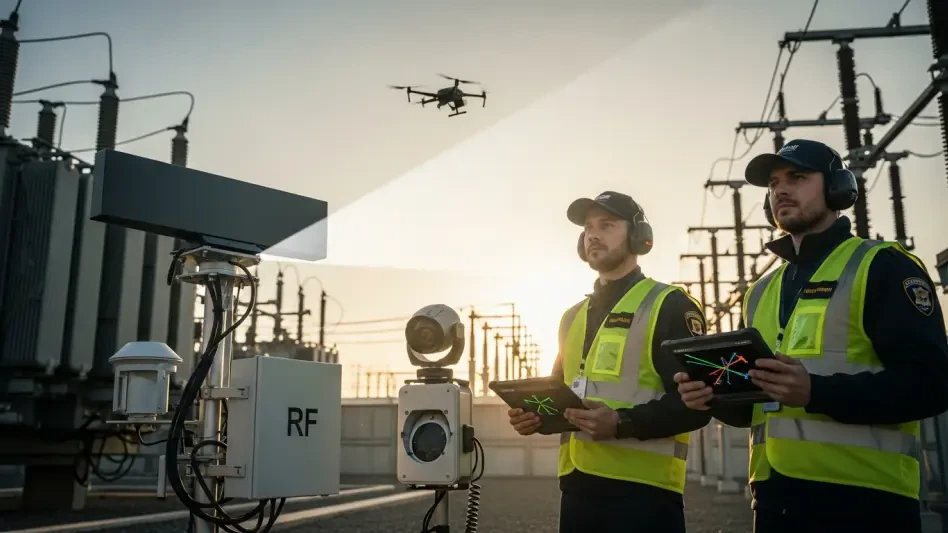
A surge of rogue quadcopters over substations is forcing security budgets to pivot from fences to firmware and training. The market conversation has shifted from abstract drone risk to concrete procurement plans, catalyzed by a bill that would move limited counter-UAS authority to the edge while keeping federal hands on the wheel. That blend of empowerment and oversight is not just a policy nuance—it is the thesis of a fast-forming market where regulated buyers, approved technologies, and certification standards define growth.
Market Context and Purpose
Utilities, nuclear operators, and pipeline owners have long relied on passive detection and a phone tree when drones appeared. That playbook strained as incidents multiplied and flight times shrank to minutes, creating operational exposure and financial risk that conventional perimeter tools could not address. The Critical Infrastructure Airspace Defense Act answers this gap by proposing a narrow, supervised carve-out: certified on-site personnel at DHS-designated facilities could detect, track, and mitigate threats using pre-approved systems with FAA coordination in the loop.
For market participants, this is the hinge point. Rather than a broad open market, the framework channels demand through certification gates, technology lists, and coordination protocols. Vendors that can document safety cases, spectrum discipline, and seamless FAA workflows will meet the bar; those built on improvisation and gray-area jamming will not. Procurement, in turn, becomes more predictable, auditable, and financeable.
Moreover, the act’s structure aligns incentives across stakeholders. Operators gain lawful response options, insurers gain standardized controls, and federal agencies maintain airspace integrity. This alignment converts a compliance problem into an investable category with measurable outcomes.
Demand Drivers and Regulatory Catalyst
The first driver is speed. Drone incursions unfold faster than federal responders can arrive, so value accrues to on-site capabilities that can compress the detect-to-decide window. The second is consequence. A downed transformer, a tripped line, or a compromised control center imposes costs far beyond equipment, rippling into service penalties and reputational damage. The third is clarity. Clear statutory authority reduces legal uncertainty that has chilled procurement, unlocking pent-up demand among high-risk nodes.
The regulatory catalyst is equally potent. A national certification program led by DHS—developed with DOE, FAA, DoD, DOT, and DOJ—and stood up within months of enactment, would create a uniform “schoolhouse” standard. This standard becomes the de facto specification guiding requests for proposals, staffing models, and service-level agreements. In practice, certification not only qualifies people; it shapes vendor roadmaps, training content, and integration patterns with incident management systems.
At the same time, the pre-approved technology list winnows the field. Tools that respect spectrum rules, coordinate in real time with the FAA, and show controlled mitigation effects will define the core stack. Expect converged solutions that fuse RF, radar, optical, and Remote ID, wrapped in safety interlocks and audit logging. The market rewards repeatability and low collateral risk over brute-force tactics.
Certification Economics and Workforce Implications
Certification creates an addressable services layer. Training providers, simulation platforms, and compliance software gain relevance as operators build rosters of qualified personnel, track currency, and schedule drills. Utilities will budget for initial training surges followed by steady-state refresh cycles, often aligning with union roles and security outsourcing contracts. This creates predictable, recurring spend tied to regulation rather than discretionary pilot projects.
Labor dynamics also evolve. Security teams take on aviation-adjacent functions, pushing demand for hybrid skill sets that blend physical security, RF literacy, and incident command. Wage premiums and retention incentives are likely at nuclear sites and major substations, where risk scores and regulatory scrutiny are highest.
Technology Stack and Procurement Patterns
Approved systems will anchor procurement around integrated suites rather than point tools. Buyers will screen for sensor fusion quality, false alarm rates in cluttered RF environments, automated FAA coordination workflows, and documented fail-safes. Cybersecurity hardening, role-based access, and chain-of-custody logging move from nice-to-have to mandatory.
Commercial models will tilt toward subscriptions for software, analytics, and compliance reporting, coupled with capital purchases for sensors and effectors. Grants authorized through 2031 inject co-funding that can accelerate initial rollouts at priority sites, while data from those deployments will calibrate broader expansion. Vendors able to provide turnkey packages—design, install, train, and maintain—will capture premium share.
Oversight, Funding, and Measurable Outcomes
The act’s biennial reporting to Congress sets a feedback loop that the market must internalize. Metrics on detections, mitigations, near-misses, training outcomes, and privacy safeguards will inform renewals, tighten standards, and steer procurement templates. This pushes vendors to instrument products for evidence generation, not just operational effect.
Funding matters too. The DHS grant program, coordinated with DOE and authorized at $250 million from 2027 to 2031, serves as a demand catalyst but not a blank check. Expect triage: nuclear generation, bulk power control centers, and high-impact substations will lead. Cost discipline will favor scalable architectures and shared services across utility footprints, such as regional operations centers with multi-site coverage.
Forecast and Scenarios
Base case adoption follows a phased curve. Designations concentrate first on top-tier risk assets; procurement ramps as certification cohorts graduate and approved products clear integration testing. From 2026 to 2028, the market forms around pioneers with strong compliance postures. From 2028 to 2031, maturing data and refined FAA playbooks lower friction, widening uptake across secondary nodes.
Bull case assumes rapid maturation of sensor fusion and tighter Remote ID compliance, which compress detection latency and reduce false positives. In this scenario, insurers offer premium credits for certified deployments, unlocking board-level endorsement and accelerating capital approval cycles. Vendors with modular upgrades and cross-site orchestration win outsized deals.
Bear case centers on missteps: a high-profile mishap, spectrum conflicts, or delays in certification rollout. Procurement pauses would follow, and purchasing would shift to detection-only systems while mitigation policies are retooled. Even under this drag, designated high-risk sites still procure minimum viable capabilities to satisfy governance expectations and reduce worst-case exposure.
Across cases, the 2031 sunset acts as a forcing function. Operators will front-load learning, run controlled pilots that feed DHS reporting, and prepare for a data-driven renewal decision. Vendors will hedge by designing features that serve adjacent markets—airports, stadiums, and logistics hubs—without relying on identical authorities.
Strategic Implications and Playbook
Operators should map assets against likely designation criteria and stage procurements in tiers aligned to grid impact and community sensitivity. Budgeting should separate compliance-critical spend—certification, FAA coordination tooling, and approved mitigation—from incremental enhancements like advanced analytics and drone forensic enrichment.
Governance will be decisive. Clear engagement thresholds, privacy-by-design telemetry practices, and disciplined after-action reviews reduce legal risk and strengthen the case for continued authority. Integrating counter-UAS alerts into existing incident command and outage management systems shortens restoration timelines and improves regulator communications during events.
For vendors, the strategy is to lead with safety cases. Demonstrate electromagnetic compatibility, deterministic fail-safes, and auditable workflows. Build training content that maps to the national curriculum, and offer outcome-based service guarantees tied to detection performance and compliance uptime. Partnerships with RF spectrum experts and aviation consultants will differentiate bids as standards harden.
Closing Outlook
The market for counter-drone defense at critical infrastructure had moved from speculative pilots to a governed, certifiable category shaped by federal guardrails. Demand had been catalyzed by the promise of on-site authority paired with FAA coordination, and spend concentrated where risk and regulatory pressure were highest. Competitive advantage had accrued to vendors that proved safety, integrated workflows, and supported certification at scale. For operators, the winning playbook had prioritized layered detection, trained personnel, rigorous governance, and phased deployment aligned to grants and sunset timelines. The path forward favored disciplined execution over improvisation, positioning the sector to convert risk reduction into measurable reliability gains.