
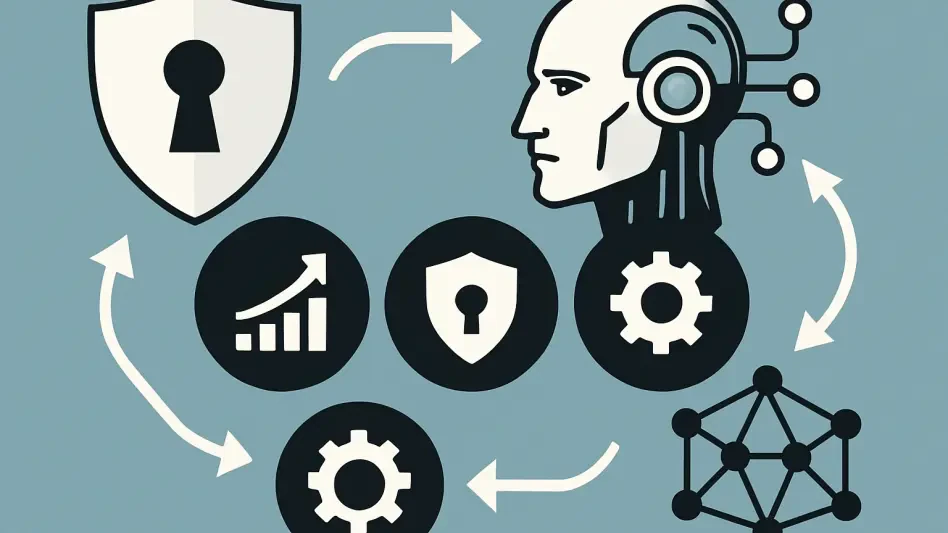
The flickering glow of a security operations center monitor no longer reveals a simple struggle between a lone hacker and a diligent defender, but rather a silent, invisible collision between two complex algorithms operating at speeds far beyond human perception. This technological shift has rewritten the rules of engagement, forcing modern enterprises to reconsider every aspect of their defensive posture. As we navigate the current landscape, the realization has dawned that the digital battlefield is no longer a human-led skirmish. It is an automated, high-velocity conflict where victory depends on more than just superior code. According to a landmark study by the World Economic Forum and KPMG, artificial intelligence has officially moved from being an experimental luxury to a foundational strategic necessity for any organization hoping to survive the decade.
The urgency of this transformation is rooted in a volatile threat environment that demands a new kind of resilience. The latest framework proposed by the World Economic Forum suggests that the future of digital safety rests upon a delicate trifectstructured deployment, rigorous governance, and the non-negotiable preservation of human oversight. Organizations are currently at a crossroads, where the failure to integrate intelligent automation could mean total obsolescence. However, the path to a secure future is not paved with technology alone; it requires a deep cultural shift that aligns technical capabilities with enterprise-wide objectives. This strategic pivot ensures that AI serves as a shield rather than a liability, providing the stability needed to operate in a borderless and often hostile digital world.
Can a Machine-Driven Defense Keep Pace with Machine-Speed Attacks?
The transition from manual security protocols to machine-driven defense is not merely a choice for modern leaders; it is an inevitable reaction to the sheer velocity of contemporary cyber threats. In the current era, an attack can propagate through a global network in milliseconds, leaving human defenders struggling to even identify the breach before the damage is done. The World Economic Forum emphasizes that this new reality requires a fundamental reimagining of what it means to be “secure.” Traditional methods, which relied heavily on signature-based detection and manual intervention, have become relics of a slower age. The focus has shifted toward predictive capabilities and autonomous response systems that can neutralize threats at the moment of inception.
This strategic evolution is characterized by a move away from reactive “firefighting” toward a more sophisticated model of proactive threat hunting. By leveraging artificial intelligence, organizations can analyze patterns and anomalies that would be invisible to the naked eye. This allows for the identification of malicious intent long before a single line of malicious code is executed. The WEF study underscores that the goal is not to remove humans from the process entirely but to elevate them. As machines handle the high-speed data processing and initial response, human experts are freed to focus on the complex, creative problem-solving and strategic decision-making that no algorithm can yet replicate. This synergy creates a defensive posture that is both agile and resilient, capable of evolving as quickly as the threats it seeks to counter.
Moreover, the integration of these intelligent systems provides a level of consistency that was previously unattainable. Human defenders are subject to fatigue, bias, and distraction, all of which can be exploited by a persistent adversary. In contrast, an AI-driven defense maintains constant vigilance, processing millions of data points every hour without a lapse in focus. This tireless nature is the cornerstone of operational resilience in the modern age. By establishing a machine-speed defense, organizations are not just keeping pace with attackers; they are building a durable foundation that can withstand the unpredictable fluctuations of the global threat landscape while maintaining the integrity of their most sensitive assets.
Navigating the Structural Challenges of a Borderless Digital Ecosystem
The drive toward AI-integrated security is a direct response to a critical breaking point in the way we manage digital environments. Today, the concept of a “perimeter” has largely disappeared, replaced by a borderless ecosystem of interconnected cloud services, remote devices, and third-party integrations. This expansion has created a massive attack surface that generates more data than any human team could realistically monitor. Every interaction, every log entry, and every user request adds to a mounting pile of noise that often obscures genuine threats. The complexity of these environments has outpaced our manual ability to govern them, making AI a vital bridge for synthesizing this data into actionable intelligence.
This structural pressure is further intensified by a persistent global talent shortage that shows no signs of abating. Companies are expanding their digital footprints at a rate that far outstrips their ability to hire and train qualified security professionals. This gap creates a dangerous vulnerability, as overworked teams become prone to “alert fatigue,” leading to missed signals and delayed responses. Artificial intelligence serves as a force multiplier in this scenario, automating the high-volume, low-complexity tasks like alert triaging and initial documentation. By filtering out the noise and prioritizing the most critical risks, AI allows the existing workforce to focus their specialized talents where they matter most, effectively bridging the personnel gap through technological efficiency.
The transition to an AI-augmented ecosystem also requires a rethink of organizational silos. Because the digital landscape is so interconnected, security can no longer be the sole responsibility of a single department. The World Economic Forum highlights the need for cross-functional collaboration, where data from finance, human resources, and operations flows into a central intelligence hub. This holistic view enables the security framework to understand the context of a potential threat, distinguishing between a legitimate but unusual business activity and a genuine intrusion. Navigating these challenges requires more than just buying the right software; it demands a comprehensive strategy that harmonizes people, processes, and data within a unified, intelligent architecture.
The Measurable Impact of AI on Operational Resilience and Financial Stability
The strategic shift toward artificial intelligence is producing quantifiable advantages that move well beyond theoretical security improvements. Empirical data from current industry benchmarks suggests that the vast majority of high-performing organizations have already transitioned to AI-integrated models to safeguard their operations. Currently, about 77% of firms have reported significant progress in this area, reaping rewards that are visible on both the balance sheet and the operational dashboard. One of the most striking findings is the impact on efficiency; security teams that utilize AI have documented an 88% improvement in time savings. This efficiency is not just about doing things faster; it is about reclaiming thousands of hours that were previously lost to manual verification and redundant tasks.
From a financial perspective, the integration of AI acts as a powerful buffer against the devastating costs of data breaches. The gap between organizations that embrace AI and those that do not is widening rapidly. For instance, firms that have implemented extensive AI protocols have managed to shorten the average lifecycle of a data breach by approximately 80 days. This accelerated response time is critical because the cost of a breach is often directly proportional to how long the adversary remains undetected in the system. By identifying and isolating threats earlier, these companies are significantly limiting the scope of the damage, which translates to a direct preservation of capital and shareholder value.
The financial protection offered by these systems is even more evident when looking at the bottom line of incident recovery. On average, AI-integrated firms have reduced the total cost of a breach by roughly $1.9 million compared to their less technologically advanced counterparts. These savings are not merely about avoiding fines; they encompass everything from reduced legal fees and forensic investigations to the preservation of brand reputation and customer trust. In a market where a single major security failure can lead to a plummeting stock price or total bankruptcy, the financial stability provided by a robust AI framework is an essential component of long-term corporate viability and strategic health.
The Adversarial Arms Race and the Double-Edged Sword of Innovation
While artificial intelligence provides defenders with unprecedented tools for protection, it has also fueled a sophisticated “arms race” with cybercriminals. Attackers are utilizing the same machine learning models and automated frameworks to sharpen their offensive capabilities, creating a double-edged sword of innovation. Today, the barrier to entry for high-level cyberattacks has been lowered significantly. Less technical actors can now use AI-augmented tools to conduct rapid reconnaissance, identifying network vulnerabilities in minutes rather than weeks. This shift has led to an explosion in the volume of attacks, as criminals use automation to launch thousands of simultaneous probes against targets across the globe.
The nature of these attacks is also becoming more personalized and harder to detect through traditional means. For example, AI is being used to generate highly sophisticated malware that can alter its own code to evade signature-based detection. Furthermore, attackers are employing large language models to create perfectly tailored phishing campaigns that mimic the tone and style of internal corporate communications. This level of deception makes it increasingly difficult for employees to distinguish between a legitimate request and a malicious trap. Defenders are therefore forced to adopt AI not just to gain an advantage, but simply to maintain parity with their opponents in an environment where the speed of offense is constantly accelerating.
To counter these evolving threats, the framework suggests that defenders must use AI to analyze their own internal datasets with even greater precision. By understanding the “normal” behavior of their systems and users, organizations can identify the subtle deviations that signal an AI-augmented attack. This involves a shift toward behavioral analytics, where the focus is on the intent and outcome of an action rather than the specific tool used to execute it. Regaining strategic ground in this arms race requires a commitment to continuous learning and model refinement, ensuring that defensive algorithms are trained on the latest threat intelligence to stay one step ahead of the adversary’s next move.
A Phased Roadmap for Strategic AI Readiness and Deployment
To avoid the common trap of adopting technology for its own sake, the World Economic Forum has outlined a rigorous, four-stage roadmap designed to guide organizations toward effective AI deployment. This journey begins with the foundational elements of process and data readiness. It is a fundamental truth that AI cannot fix a broken or chaotic workflow; in fact, automating an inefficient process only serves to accelerate the failure. Organizations must first ensure that their security protocols are stable, well-documented, and based on high-quality data. Accurate and complete datasets are the lifeblood of any intelligent system, and without them, the output of the AI will be unreliable or outright misleading.
The second phase of the roadmap focuses on the technical infrastructure and the development of the necessary human skills to manage it. Modernizing the technical environment is essential to support the heavy workloads associated with machine learning and real-time data processing. Simultaneously, the workforce must be upskilled to transition from being operators of security tools to being overseers of intelligent systems. This involves training staff on the nuances of the AI lifecycle, from initial implementation to the ongoing maintenance of the models. By investing in both the hardware and the people, organizations create a sustainable ecosystem where technology and human expertise reinforce one another.
The final stages of the roadmap involve critical decision-making regarding the “build vs. buy” dilemma and the execution of structured pilot programs. Leaders must carefully weigh the speed and scalability of third-party security tools against the potential advantages of developing proprietary solutions tailored to their specific needs. Once a direction is chosen, the implementation should not be a blind, full-scale rollout. Instead, the framework recommends controlled pilots with clearly defined success criteria. These pilots allow for the validation of technical performance and the building of executive confidence, ensuring that the technology delivers real-world value before it is integrated into the core of the enterprise’s defensive strategy.
Maintaining the Human-in-the-Loop and Navigating Agentic AI
As automation becomes the dominant force in cybersecurity, there is a growing risk of “systemic fragility,” where an overdependence on technology begins to erode essential human expertise. The World Economic Forum warns that if an organization relies too heavily on an algorithm without understanding its underlying logic, they become vulnerable to the algorithm’s blind spots and errors. To mitigate this risk, the framework strongly advocates for a “human-in-the-loop” model. In this approach, artificial intelligence acts as a powerful cognitive augment, handling the heavy lifting of data analysis while leaving the final, high-stakes decisions to human professionals. This ensures that intuition, ethics, and contextual understanding remain at the heart of the security strategy.
This balance is becoming even more critical with the emergence of “agentic AI”—autonomous systems that are capable of making independent decisions and taking actions without constant human oversight. While these agents can preemptively stop an attack in progress, they also introduce a new layer of unpredictability. An autonomous agent might misinterpret a legitimate system update as a threat and shut down critical services, leading to unintended downtime. Governance frameworks must therefore include robust guardrails to manage these agents, ensuring that their actions remain transparent, explainable, and fully aligned with the organization’s safety protocols. Regular audits and performance monitoring are necessary to prevent “model drift,” where the AI’s behavior slowly shifts away from its original intent over time.
Ultimately, the goal of modern governance is to ensure that every AI-driven action remains under a umbrella of human accountability. As these systems become more integrated into the fabric of the digital world, the ability to explain “why” a system made a certain decision becomes as important as the decision itself. This transparency is vital for maintaining trust with regulators, customers, and internal stakeholders. By keeping a firm hand on the tiller, organizations can harness the incredible speed and analytical power of artificial intelligence without losing the nuanced judgment that only a skilled human workforce can provide. The future of security is not a world without humans, but one where humans and machines work in a seamless, high-performance partnership.
The path forward for global organizations was defined by a commitment to total transparency and proactive adaptation as they integrated these advanced frameworks. Leaders recognized that the initial deployment of AI was merely the first step in a much longer journey of continuous refinement and ethical oversight. They established rigorous feedback loops where human security analysts regularly critiqued the decisions made by autonomous agents, ensuring that the machine’s logic remained sound and aligned with evolving business values. This collaborative environment turned the security department into a center of innovation rather than a mere cost center, fostering a culture where every employee felt responsible for the collective digital hygiene of the enterprise.
Organizations also moved toward a model of collective defense, sharing anonymized threat intelligence and AI training data with industry peers to build a more resilient global ecosystem. This shift helped neutralize the advantages previously held by attackers, who had long benefited from the isolation of their targets. Regulatory bodies played a crucial role by standardizing the requirements for AI transparency, making it easier for firms to prove compliance with frameworks like DORA and NIS2. By prioritizing the human element and maintaining a disciplined approach to technological growth, the global community successfully rebalanced the scales, creating a digital environment where the speed of defense finally matched the speed of innovation.