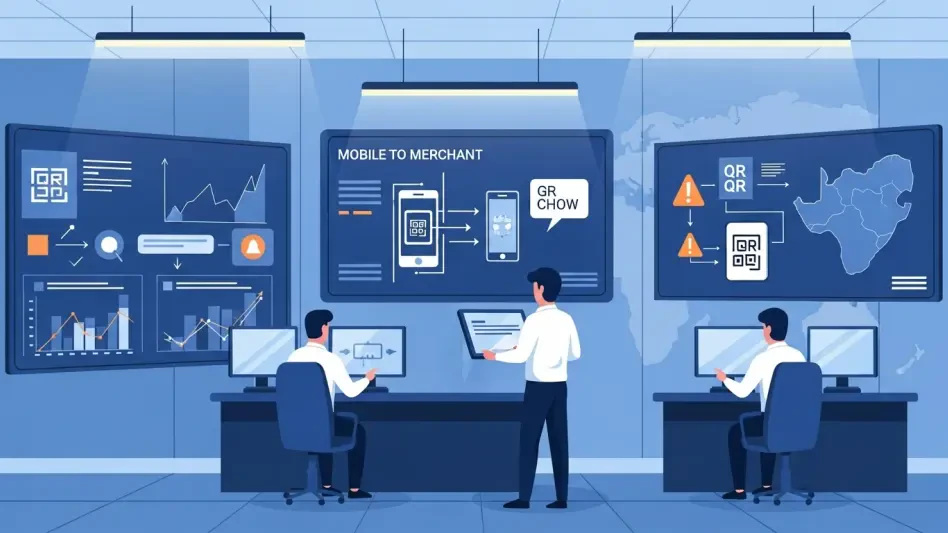
QR stickers at tills, tabletops, and parking meters turned from convenience to conduit as criminals learned that a tiny square could smuggle a phishing site past human caution and mobile defenses, and that shift has been reflected in banking losses that ballooned alongside everyday scanning. South Africans embraced QR codes for menus, contactless payments through services like SnapScan, Zapper, and Masterpass, and even municipal service portals after the pandemic normalized camera‑based checkouts. Offenders adapted in lockstep. They paste counterfeit codes over legitimate decals, embed redirects in promotional posters, and seed shortened URLs that resolve to look‑alike pages. Once scanned, victims meet cloned payment screens, sham WhatsApp Business profiles, or forms that harvest credentials under the guise of a routine top‑up or courier fee—an old con wearing a new, familiar pattern.
The Playbook: How QR Codes Became a Fraud Channel
From Menus to Money: Why Scans Feel Safe
Quishing works because scanning feels mechanical and low risk, a reflex reinforced by the frictionless design of QR journeys. A patron orders via a code on a table, a commuter pays parking by scanning a pole, a patient checks in at a clinic kiosk—no typing, minimal thought. Offenders bank on this rhythm. They spoof merchant branding, insert urgency—“invoice expires in 10 minutes”—and drive taps toward counterfeit domains that mimic local banks or wallet gateways. SABRIC’s figures underscored the cost of that familiarity: digital banking fraud losses more than doubled from over R740 million in 2022 to over R1.4 billion in 2024, with social engineering the consistent catalyst. The QR vector did not replace email phishing or SMS smishing; it blended with them. A poster scan hands off to a text link, which escalates to a call, where a “bank agent” harvests one‑time pins.
The Toolkit: From Smishing to Vishing
South Africa’s threat mix has widened rather than shifted, and quishing slots neatly alongside long‑running schemes. Smishing remains stubbornly effective because mobile spam filters lag email gateways, letting persuasive, localized messages through. Spear phishing adds precision, using breached loyalty data or parcel numbers to pre‑fill forms on a QR‑driven site, lowering doubt. Vishing closes the loop. After a scan, a victim may receive a call spoofing a bank’s caller ID, urging approval of a “reversal” while attackers push transactions in real time. On‑device giveaways still surface—mismatched URLs, typos, browser certificate warnings—yet haste blurs them. Criminals also abuse legitimate tools: dynamic QR codes that can be updated remotely, link shorteners that mask domains, and WhatsApp Business profiles dressed in stolen logos. The common denominator is not the medium but manipulation of attention.
The Countermove: What Banks and Users Should Do
The TUS Check: Spotting Tampering, Urgency, and Suspicion
Effective defense starts with a repeatable habit on the sidewalk, at a kiosk, or in an inbox: the TUS check. First, tampering—inspect the physical code. If a glossy sticker sits crooked over another, if edges lift, or if a poster’s print quality differs around the square, avoid it and use a merchant’s official app instead. Next, urgency—watch for expiring timers, courier penalties, or refund deadlines that compress judgment. Real institutions seldom force immediate payment from a scan. Finally, suspicion—scrutinize the landing page. Does the domain match a bank’s known URL? Are fonts, colors, or spelling off? Do browsers flag certificates? Are irrelevant payment prompts injected into unrelated flows, such as a restaurant asking for full card details to view a menu? Step back if anything misaligns and re‑route via a saved bookmark or a bank app.
Building A Resilient Routine: Layered Controls That Worked
A layered approach translated awareness into outcomes. Consumers who defaulted to official apps for bill pay and EFTs, enabled multi‑factor authentication on banking and email, and refused to share passwords or one‑time pins over calls markedly shrank exposure. Retailers and venues that printed unique, serialized QR decals and audited them weekly reduced swaps; some tethered codes to short, human‑readable URLs on receipts so staff could compare on sight. Banks that tightened real‑time transaction monitoring—flagging QR‑triggered push payments to new beneficiaries, throttling first‑use devices, and requiring in‑app confirmation rather than SMS—intercepted more attempts without crippling convenience. Mobile security from reputable vendors added guardrails by warning on malicious domains and scanning QR payloads before launch. Looking ahead, standardizing visible trust marks on static codes, expanding DMARC‑style authentication for QR destinations, and normalizing “pause before you scan” prompts in camera apps offered practical next steps that emphasized user control over choreography criminals had exploited.