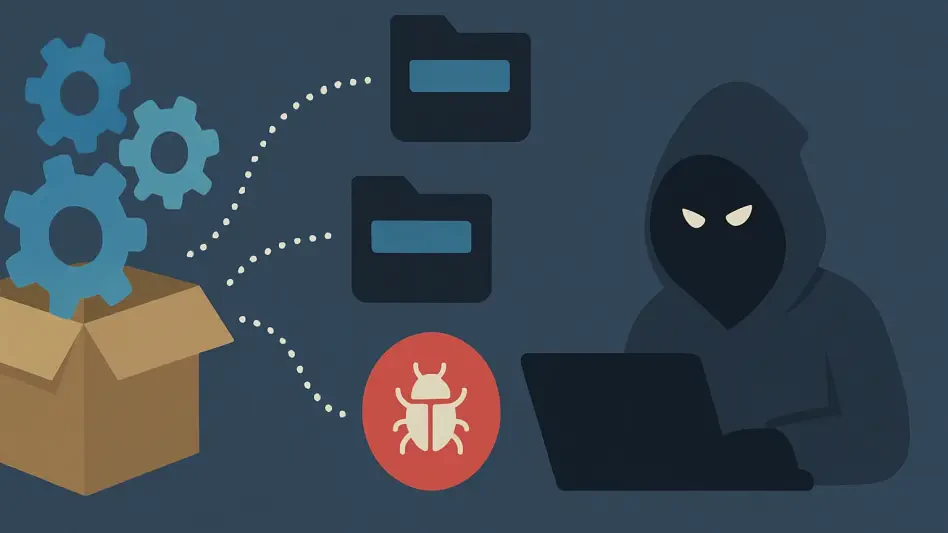

A modern software engineer might assume that their code remains private while working within a secure local environment, yet the silent integration of advanced AI plugins has fundamentally altered that traditional trust boundary. Not long ago, artificial intelligence was discussed in hushed tones, often viewed with skepticism or treated as a futuristic novelty in the corporate world. Today, that hesitation has vanished as AI becomes a foundational element of daily professional life, integrated into everything from routine administrative tasks to complex software development. While this shift has unlocked unprecedented levels of productivity and innovation, it has also introduced a new category of vulnerability where AI acts as a pervasive intermediary in digital interactions. This transition has given rise to the AI Man-in-the-Middle risk, a modern evolution of traditional interception techniques that targets the very heart of the digital transformation. Rather than a human intruder, the “middle” is now the AI system itself, consisting of assistants, plugins, and automated workflows that handle sensitive data. Because these tools are no longer just chatbots but functional participants in the business process, they represent a significant shift in the corporate attack surface.
The New Architecture of Enterprise Risk
Integration Hazards: The AI Intermediary Model
AI now occupies a critical space between employees and their tools, developers and their code, and security teams and their alerts. It is increasingly connected to deep data sources like customer relationship management systems, internal email servers, and private code repositories to provide actionable insights. This high level of connectivity means that if an AI system is compromised or poorly governed, it can manipulate business outcomes or serve as a silent gateway for systemic intrusion. By functioning as a digital translator and executor, the AI layer possesses a unique vantage point that traditional firewalls and endpoint detection systems often miss entirely. When an AI tool summarizes a confidential legal brief or suggests a code snippet for a financial application, it is effectively touching the core intellectual property of the enterprise. This level of access transforms the AI from a mere utility into a high-value target for interception, as any vulnerability in the model’s processing logic could lead to unauthorized data exfiltration or the subtle manipulation of critical business information.
The danger of this architecture lies in its relative invisibility to standard monitoring tools that were designed to track human-to-machine interactions. Traditional security protocols focus on verifying the identity of the human user, but they frequently fail to scrutinize the secondary requests made by the AI agent on behalf of that specific user. As organizations deploy these intermediaries to automate cross-platform workflows, the complexity of the data transit path increases exponentially. This creates a “black box” environment where sensitive credentials or proprietary datasets might be processed by third-party large language models without explicit oversight. Consequently, the intermediary role of AI necessitates a fundamental rethinking of how data flows are audited and secured. Security professionals must now account for the latent risks associated with the middleware that connects disparate business systems. This involves not just securing the endpoints, but ensuring that the AI components themselves do not inadvertently become the weakest link in a chain of otherwise robust security measures.
Autonomous Agency: Vulnerabilities in Functional AI
The risk profile becomes particularly acute when AI is granted agency, or the ability to act upon systems autonomously without immediate human intervention. While the promise of AI agents capable of booking travel, managing calendars, or even deploying code is enticing, this autonomy introduces profound security challenges. Vulnerabilities such as prompt injection allow attackers to hide malicious instructions within benign documents, potentially tricking AI assistants into leaking sensitive information or performing unauthorized actions. For instance, an attacker could embed a hidden command in an emailed invoice that tells an automated accounting AI to redirect a payment to a different bank account. These indirect injections are difficult to detect because the malicious input is often obfuscated within legitimate data that the AI is programmed to process. As AI systems become more proactive in their operations, the distinction between a legitimate user command and a malicious injection becomes increasingly blurred, making the defense of these systems a constantly moving target for security teams.
Furthermore, insecure code generation and the use of over-privileged plugins create backdoors that traditional security architectures are often ill-equipped to detect. When developers rely on AI to generate complex functions or boilerplate code, they may inadvertently introduce subtle security flaws that have been learned from public repositories containing vulnerable patterns. These AI-generated vulnerabilities can remain dormant until they are exploited by threat actors who understand the common pitfalls of model training data. Additionally, the proliferation of third-party plugins designed to extend AI capabilities often lacks the rigorous vetting required for enterprise-grade software. These plugins frequently request excessive permissions, such as full access to an employee’s mailbox or cloud storage, creating a massive attack surface that bypasses traditional identity and access management controls. Managing this risk requires a paradigm shift toward treating AI agents as unique identities that require their own set of restricted permissions and constant monitoring.
Evolution of Offensive AI Methodologies
Tactical Advantages: AI as a Force Multiplier
Threat actors are leveraging AI as their own analyst to navigate the more labor-intensive parts of a cyberattack with unprecedented speed and precision. By using AI to craft convincing phishing lures that mimic a specific executive’s writing style or to triage massive amounts of stolen data, criminals can quickly identify valuable assets like passwords, encryption keys, or intellectual property. This automation significantly compresses the time between an initial breach and its final impact, leaving defenders with a much smaller window for response. In the past, a manual data breach might take weeks for an attacker to sift through and find the “crown jewels” of a corporation, but modern AI tools can perform this analysis in seconds. Moreover, AI allows low-skilled attackers to conduct sophisticated operations that were previously the domain of nation-state actors. By lowering the barrier to entry, AI is democratizing high-level cybercrime and increasing the frequency of complex, multi-stage attacks that target the heart of corporate infrastructure.
Beyond the initial stages of an attack, AI is being used to develop polymorphic malware that can change its signature to evade detection by antivirus software. This adaptive behavior makes it increasingly difficult for signature-based security tools to keep pace with the sheer volume of unique threats. The use of generative AI to create realistic deepfake audio and video is also becoming a staple in social engineering attacks, where employees are tricked into authorizing fraudulent wire transfers by a voice they believe to be their supervisor. This level of psychological manipulation, combined with the technical speed of automated exploitation, creates a formidable challenge for even the most well-funded security teams. As malicious actors continue to refine their use of AI for reconnaissance and weaponization, organizations must recognize that the speed of the game has fundamentally changed. The defense must transition from a reactive posture to a proactive one that anticipates how AI will be used to scale and diversify attack vectors across the entire digital landscape.
Sophisticated Interception: AI-Enhanced Toolkits
Adversary-in-the-Middle attacks are becoming more sophisticated through AI-enhanced toolkits that automate the interception of secure communications. These kits are specifically designed to capture session tokens and bypass multi-factor authentication in real-time, effectively rendering traditional perimeter defenses obsolete. By sitting between a user and a legitimate service, these AI-driven platforms make it easier for attackers to maintain persistence within an organization’s cloud environment or identity platform. Unlike older phishing kits that required manual intervention to handle MFA prompts, these modern versions use AI to synchronize the attack with the user’s login attempt, tricking them into providing the necessary codes or biometric approvals. This seamless integration allows the attacker to hijack a live session without ever needing the user’s password. Once the session token is secured, the attacker has a direct path into the internal corporate network, where they can move laterally and exploit other vulnerable systems.
The commercialization of these AI-driven interception tools on underground forums has significantly expanded the threat landscape for businesses of all sizes. These toolkits are often sold as a subscription service, complete with user-friendly dashboards, automated evasion features, and technical support. This Cybercrime-as-a-Service model means that even unsophisticated threat actors can launch high-impact attacks that bypass the security measures of major cloud providers. The AI component of these tools allows for the rapid identification of a target’s underlying technology stack, enabling the attacker to tailor their exploits on the fly. This level of customization was once a time-consuming manual process, but it is now a standard feature of the latest offensive toolsets. As these technologies continue to evolve, the traditional reliance on static authentication methods must be replaced by continuous, behavior-based identity verification. Organizations that fail to adapt to this reality will find themselves increasingly vulnerable to a new generation of stealthy and highly automated interception attacks.
Strategic Defensive and Governance Frameworks
Intelligence-Driven Security: Monitoring the Perimeter
Effective defense requires moving beyond simple keyword monitoring to find actionable signals within the massive amount of digital noise generated by modern systems. Modern threat intelligence reveals that advanced interception capabilities are being sold as commercial products on underground forums, which allows security teams to prioritize their resources against the most relevant tactics and tools. By analyzing the telemetry from across the global threat landscape, organizations can identify the specific indicators of compromise associated with AI-driven attacks. This intelligence-led approach enables a more surgical response to threats, focusing on the techniques that are actually being used by active threat groups. Instead of trying to defend against every possible vulnerability, security leaders can allocate their budgets toward the high-fidelity detection of the specific behaviors that characterize AI Man-in-the-Middle attacks. This involves integrating external threat feeds with internal logs to create a comprehensive view of the organization’s risk profile.
Identifying the involvement of specific threat groups allows security teams to anticipate the next moves in a multi-stage attack and deploy targeted countermeasures. For instance, if an organization knows that a particular group specializing in session hijacking is active in their industry, they can implement more stringent session timeout policies and step-up authentication for high-value transactions. This contextual awareness is a critical component of a modern defense strategy, as it transforms security from a static barrier into a dynamic and adaptive system. Furthermore, sharing threat intelligence with industry peers and government agencies creates a collective defense that benefits everyone. By contributing to a shared repository of attack patterns and indicators, organizations can help to dismantle the infrastructure used by cybercriminals. This collaborative effort is essential for keeping pace with the rapid innovation seen in the underground economy, where AI is being used to build increasingly complex and evasive tools for exploitation.
Holistic Governance: Securing the Digital Supply Chain
Organizations had to confront the systemic risks embedded within the supply chain, where AI was often integrated without explicit notification to the end user. A large-scale blast radius attack on a critical vendor could jeopardize hundreds of downstream companies simultaneously, creating a cascading failure that was difficult to contain. To mitigate this, businesses implemented rigorous visibility into how third-party providers governed their AI models, turning what was once an optional check into a prerequisite for managing hidden risks. Security leaders prioritized the auditing of API connections and the verification of data handling policies to ensure that AI-driven services did not introduce backdoors. By establishing a clear set of requirements for AI transparency, organizations successfully reduced their exposure to unvetted technologies. This proactive approach to vendor management ensured that the efficiencies gained through AI did not come at the cost of corporate security, fostering a more resilient ecosystem.
Managing the AI era ultimately required a framework built on visibility, strict access controls, and the treatment of AI agents as distinct identities with limited permissions. Security teams adopted the principle of least privilege for all automated tools, ensuring that no AI assistant had more access to the corporate environment than was strictly necessary for its function. By combining human oversight with contextual intelligence, businesses were able to embrace the efficiencies of AI while safeguarding against the risks of the intermediary layer. They developed sophisticated monitoring systems that could detect anomalies in AI behavior, such as an assistant attempting to access data outside of its usual scope or executing unusual commands. These measures, along with regular red-teaming exercises focused on AI vulnerabilities, provided a robust defense against both internal and external threats. This shift in strategy successfully transformed AI from a potential security liability into a powerful asset that could be managed with confidence.