
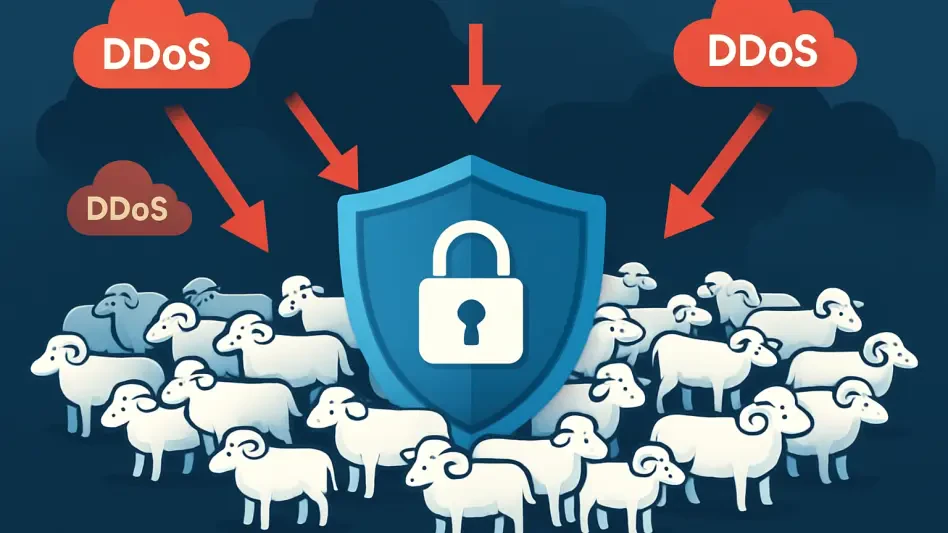
The persistent escalation of volumetric cyber threats has forced a radical reimagining of digital defense, transitioning away from isolated perimeter security toward a collective, network-wide strategy. For years, the industry relied on reactive measures where individual organizations bore the brunt of mitigation costs, often deploying scrubbing centers that functioned only after a malicious surge was already underway. This traditional model is failing because the temporal dynamics of modern attacks have shifted dramatically; recent data reveals that nearly eighty percent of contemporary Distributed Denial of Service events now last less than five minutes. When a third of these bursts conclude in under two minutes, the time required to detect, redirect, and filter traffic often exceeds the duration of the attack itself. Consequently, the concept of network-level herd immunity has emerged as a vital framework, suggesting that if major telecommunications providers neutralize threats at the core, the entire internet becomes resilient.
Disrupting the Preliminary Stages of Infection
Every significant botnet operation originates in a reconnaissance phase that involves massive, automated scanning of the global IP space to locate vulnerable hardware or exposed ports. While many network administrators historically dismissed this activity as harmless background noise, modern defense strategies recognize it as a critical early-warning signal visible at the peering edge. The primary challenge lies in distinguishing between legitimate security research conducted by academic institutions and the aggressive probing performed by malicious actors. By analyzing traffic patterns and identifying specific hosting providers that consistently facilitate suspicious scanning, network operators can implement preemptive filtering. This proactive stance prevents attackers from gaining the initial foothold necessary to build a botnet. Instead of waiting for a full-scale assault, providers are now using this intelligence to identify and isolate scanning sources, effectively quenching the spark before it can ignite a wildfire across the digital landscape.
Once a vulnerability is identified, the botnet lifecycle progresses to the delivery stage, where specialized staging servers distribute malicious payloads to compromised devices. These servers are often short-lived and utilize rotating IP addresses to evade manual blacklists, making traditional static defense mechanisms largely ineffective in the current climate. To counter this, the herd immunity model employs highly sophisticated, automated intelligence pipelines that monitor infrastructure movements in real-time. These systems can attribute malicious behavior to specific staging environments almost instantly, allowing for the immediate blocking of malware delivery before infection occurs. By neutralizing the distribution mechanism, telecommunications providers protect not only the intended target but also the integrity of their own infrastructure and the security of their subscribers’ devices. This preventative approach ensures that the malware never reaches the host, thereby maintaining the health of the network fabric and reducing the overall population of potential bots in the ecosystem.
Neutralizing Command and Control Infrastructure
Even when an infection is successful, a compromised device remains a dormant threat until it receives specific instructions from a Command and Control server. This communication channel represents a significant strategic vulnerability for the attacker, as it provides a clear choke point where defense can be centralized. By implementing network-level null-routing or surgical address blocking, providers can effectively sever the link between the bot and its master, rendering the entire botnet functionally useless. This intervention offers a multifaceted benefit to the global internet community: it shields the ultimate target from the intended surge, preserves the operator’s valuable network capacity, and alerts hosting providers to the presence of compromised high-bandwidth servers within their own facilities. Telecommunications operators are uniquely positioned to perform this task because they possess simultaneous visibility into external peering points and internal subscriber networks. This dual perspective allows them to act as a primary firewall, preventing malicious commands from propagating through the core infrastructure.
Despite the development of more complex application-layer attacks, a vast majority of volumetric threats still depend on relatively simple reflection and amplification vectors, such as DNS or NTP. Managing these well-known vectors on an individual customer basis is an inefficient use of resources that allows malicious traffic to saturate network capacity before it reaches the edge. The industry is now moving toward a model where the responsibility for mitigating these basic threats is integrated directly into the network fabric. Much like the existing protocols for dropping invalid IP addresses or filtering spam, the policing of amplification traffic is becoming a standard feature of core network operations. This collective defense ensures that a vaccinated network prevents the spread of digital pathogens, making it significantly more difficult and expensive for attackers to orchestrate large-scale events. By shifting the burden of mitigation upstream, the industry effectively reduces the total volume of malicious traffic in transit, thereby protecting all downstream users regardless of their individual security posture.
The shift toward a network-centric defense model proved that systemic resilience was more effective than isolated mitigation. Industry leaders recognized that the peering edge provided the most advantageous vantage point for neutralizing botnet infrastructure before it reached critical mass. This transition required telecommunications providers to adopt automated intelligence systems that could react with the same speed as the attacks they were designed to stop. Furthermore, the collaboration between global operators facilitated a shared understanding of threat indicators, which transformed the internet from a collection of vulnerable silos into a cohesive, self-defending organism. Stakeholders realized that the true solution to DDoS threats lay in the core infrastructure’s ability to act as a filter for known malicious vectors. Future efforts were directed toward enhancing the transparency of these mitigation actions and ensuring that automated responses remained accurate and surgical. By prioritizing the health of the network fabric, the industry moved toward a future where the cost of launching a successful attack became prohibitive for most malicious actors.