A threat that makes no noise can often be the most dangerous, and the current quiet from the state-sponsored cyber group Volt Typhoon is creating a profoundly deceptive sense of security across North America’s critical infrastructure. While the absence of disruptive cyber events might suggest a reprieve, a growing body of research indicates the opposite. This silence is not a sign of inactivity but rather a deliberate, strategic phase in a long-term campaign aimed at pre-positioning assets within the most sensitive networks. The central challenge now facing industry leaders and national security officials is understanding that this “long-dwell” quiet period is more dangerous than an overt attack, as it is designed to give a sophisticated adversary the upper hand in a future geopolitical crisis. This research summary synthesizes intelligence from government and industry sources to illuminate the nature of this patient threat and outline the urgent need for a paradigm shift in defensive strategy.
The Strategic Imperative of Understanding Volt Typhoon’s Patient Threat
The core argument of recent threat analysis is that Volt Typhoon’s current operational posture represents a calculated, long-term strategic investment. Unlike opportunistic cybercriminals who seek immediate financial gain, this state-sponsored group is engaged in a patient campaign of infiltration and persistence. Their objective is not to cause random disruption but to secure deep, enduring access to critical infrastructure, particularly within the electric utility sector. This access is a strategic asset, held in reserve for a time of heightened geopolitical tension or conflict. The group’s ability to remain dormant within a network for months or even years is a feature of their strategy, not a bug, allowing them to map out systems, escalate privileges, and prepare for a future operation without raising alarms.
Recognizing this “long-dwell” approach is the primary challenge for defenders. Traditional security systems are often tuned to detect loud, disruptive activities—the digital equivalent of a smash-and-grab. Volt Typhoon, in contrast, operates like a covert agent, slowly and meticulously learning the environment to avoid detection. This makes their silence a far greater threat than a noisy attack. The adversary’s goal is to achieve a state of readiness where they can manipulate or disrupt operational technology (OT) systems at a moment of their choosing. Consequently, the danger lies not in what Volt Typhoon has done, but in what it is methodically preparing to do, turning the lack of alerts into a false and perilous sense of security for unprepared organizations.
The New Paradigm of Covert Attacks: Context and Significance
This research establishes a clear distinction between Volt Typhoon and more common cyber threats like ransomware. While ransomware groups announce their presence with encryption and ransom demands, Volt Typhoon’s modus operandi is defined by stealth, persistence, and a light footprint. They achieve this by heavily relying on “living off the land” (LOTL) techniques, which involves using legitimate, pre-existing tools and credentials already present in the target environment. By abusing native administrative software, scripting languages, and valid user accounts, their activities blend seamlessly with normal network operations, making them exceptionally difficult to distinguish from benign administrative tasks.
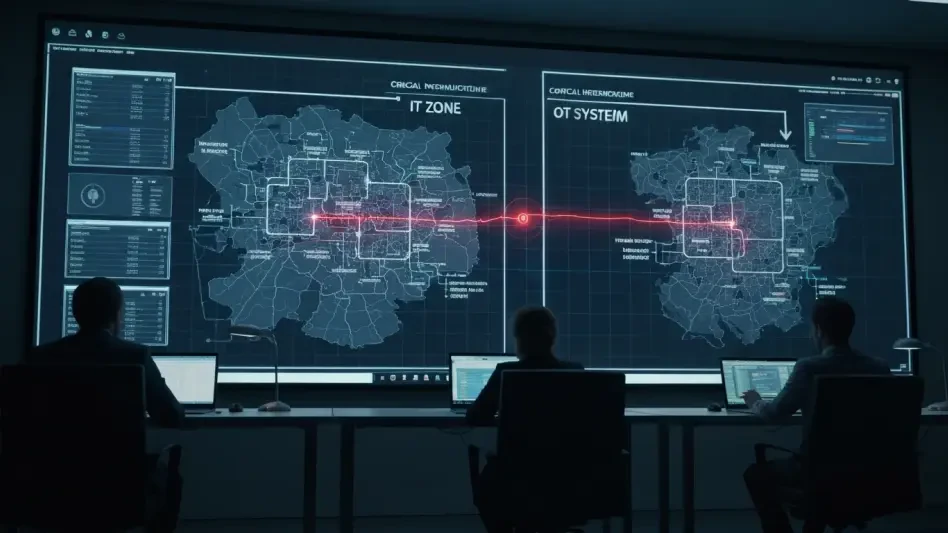
This reliance on covert methods fundamentally alters the threat model for the North American electric utility sector. The research underscores a critical and often overlooked connection: a breach in an enterprise IT network is a direct and immediate precursor to a catastrophic threat against operational technology. Volt Typhoon uses the IT environment as a staging ground, a place to harvest credentials, understand network architecture, and identify pathways into the more sensitive OT systems that control the physical processes of power generation and distribution. Therefore, the traditional separation between IT security and OT security is no longer a viable defense; the adversary treats them as a unified battlespace, and defenders must adopt the same perspective to stand a chance.
Research Methodology, Findings, and Implications
Methodology
The research methodology for understanding this threat eschewed traditional, malware-centric approaches in favor of a comprehensive synthesis of strategic threat intelligence. Analysts aggregated and cross-referenced advisories from government agencies, including CISA and the NSA, with findings from leading private-sector cybersecurity firms. This approach focused on deconstructing the group’s overarching strategy and its specific tactics, techniques, and procedures (TTPs). Rather than hunting for unique malware signatures—which Volt Typhoon intentionally avoids creating—the analysis centered on their behavioral patterns.
This strategic risk assessment involved mapping how the group leverages legitimate credentials and built-in system tools to navigate networks and maintain persistence. By focusing on the how and why of the adversary’s actions, the research moved beyond simple indicators of compromise (IOCs) to build a more resilient defensive model. The methodology’s strength lies in its ability to assess risk based on adversary behavior, a far more durable metric than tracking specific tools that can be easily changed. This provides a clearer picture of the threat posed to critical infrastructure, where the attacker’s intent and capabilities are more important than the specific malware they might (or might not) use.
Findings
The primary finding of this comprehensive analysis is that Volt Typhoon consistently prioritizes establishing long-term, undetected access over causing immediate, visible disruption. This patient strategy allows the group to maintain a persistent presence within enterprise IT networks for extended periods, often for months or even years, before they are discovered, if they are discovered at all. This “low and slow” approach is designed to outlast typical security audit cycles and personnel changes, embedding the adversary deeply within the organizational fabric. The research identifies electric utilities as uniquely vulnerable, not only due to their critical importance but also because of the accelerating convergence of modern IT systems with legacy OT environments that were never designed for internet-era threats.
Furthermore, the analysis reveals that the true risk posed by Volt Typhoon is not an unprompted, large-scale blackout. Instead, the more strategic and probable danger is the adversary’s capability to activate its access during a separate, parallel crisis. This creates a scenario of a “loss of decision advantage,” where a utility’s leadership is simultaneously grappling with a geopolitical event, a natural disaster, or a supply chain failure while also discovering a deep-seated cyber intrusion. In this high-stress environment, the adversary can act faster than defenders can react, sowing chaos, undermining public trust, and hampering response efforts when the organization is at its most vulnerable.
Implications
These findings carry profound implications for the cybersecurity posture of all critical infrastructure organizations. The traditional, perimeter-focused security model, which relies on firewalls and antivirus software to keep threats out, is demonstrably insufficient against an adversary like Volt Typhoon. The group’s ability to operate using legitimate credentials renders these defenses ineffective once an initial foothold is gained. Consequently, organizations must urgently shift to an “assume breach” defensive posture, operating under the assumption that the adversary is already inside the network and focusing efforts on detection and response.
This necessary shift demands that organizations prioritize gaining deep visibility into all privileged access and actively monitor for the anomalous use of legitimate tools. Rigorous enforcement of network segmentation, particularly at the boundary between IT and OT systems, becomes a non-negotiable control to prevent lateral movement. Moreover, the threat must be elevated from a technical problem handled by the IT department to a strategic business risk that requires sustained executive and board-level engagement. Leadership must drive the allocation of resources and foster a culture of security that values long-term resilience over short-term compliance checklists.
Reflection and Future Directions
Reflection
This study served as a stark reflection on the immense challenge of detecting an adversary that intentionally camouflages its activities to look like normal administrative behavior. The silence of Volt Typhoon is the primary obstacle to mounting an effective defense, as it exploits the natural human and organizational bias to equate a lack of alarms with a state of security. This analysis provides a critical counter-narrative to that dangerous assumption, reframing the current period of quiet as a calculated preparatory phase for a future confrontation.
It has become clear that this moment represents a narrow but vital window of opportunity. Utilities and other critical infrastructure providers have the chance to harden their defenses, improve visibility, and train their teams before a crisis forces them into a reactive and likely insufficient response. Waiting for a disruptive event to justify investment is, in this context, a strategic failure. The reflection here is that proactive, threat-informed defense is not merely a best practice but an existential necessity when facing a patient, well-resourced, and strategically motivated state actor.
Future Directions
Looking forward, future defensive efforts must be driven from the top down, with boards and executives asking their security leaders pointed, strategic questions. These inquiries must move beyond compliance and probe the true state of resilience. Leaders should be demanding to know about their organization’s real-time visibility into privileged access, its proven capability to detect credential abuse, the security of its highest-risk internet-facing systems, and the verifiable integrity of the IT-OT boundary. These are the questions that define a mature security program in the face of this modern threat.
In response, future security investments should be strategically realigned. Budgets must shift away from a singular focus on meeting short-term compliance goals or building ever-higher perimeter walls. Instead, resources must be directed toward sustained architectural improvements that build long-term resilience. This includes investing in comprehensive network visibility, identity and access management solutions, continuous validation of security controls, and robust incident response plans that account for an adversary already embedded within the network.
Conclusion: Redefining Security in an Era of Silent Adversaries
The research ultimately concluded that Volt Typhoon heralded a new era of cyber threats, one defined not by speed and noise but by patience, stealth, and strategic positioning for future conflict. The group’s calculated silence was identified as a core feature of its campaign, not a sign of its absence, constituting a profound risk that demanded immediate and sustained leadership attention. The findings underscored that traditional security models were ill-equipped to handle an adversary that “lives off the land” and operates with the legitimacy of an insider. The only effective defense identified was a proactive, sustained investment in deep network visibility, rigorous operational security, and resilient system architecture. This approach prepares an organization to counter an adversary that has already patiently chosen its targets and is simply waiting for the right moment to decide when, not whether, to act.