
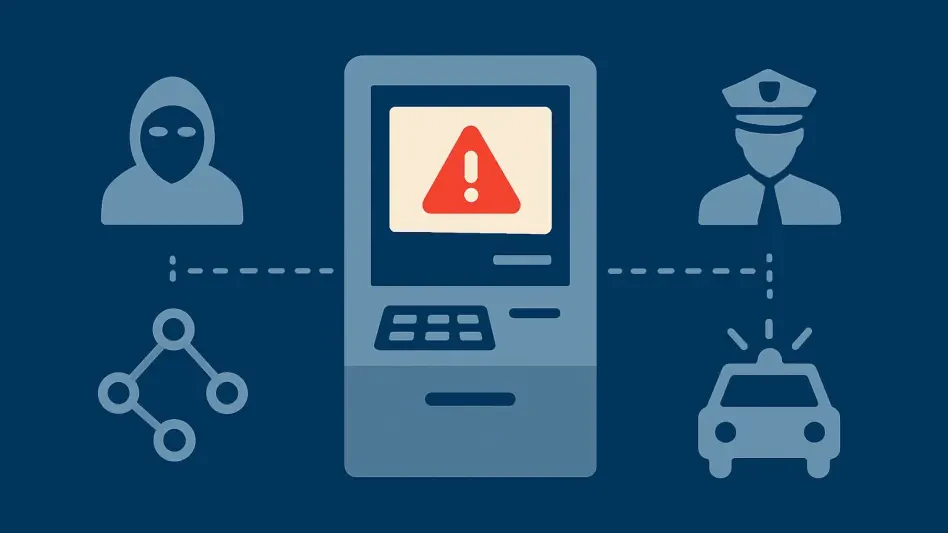
The once-unassuming neighborhood ATM has become the new frontier for organized crime, with federal prosecutors revealing a massive conspiracy that merged sophisticated malware with old-fashioned burglary to steal millions.
A Widening Dragnet in a High-Tech Bank Robbery Spree
A federal case that initially targeted a significant criminal ring has dramatically expanded, with new indictments bringing the total number of suspects to 87. This development cements the investigation as one of the largest prosecutions of an ATM “jackpotting” scheme in United States history.
This conspiracy represents a dangerous evolution in financial crime, combining sophisticated malware with brazen physical tactics to drain millions from the nation’s banking infrastructure. The operation, fueled by international connections, involved a meticulously planned campaign that prompted a sweeping and coordinated federal law enforcement response to dismantle the network.
Unpacking the Anatomy of a Digital-Age Heist
From USB Sticks to Cash Gushers The Mechanics of the Ploutus Malware Attack
The attackers employed a patient and calculated methodology. Their process began with low-tech physical reconnaissance, where they would pry open an ATM’s housing simply to see if an alarm would trigger a law enforcement response. If the coast remained clear, they would return to deploy their digital weapon.
With physical access secured, operatives would either swap the machine’s original hard drive with a pre-infected one or insert a USB stick to install the Ploutus malware. This malicious software was designed to directly command the ATM’s cash dispenser, bypassing all security protocols and forcing the machine to eject its entire cash supply, effectively turning it into a rogue money fountain. The debate continues among security professionals whether the scheme’s success hinged more on its digital sophistication or its exploitation of surprisingly basic physical security lapses.
The International Syndicate Behind the Empty ATMs
The human element of this conspiracy reveals a disturbing link between cybercrime and traditional organized crime. The Justice Department has alleged that some of the individuals charged are undocumented immigrants with connections to Tren de Aragua, a notorious and violent Venezuelan gang, highlighting a growing trend of transnational syndicates operating on U.S. soil.
This network operated with a clear hierarchy, from the skilled technicians who deployed the malware to the “money mules” who performed the high-risk job of collecting the stolen cash from the compromised machines. The alleged strategy of recruiting undocumented individuals for these frontline roles provided the syndicate with operatives who were less likely to cooperate with authorities, adding a layer of insulation for the organization’s leadership.
The Justice Department’s Escalating Campaign Against the Operation
The progression of the federal investigation showcases a determined, multi-agency effort to bring the perpetrators to justice. The defendants face a formidable list of federal charges, including conspiracy to commit bank burglary, computer fraud, and bank fraud, reflecting the multifaceted nature of their crimes.
This case required a coordinated response from various law enforcement bodies to track a criminal enterprise that was both geographically dispersed and technologically advanced. It powerfully challenges the perception of cybercrime as a remote, bloodless affair, demonstrating how digital intrusion and physical-world burglary can merge into a single, cohesive criminal act.
Beyond the Code Exposing Critical Flaws in Physical Banking Infrastructure
The confirmed financial toll of the heists stands at a minimum of $5.4 million stolen from at least 63 ATMs between February 2024 and December 2025, though authorities suspect the actual total could be significantly higher. This jackpotting scheme stands in stark contrast to other financial cybercrimes like card skimming or phishing.
Unlike those methods, which target individual accounts, this operation attacked the bank’s own infrastructure, exploiting a unique combination of digital and physical vulnerabilities. The scale of this breach raises urgent questions about the future of ATM security, pressuring the financial industry to finally commit to a systemic overhaul of legacy hardware and outdated software that proved so easy to compromise.
Fortifying the Vault Urgent Security Lessons for the Financial Sector
The primary lesson for financial institutions is that the digital security of an ATM is meaningless if its physical housing can be easily breached. This case underscores that software integrity and physical security are not separate concerns but are deeply intertwined components of a comprehensive defense strategy.
Banks and credit unions must now move to harden the physical access points of their ATM fleets, such as reinforcing enclosures and upgrading locking mechanisms. Concurrently, implementing advanced endpoint detection on terminals and enhancing real-time monitoring for unauthorized access have become non-negotiable security measures to prevent a repeat of this widespread attack.
The Long Shadow of Transnational Cybercrime
This massive jackpotting operation signals a dangerous new era of organized crime, where sophisticated hacking capabilities are merged with the operational tactics of violent street gangs. The alleged involvement of a group like Tren de Aragua illustrates how transnational criminal organizations are leveraging technology to extend their reach and threaten financial stability within U.S. borders.
The battle against these hybrid cyber-criminal syndicates is rapidly becoming a defining challenge for modern law enforcement. The ongoing threat they pose demands constant innovation in investigative techniques and international cooperation to protect the integrity of the global financial system from criminals who operate without regard for digital or physical boundaries.