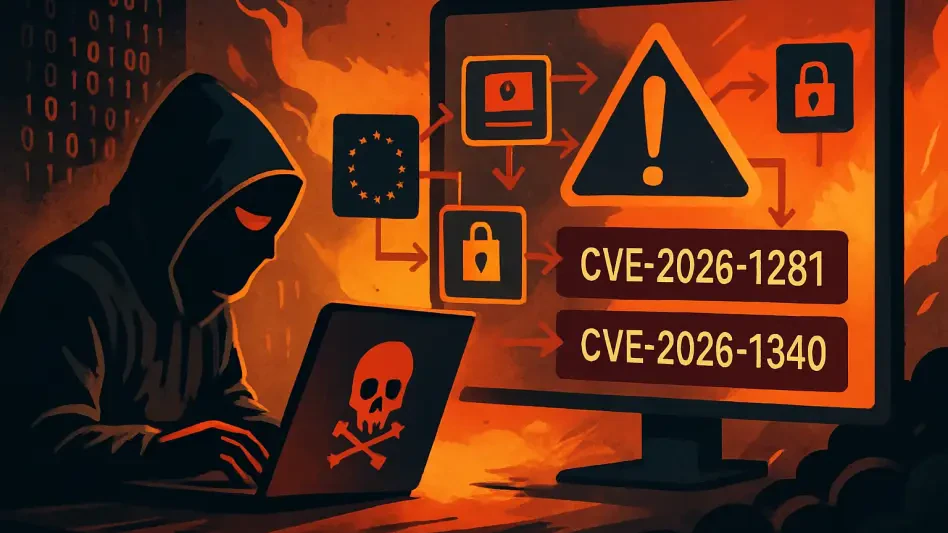
Recent security breaches at high-profile governmental bodies, including the Dutch Data Protection Authority and the European Union’s Judicial Council, have sent a shockwave through the cybersecurity community, escalating concerns that widespread attacks are imminent. The incidents stem from the active exploitation of two critical remote code execution (RCE) vulnerabilities found in Ivanti Endpoint Manager Mobile (EPMM), a widely used mobile device management platform. Both vulnerabilities, tracked as CVE-2026-1281 and CVE-2026-1340, carry a severity score of 9.8 out of 10, indicating an extreme level of risk. The situation is so severe that on January 28, CISA added CVE-2026-1281 to its Known Exploited Vulnerabilities (KEV) catalog, officially confirming it is being used in real-world attacks. Security experts are now universally advising organizations to treat this as an emergency patching situation, urging immediate action to prevent catastrophic data breaches and system compromises.
1. The Critical Nature of the Threat
Security teams have been strongly advised to escalate their response beyond routine maintenance, as the vulnerabilities represent a clear and present danger to enterprise security. Denis Calderone, co-founder and CTO at Suzu Labs, stressed the urgency, stating that this is not a scenario for a standard patch cycle. The vulnerabilities are unauthenticated RCEs, meaning an attacker does not need valid credentials to exploit them, making them exceptionally dangerous. The target, mobile device management (MDM) infrastructure, is a particularly high-value asset for cybercriminals. A successful compromise of an MDM system like Ivanti EPMM would grant attackers the ability to push malicious configurations, deploy unauthorized applications, or exfiltrate sensitive data from an entire fleet of corporate mobile devices. This level of control could lead to widespread data loss, corporate espionage, and significant operational disruption, transforming a single vulnerability into a full-scale organizational crisis. The potential for a complete takeover of mobile endpoints elevates this threat far beyond a typical server vulnerability.
Recognizing the gravity of the situation requires a shift in mindset from routine patching to active incident response. Organizations that have not yet applied the emergency patches must do so immediately and then proceed with a thorough audit of their MDM logs. This audit should focus on identifying any suspicious policy changes, unauthorized application deployments, or unusual configuration modifications that may have occurred over the past several weeks. According to Calderone, since these were zero-day vulnerabilities before their public disclosure, security teams must operate under the assumption that attackers may have already had access during that undisclosed window. Consequently, the investigation should extend to the mobile devices themselves, checking for any unexpected profiles or security certificates that could indicate a compromise. This proactive, forensic approach is critical because the impact of a compromised EPMM extends to every single managed device within an organization, making containment and remediation a top priority to prevent further damage.
2. Broader Implications and Defensive Strategies
The recent compromises of Ivanti systems serve as a stark and powerful reminder that the network edge remains a primary battleground in the complex arena of global diplomacy and cyber warfare. John Carberry, a solution sleuth at Xcape, Inc., highlighted that the data exfiltrated in such attacks is precisely the type of information needed to orchestrate highly sophisticated and targeted vishing and spear-phishing campaigns against high-ranking officials and key personnel. This is not an isolated incident confined to a few government agencies; it is the beginning of what appears to be a global collection phase. With over 1,400 vulnerable Ivanti systems still exposed worldwide, state-sponsored adversaries are actively working to establish persistent access before organizations can fully implement the necessary patches. This strategic move allows them to maintain a foothold within target networks, enabling long-term espionage and intelligence gathering. Organizations must therefore prioritize immediate patching where feasible and actively hunt for indicators of compromise, operating under the assumption that any unpatched device may already be compromised.
In situations where immediate patching is not possible due to operational constraints, security teams must consider more drastic defensive measures. Carberry advised that isolating or temporarily disabling the affected systems might be the most prudent course of action to prevent exploitation. Furthermore, a fundamental shift in security architecture is recommended. Instead of leaving these critical systems exposed to the public internet, where attackers can identify and compromise them in seconds, organizations should reclassify their Ivanti devices as Tier-0 assets. This classification signifies their critical importance and dictates that they should be protected with the highest level of security. Routing them through a robust zero-trust gateway would enforce strict access controls and continuous verification, significantly reducing the attack surface. This proactive security posture is non-negotiable in the current threat landscape, as the consequences of inaction are severe. As Carberry aptly warned, “Patch Ivanti yesterday, as tomorrow’s headline is going to be about the one who waits.”
3. The Rapid Proliferation of Exploits
The speed at which these types of exploits spread across the digital landscape is a significant concern for cybersecurity professionals. Andi Ursry, a threat intelligence analyst at Blackpoint Cyber, noted that once attackers confirm a particular exploitation method is effective, the technique is often rapidly copied, adapted, and reused by a wide array of threat groups within a matter of days. This rapid proliferation means that the threat is no longer confined to the initial targets or industries. Organizations outside of the government sector and in different geographical regions are now likely targets, especially those that have been slow to apply the necessary security patches. The attackers’ goal is to maximize their impact by hitting as many vulnerable systems as possible before the window of opportunity closes. This pattern of behavior underscores the critical importance of a proactive and agile security posture, as the threat actors are constantly evolving their tactics to exploit any delay in an organization’s defense and response mechanisms.
In the wake of these attacks, the importance of a robust and agile patch management program was brought into sharp focus. The incidents demonstrated that organizations needed not only the ability to deploy patches quickly but also the capacity to mitigate access and apply temporary workarounds until a permanent fix could be implemented. The most resilient organizations were those that had already established a comprehensive security framework capable of adapting to emerging threats. They understood that relying solely on patching was insufficient; a multi-layered defense that included proactive threat hunting, network segmentation, and strict access controls proved essential in containing the potential damage. The events served as a critical lesson: a security strategy built on rapid response and proactive mitigation was the only effective way to counter the fast-moving and sophisticated threats that define the modern cyber landscape.