
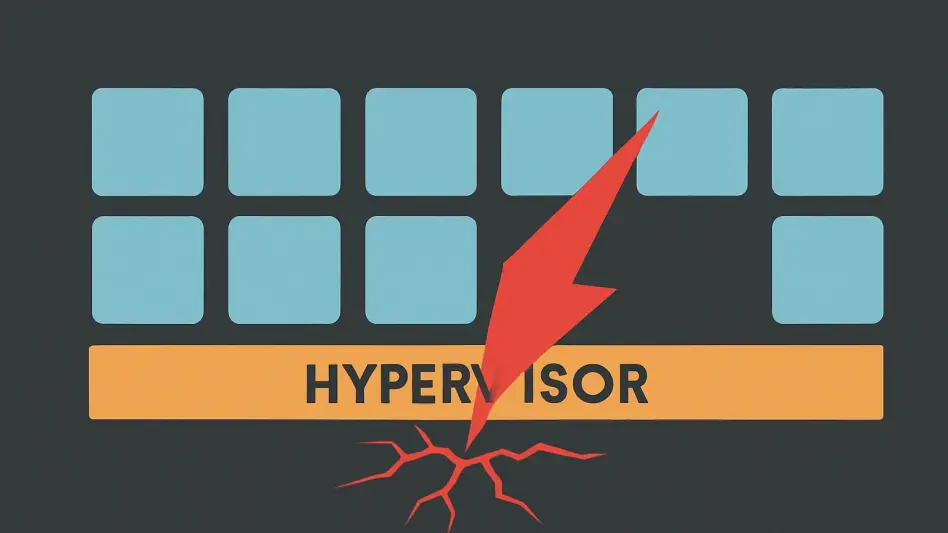
The foundational promise of virtualization technology has always been secure, isolated environments, where virtual machines operate in sandboxes, neatly separated from each other and the underlying hardware. This separation has been a cornerstone of modern IT infrastructure, but a sophisticated attack campaign is challenging this core assumption by targeting the very fabric of virtualization itself—the hypervisor. Security researchers have uncovered a zero-day exploit toolkit, dubbed MAESTRO, that allows threat actors to perform a virtual machine escape, breaking out of a guest VM to seize root-level control of the VMware ESXi host. This incident signals a significant escalation in cyber warfare, where adversaries are no longer content with compromising individual machines on a network; they are now aiming for the command-and-control layer that governs the entire virtualized estate, turning what was once a bastion of security into a new, high-stakes battleground.
The Anatomy of a Hypervisor Breach
A Meticulous Attack Chain
The path to compromising the hypervisor began not with a direct assault on the virtual infrastructure, but with a patient, multi-stage intrusion that demonstrated the attackers’ methodical approach. The initial point of entry was a compromised SonicWall VPN appliance, a common vector for gaining a foothold within a corporate network. Once inside, the threat actors leveraged stolen Domain Admin credentials to pivot laterally, moving stealthily through the network until they gained control of the primary domain controller. This gave them the proverbial keys to the kingdom, but it was only a stepping stone. From this privileged position, they conducted extensive reconnaissance using tools like Advanced Port Scanner and ShareFinder to map the network topology and identify high-value targets, ultimately zeroing in on the ESXi hosts. To maintain their covert presence and evade detection from security monitoring tools, the attackers cleverly modified Windows firewall rules, strategically blocking outbound connections to prevent security alerts while permitting internal traffic, effectively cloaking their command-and-control activities within the noise of everyday network operations. This meticulous preparation laid the groundwork for the final, critical stage of their attack: the deployment of the MAESTRO toolkit against the hypervisor itself.
The MAESTRO Toolkit Unleashed
The technical execution of the MAESTRO toolkit reveals a remarkable level of sophistication and deep knowledge of VMware’s architecture. Once deployed on a target virtual machine, the attack begins by disabling VMware’s Virtual Machine Communication Interface (VMCI) drivers, a preliminary step to prepare the system for kernel-level manipulation. The attackers then employ a utility known as KDU to load an unsigned kernel driver, MyDriver.sys, a maneuver that skillfully bypasses the Windows Driver Signature Enforcement security measure designed to prevent such unauthorized code from running. What makes this driver particularly formidable is its built-in versatility; it contains a comprehensive table of memory offsets that allows it to target 155 different builds of ESXi, spanning a wide range of versions from 5.1 to 8.0. This broad compatibility indicates extensive reverse engineering and development effort. The exploit then proceeds by chaining together three distinct zero-day vulnerabilities. It starts with CVE-2025-22226 to trigger a memory leak, gathering crucial information about the kernel’s memory layout. This is followed by the exploitation of CVE-2025-22224 and CVE-2025-22225 to corrupt kernel memory, escalate privileges, and ultimately achieve the coveted sandbox escape, granting the attackers complete control over the host system.
Aftermath and Fortification
Covert Persistence and Attribution
Achieving root-level access to the ESXi host was not the endgame but the beginning of a long-term, stealthy occupation. Upon compromising the hypervisor, the attackers deployed a sophisticated backdoor named VSOCKpuppet to ensure persistent control. This backdoor was ingeniously designed to hijack the ESXi host’s legitimate inetd service on port 21, establishing a resilient channel for remote command execution at the highest privilege level. The most critical aspect of this implant is its use of VSOCK, a communication protocol for guest-to-host interactions, to transmit its malicious traffic. This choice was deliberate and highly effective, as VSOCK communication is not typically monitored by conventional network security tools, rendering the backdoor’s activity practically invisible to defenders. Forensic analysis of the toolkit provided further insights into its origins. The presence of PDB debug symbols indicated that the toolkit was developed in a simplified Chinese environment. Furthermore, artifacts were dated as early as February 2024, more than a year before the vulnerabilities were publicly disclosed, underscoring the fact that this was a well-resourced operation with access to powerful zero-day exploits long before they were known to the security community.
A New Paradigm for Virtualization Security
This incident served as a stark reminder that the security of virtualized infrastructure can no longer be taken for granted. The compromise highlighted the urgent need for organizations to treat the hypervisor layer with the same level of security scrutiny as traditional network and endpoint defenses. The immediate defensive actions recommended included the prompt patching of all ESXi systems to remediate the newly disclosed vulnerabilities. Moreover, organizations were strongly advised to decommission any end-of-life versions of the software, as these no longer receive security updates and represent a significant, unmitigated risk. Securing initial access points, such as the VPN appliance exploited in this attack, was reinforced as a critical first line of defense. Beyond these foundational steps, the incident underscored the necessity for advanced monitoring capabilities that can detect suspicious kernel driver loading and anomalous VSOCK process activity. Ultimately, the MAESTRO campaign demonstrated a fundamental shift in the threat landscape, proving that determined adversaries now possess the capability to dismantle the core protections of virtualization and establishing that the hypervisor has indeed become a primary frontline in enterprise cybersecurity.