
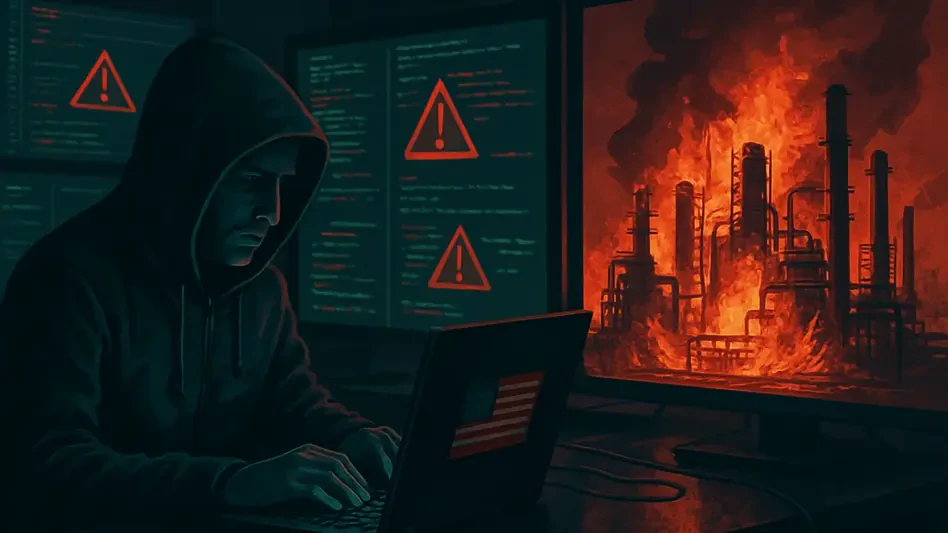
Pumps slowed, screens flickered, and credentials worked a little too well—signals that a familiar adversary had moved beyond spying to tampering with the machinery of daily life and the systems that keep it running safely and on time. The escalation of Iran-linked cyber activity since February’s coordinated U.S.–Israeli strikes did not just broaden the target list; it shifted the goal from collecting documents to imposing costs in the physical world. Government advisories, private threat research, and sector watchdogs pointed to a converging playbook: hit exposed operational technology first, ride identity and management tools to scale, and lace operations with messaging engineered to fray public confidence. This was not theoretical. Attempts to manipulate water treatment parameters, the deliberate misuse of mobile device management, and VPS-staged control software painted a picture of adversaries that learned from past campaigns and translated opportunistic access into visible disruption.
Escalation and Evolution
The past several months brought a sharp change in tone from analysts who track Iran-nexus actors. Annie Fixler of the Center on Cyber and Technology Innovation captured a broad consensus: the intent had shifted toward visible impact. Data-wiping malware featured more prominently, while intrusions probed for opportunities to alter process controls rather than merely map a network. This push for effect aligned with a wider geopolitical arc—limited by conventional deterrence but energized by information operations—where a dramatic cyber moment could deliver outsized policy leverage. The result was a spectrum of actors, from state-directed APTs to ideologically aligned crews, converging on a single objective: translate network presence into operational shock.
This change in intent surfaced in the design of toolsets and the selection of targets. Malware authors embedded slogans and flags into binaries, pairing capability with intimidation. Groups that once favored long, quiet footholds now mixed patience with punctuated bursts, using wipers or HMI tampering to command headlines. Investigators noted that psychological cues frequently accompanied technical moves, suggesting deliberate orchestration rather than incidental noise. Attribution remained complex—proxies and borrowed infrastructure clouded lines—but the throughline was evident in recurring vendor ecosystems, recurring administrative abuse, and recurring attempts to control the narrative. The overall trajectory pointed to tighter cross-team coordination, better staging, and a greater willingness to accept operational risk for strategic effect.
Inside the OT Kill Chain
Operational technology environments—water plants, energy sites, and industrial controls—sat at the center of this campaign set. Adversaries routinely targeted human-machine interfaces and supervisory control displays to distort what operators saw and, where possible, to alter underlying logic on programmable controllers. Rockwell Automation/Allen-Bradley and Unitronics devices resurfaced as high-frequency touchpoints, both because of their prevalence and because misconfigured instances often faced the internet with default credentials intact. Security teams reported attempted changes to chlorine dosing and pressure controls in water facilities, while energy operators tracked anomalies in FactoryTalk and related components that could enable unauthorized actions or mislead technicians at the console.
What distinguished recent activity was not exotic zero-days at scale but the ease of initial access. CISA’s acting director Nick Andersen emphasized that a large fraction of cases began with exposed interfaces, outdated firmware, and unmanaged remote access. That baseline sloppiness multiplied the adversary’s reach. A vulnerable HMI became the on-ramp to a flat network, and a forgotten vendor account became the key to the crown jewels. Even when safety interlocks and manual procedures contained worst-case outcomes, the signal to the public and to policymakers was unmistakable: everyday infrastructure could be touched. For small and under-resourced utilities, the odds were worse. Thin staffing and aging equipment created blind spots that attackers systematically exploited, turning avoidable misconfigurations into headline risk.
Identity and Admin Planes Under Fire
As footholds formed on the edge, the center of gravity shifted rapidly to identity and administration. The wiper attack at Stryker showcased how legitimate management tools could become destructive force multipliers. By pushing policies through Microsoft Intune, attackers wiped data across thousands of mobile devices, demonstrating both deep persistence and the leverage that comes with control of enterprise management planes. Investigators suspected that access predated the destructive action by months, reflecting a maturing approach: compromise first, wait, and then redeploy the same administrative levers to impose cost at scale. Claims from the Handala-branded group of access to Microsoft Entra, VMware vSphere, and IBM FlashSystem consoles further illustrated the appetite for central control points.
The mechanics of identity abuse grew more sophisticated as well. Reports pointed to the use of Temporary Access Passes to sidestep multifactor authentication, a subtle yet potent way to live off the land within enterprise directories. Conditional access gaps, lingering privileged roles, and unmonitored service principals amplified the blast radius once an adversary reached the tenant core. In this framing, mobile device management and endpoint suites were not just support tooling; they were Tier 0 assets that, if hijacked, could reconfigure fleets, redirect telemetry, or deploy wipers with a few clicks. The lesson cut across sectors: harden identity as if it were a plant floor controller, gate administrative actions with just-in-time workflows, and treat change control as a safety function rather than a compliance checkbox.
Blended Operations and Sector Impact
The cyber activity did not exist in isolation. Analysts tied intrusions to broader information operations and potential physical coordination, citing the exploitation of internet-connected cameras to refine targeting and conduct battle damage assessment. Malware like ZionSiphon exemplified this blend. Assessed by Darktrace as capable of modifying water treatment parameters—including chlorine levels and pressure—it arrived freighted with pro-Iran and pro-Palestinian messaging, designed to unnervingly link keystrokes to taps and faucets. Even where safeguards held, the sight of propaganda inside operational malware reframed risk for communities and boards: the narrative was as much the weapon as the code.
Sector impacts reflected uneven readiness. Water and wastewater operators struggled with chronic underfunding and fragmented oversight, making them prime candidates for opportunistic compromise. Energy and industrial sites faced targeted attempts against HMIs and SCADA software, with particular attention on Rockwell/FactoryTalk ecosystems. Healthcare and medtech learned that adjacency offered little protection: the Stryker incident revealed how administrative planes that manage device fleets could interrupt clinical workflows, delaying maintenance, disrupting logistics, and eroding trust in upstream suppliers. Government and telecom remained long-standing espionage targets, consistent with MuddyWater’s history, but the throughline was broader—the same identity and admin abuses that enabled data theft could be repurposed to impose downtime on demand.
Incidents and Tradecraft
The most arresting example of destructive tradecraft involved Stryker’s Microsoft Intune environment. Thousands of mobile devices were wiped in a coordinated push, suggesting careful planning, staged access, and fluency with enterprise change management flows. Forensic hypotheses centered on earlier credential exposure and persistent footholds within identity systems, which, once activated, allowed the adversary to weaponize configurations trusted by defenders. In parallel, U.S. agencies and sector ISACs issued warnings that water and energy facilities faced active attempts to manipulate Rockwell HMIs and related SCADA interfaces. The timing of these advisories underscored a synchronized campaign tempo and a willingness to test process manipulation beyond mere visibility.
Tradecraft extended to staging environments that blurred detection. Palo Alto Networks Unit 42 tracked a cluster labeled CL-STA-1128 and cross-referenced to Cyber Av3ngers/Storm-0784, in which attackers installed Rockwell’s FactoryTalk on virtual private servers. Hosting control software in the cloud gave operators a low-cost lab to probe features, script interactions, and potentially proxy commands without tripping on-premises alarms. It also complicated attribution chains, as VPS footprints can be easily recycled and shared across crews. Historical precedent reinforced the trajectory: the 2022 Albania operation, carried out under the HomeLand Justice moniker, showed patient infiltration culminating in disk-wiping and ransomware—an arc that matched the current emphasis on persistent access followed by destructive flourish.
Mitigation and Oversight Priorities
Defensive priorities coalesced around a few concrete moves. Shrink public exposure first: inventory every internet-facing HMI, PLC, and engineering workstation; then disconnect or broker access through secure gateways. Segment rigorously between IT and OT, keep jump hosts locked down, and require multifactor authentication for remote sessions that reach plant networks. Identity came next. Enforce conditional access baselines in Entra ID, adopt phishing-resistant authenticators, and employ privileged access workstations for administrators. Temporary Access Pass issuance required strict controls and alerting, while standing admin roles gave way to just-in-time grants with human approval. For management platforms like Intune, change control needed dual authorization and tiered logging that retained immutable records beyond an adversary’s reach.
Resilience inside OT demanded old-school rigor paired with modern monitoring. Offline, tested backups of PLC logic and HMI configurations mattered only if operators verified integrity before restoration. Where supported, physical mode switches on controllers stayed in “Run” to prevent remote reprogramming without hands on hardware. Baselines of SCADA visualizations helped catch subtle manipulations, while application allowlisting on engineering workstations curbed unauthorized tools. Hygiene closed many doors: changing vendor defaults, patching well-known vulnerabilities, disabling unused services, and enabling centralized logging with alerting for off-hours configuration changes. Oversight layered on top. Sanctions against MOIS and IRGC elements signaled accountability but did not patch a panel; audits in the water sector highlighted gaps in reporting and coordination that demanded minimum security standards, targeted funding, and cross-agency surge support when incidents broke.
Path Forward for Resilience
The path that delivered the most measurable risk reduction relied on treating identity, device management, and OT control layers as the organization’s Tier 0, then enforcing least privilege and rigorous change governance as if safety depended on it—which it did. Effective next steps were scoped around outcomes rather than checklists: public exposure was driven to zero for OT assets; conditional access and phishing-resistant MFA locked down administrator accounts; and MDM policy pushes were gated by two-person approval with real-time monitoring. Water utilities that lacked in-house capacity benefited most when regional authorities and private partners had already stood up managed detection for identity and OT, prearranged emergency funding, and templated incident playbooks for wipers and configuration tampering.
Progress also hinged on practice. Tabletop exercises that walked through chlorine-setpoint tampering and Intune misuse prepared executives to authorize isolation quickly, even at operational inconvenience. Immutable backups and offline reconstitution paths cut downtime after destructive actions, while prepositioned spare controllers and validated firmware images reduced uncertainty during rebuilds. At the policy level, minimum controls for small utilities, coupled with enforceable reporting timelines and shared telemetry, established a floor that opportunistic actors struggled to slip under. Taken together, these moves reframed the contest. Attackers still favored the path of least resistance, but with reachable gaps closed and administrative cores hardened, opportunism lost its edge and destructive intent faced higher friction at every step.