
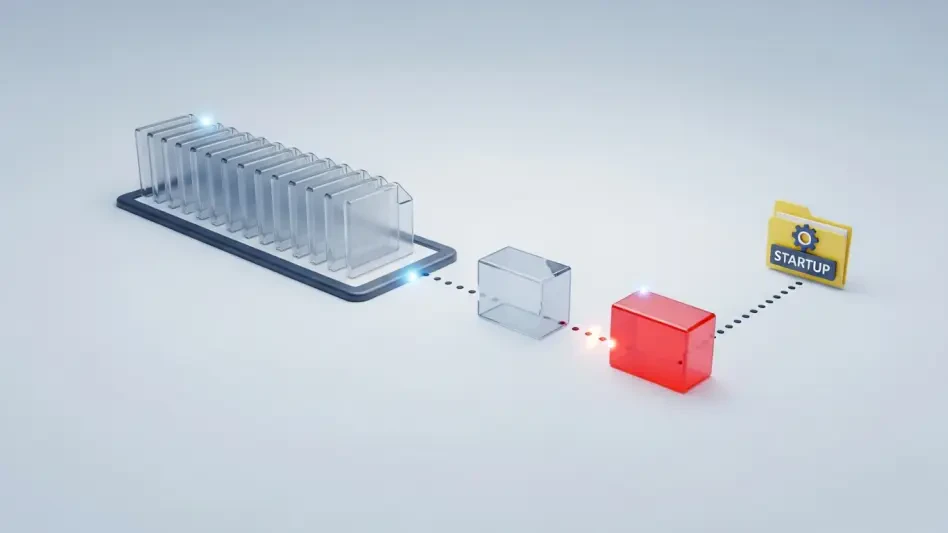
A seemingly harmless compressed file, a daily staple for millions of users, has become the delivery mechanism for a sophisticated and persistent form of cyberattack targeting a critical vulnerability in the WinRAR file archival tool. A detailed report from the Google Threat Intelligence Group (GTIG) reveals that a high-severity flaw, tracked as CVE-2025-8088, is being widely exploited by a diverse array of threat actors to gain complete and lasting control over victims’ systems. The core of the vulnerability is a path traversal bug, which allows meticulously crafted archive files to bypass standard security measures. When an unsuspecting user opens such a file with an unpatched version of the software, the program is tricked into extracting a malicious payload directly into the Windows Startup folder. This placement is strategic, ensuring the malware executes automatically every time the computer is turned on or the user logs in. This method provides attackers with a persistent foothold on the compromised machine without needing further user interaction or triggering common security alerts, such as macro-enablement prompts often seen with document-based attacks.
The Anatomy of the Exploit and Human Factor
The technical execution of this attack demonstrates a deep understanding of both the software’s weakness and the operating system’s architecture, while its continued success highlights a significant gap in user security practices.
Deceptive Delivery and Persistent Access
Attackers have refined their methods to ensure the malicious payload remains hidden while achieving its objective of persistent system access. One particularly effective technique involves the use of Windows Alternate Data Streams (ADS), a feature that allows data to be stored in hidden streams attached to a file. In this scenario, a malicious script is appended to a seemingly innocuous file, such as a PDF or an image, contained within the malicious archive. When the archive is opened, the path traversal vulnerability directs WinRAR to place this file in the Startup folder. The operating system, upon startup, executes the hidden script, launching the malware. This elegant and stealthy approach makes detection difficult for both users and some security software. The primary issue driving the exploit’s widespread success is not its technical sophistication alone, but the failure of users to apply the available security patch. Despite a fix being released in July, a vast portion of WinRAR’s estimated 500 million users have yet to update their software, leaving them exposed.
A Widespread Problem of User Complacency
The continued exploitation of CVE-2025-8088 underscores a persistent and dangerous trend in user behavior: the underestimation of threats posed by utility software. Security experts agree that the primary reason for the vulnerability’s continued relevance is a widespread lack of patching discipline among the user base. Unlike operating systems or web browsers, which often have robust automatic update mechanisms and are perceived as primary targets, file compression tools like WinRAR are frequently overlooked. Many users operate under the false assumption that archive files are inherently safe or that the tools used to manage them do not represent a significant attack surface. This perception leads to a “set it and forget it” mentality, where the software is installed and rarely updated. This complacency creates a vast and vulnerable landscape for attackers to target. The success of this campaign serves as a critical reminder that any software, regardless of its function, can be a gateway for malicious actors if not properly maintained and updated.
A Spectrum of Malicious Actors
The vulnerability’s accessibility and effectiveness have attracted a wide range of threat actors, from state-sponsored espionage groups to financially motivated cybercriminals, each with distinct goals.
Nation State Espionage Campaigns
Governments and their intelligence agencies have been identified as key exploiters of the WinRAR flaw, using it to conduct sophisticated espionage operations. GTIG has observed campaigns attributed to Russian-nexus actors specifically targeting Ukrainian government and military entities, leveraging the vulnerability to establish long-term surveillance and data exfiltration channels. This method of gaining persistent access is highly valuable for intelligence gathering, as it allows for continuous monitoring of sensitive systems. Similarly, a threat group with links to China has been observed using the exploit to deploy the PoisonIvy remote access trojan (RAT). This well-known malware provides attackers with comprehensive control over an infected system, enabling them to steal files, log keystrokes, and use the compromised machine as a pivot point for further attacks within the network. These campaigns highlight how a simple software flaw can be weaponized to achieve significant geopolitical objectives.
Financially Motivated Cybercrime
In parallel with state-sponsored activities, cybercriminal organizations are actively exploiting CVE-2025-8088 for direct financial gain. These groups have been observed targeting corporate networks in various regions, including Indonesia and South America, with the primary goal of deploying ransomware. The exploit serves as an initial entry point, allowing attackers to install remote control malware and conduct reconnaissance within the victim’s network. Once they have a sufficient understanding of the network’s layout and have escalated their privileges, they deploy the ransomware to encrypt critical files and demand a ransom. Other financially motivated campaigns focus on stealing sensitive information, such as login credentials for online banking and cryptocurrency wallets. By gaining a persistent foothold on a victim’s machine, these criminals can monitor activity over time, maximizing their potential for theft. The broad application of this single vulnerability for both espionage and financial crime demonstrates its versatility and the severe risk it poses to all users.