
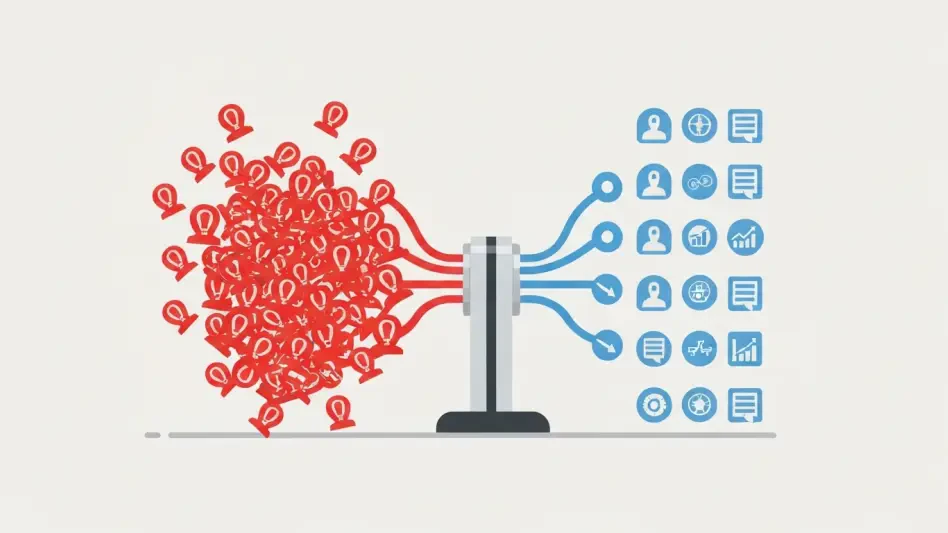
A constant deluge of vulnerability alerts floods security teams daily, yet a staggering number of breaches still trace back to known, unpatched flaws, creating a frustrating and dangerous paradox in modern cybersecurity. This relentless cycle of discovery and remediation has left many organizations in a perpetually reactive state, struggling to distinguish genuine threats from background noise. The core issue is not a lack of data but a profound absence of context, which paralyzes decision-making and leads to inefficient resource allocation. In response, a strategic shift is underway, moving away from the Sisyphean task of patching everything toward a more intelligent framework: exposure management. This approach promises to bring order to the chaos by aligning security efforts with tangible business risk, enabling faster, more effective mobilization against the threats that truly matter.
When Patching Everything Protects Nothing
The conventional wisdom in vulnerability management has long been to patch as much as possible, as quickly as possible. However, this volume-based approach is buckling under the weight of the modern digital landscape. As organizations expand their infrastructure into cloud environments, operational technology (OT), and the Internet of Things (IoT), their attack surface grows exponentially. Each new asset introduces a potential entry point for attackers, and security tools dutifully flag every corresponding weakness. The result is an overwhelming backlog of vulnerabilities that far exceeds the capacity of any IT team to remediate, creating a scenario where trying to fix everything means that critical flaws are often overlooked.
This strategy creates a paradox where increased visibility leads to decreased security effectiveness. Security teams, armed with lists of thousands of potential vulnerabilities, pass these findings to IT and development teams who lack the context to prioritize them effectively. Without a clear understanding of which flaws pose a genuine, immediate threat to the organization’s most critical assets, teams often resort to addressing the list from top to bottom or focusing on easily patched items. This inefficiency not only leaves significant security gaps open but also fosters a culture of alert fatigue, where the sheer noise of low-priority findings drowns out the signal of a truly dangerous exposure.
The Operational Gap Why Traditional Remediation Falls Short
At the heart of this inefficiency is a deep-seated reliance on generic metrics, most notably the Common Vulnerability Scoring System (CVSS). While useful for conveying the intrinsic severity of a flaw, a high CVSS score does not account for an organization’s specific environmental context. It fails to answer critical questions: Is the vulnerable asset accessible from the internet? Does exploit code exist in the wild? Can this flaw be combined with other weaknesses to create a path to a critical system? Consequently, security teams are left drowning in data but starving for the contextual intelligence needed to make risk-informed decisions, often spending valuable resources on vulnerabilities that pose no material threat.
This problem is compounded by organizational and technological fragmentation. In most enterprises, security responsibilities are divided among siloed teams managing the cloud, corporate network, and operational technology, each using its own set of disconnected tools. This structure creates significant blind spots, as no single team has a comprehensive view of how a weakness in one domain could impact another. An attacker, however, does not see these organizational boundaries; they see a continuous attack surface. Without a unified platform to correlate data across these disparate environments, it becomes impossible to identify the complex, multi-stage attack paths that adversaries are increasingly leveraging.
The human cost of this broken process is substantial and often underestimated. IT and operations teams are perpetually inundated with remediation demands from security, creating friction and what is often described as “bad blood” between departments. The endless cycle of receiving long, decontextualized lists of vulnerabilities to fix fosters a sense of futility and burnout. This constant pressure not only damages interdepartmental relationships but also slows down the entire remediation lifecycle. When every vulnerability is presented as urgent, nothing is truly prioritized, and the time-to-remediate for the most critical threats can extend to dangerous lengths.
Deconstructing the Disconnect How Attackers Exploit a Fractured Defense
The catastrophic consequences of a fractured defense were starkly illustrated in the 2019 breach of a major North American bank. This incident, which exposed the personal data of over 100 million customers and resulted in more than $250 million in fines, was not the result of a single, high-severity vulnerability. Instead, attackers exploited a chain of interconnected, lower-priority weaknesses that spanned different parts of the organization’s infrastructure. The attack began with a misconfigured web application firewall, which allowed the adversary to execute a server-side request forgery (SSRF) attack against a cloud server, ultimately leading to the theft of over-permissioned credentials.
Individually, none of these flaws would have likely triggered a high-priority alert within their respective security silos. A misconfigured firewall, a common cloud server flaw, and overly permissive credentials are all routine findings. However, when linked together, they formed a clear and devastating attack path to the bank’s most sensitive data. This case highlights the fundamental flaw in traditional, siloed vulnerability management: it fails to assess cumulative risk. Attackers excel at connecting these seemingly minor dots, while defensive teams, hampered by their fragmented tools and organizational structure, often miss the bigger picture until it is too late.
This breach represented a massive missed opportunity for prevention. A unified security platform capable of mapping the relationships between assets, permissions, and vulnerabilities would have flagged this “toxic combination” of weaknesses. By visualizing the potential attack path, security teams could have understood that the cumulative risk was far greater than the sum of its parts. More importantly, they would have seen that breaking any single link in that chain—by correcting the firewall misconfiguration, patching the SSRF flaw, or right-sizing the credentials—could have thwarted the entire attack, demonstrating how a holistic view can transform reactive incident response into proactive risk reduction.
A Paradigm Shift to Proactive Exposure Management
To counter these systemic failures, organizations are embracing a new paradigm: proactive exposure management. This approach centers on a unified platform that acts as a single source of truth for an organization’s entire attack surface. By aggregating and correlating data from across all environments—including traditional IT, cloud infrastructure, and operational technology—this platform eliminates the blind spots created by siloed tools. It provides a comprehensive, contextualized inventory of every asset and a clear understanding of every potential exposure, from software vulnerabilities and misconfigurations to identity and access issues.
The true power of this model lies in its ability to move beyond analyzing individual flaws and instead focus on mapping potential attack paths. An exposure management platform simulates how an attacker could chain together various weaknesses to compromise “crown jewel” assets, such as domain controllers or sensitive databases. This provides security teams with a clear, visual understanding of how an externally accessible vulnerability on a non-critical server could ultimately lead to administrative-level control over the entire network. This shift in perspective allows for prioritization based not on generic severity scores, but on actual business impact.
The chaotic scramble following the disclosure of the Log4j vulnerability in 2021 served as a real-world test of this new model. Organizations relying on traditional, fragmented tools struggled for weeks to simply identify all affected assets scattered across their diverse environments. In contrast, those with a centralized exposure management platform were able to quickly query their unified asset inventory to pinpoint every vulnerable instance. Furthermore, the platform could overlay threat intelligence to highlight which assets were being actively targeted by known threat actors and identify the most effective “choke points” for remediation, bringing clarity and order to a high-pressure situation.
An Experts Perspective on Scalable Risk Reduction
The principles behind this strategic shift are validated by experts in the field who see the daily struggles of security teams firsthand. According to Pierre Coyne, a director of product marketing for Tenable One, the key to escaping the cycle of reactive patching is to bring deep context to the remediation process. He advocates for a pragmatic, two-step approach to prioritization that cuts through the noise of vulnerability scanners and focuses on what truly matters to the business.
Coyne explains that the first critical step is to evaluate genuine exploitability. This involves determining not only if a vulnerability has a high CVSS score, but also if it is accessible from the outside, if public exploit code is available, and if it is being actively targeted by threat actors. The second, equally crucial step is to assess the potential business impact by understanding the asset’s role and connectivity. An exposure management platform automates this by mapping how different risks can create viable attack paths. This intelligence allows teams to focus on the small percentage of vulnerabilities—often less than 5%—that pose a clear and present danger to the organization.
This context-driven approach enables what Coyne describes as an “infinitely more scalable” method for risk reduction: focusing on “choke points.” Instead of attempting to patch every vulnerability in a potential attack chain, teams can identify the single most critical weakness that, if remediated, breaks the entire chain. For instance, if one CVE provides the initial access required to exploit ten downstream vulnerabilities, fixing that single entry point effectively neutralizes the entire threat. This strategic focus allows security teams to achieve the greatest possible risk reduction with the most efficient use of resources.
Activating an Optimized Response
The tangible benefits of adopting an exposure management framework manifested quickly in improved operational efficiency and security posture. By providing clear, context-aware prioritization, this approach enabled organizations to direct their limited resources toward the threats that posed a material risk, rather than wasting effort on theoretical or low-impact vulnerabilities. This newfound clarity accelerated the entire response lifecycle, from detection to remediation. When a new, high-impact threat emerged, teams were no longer paralyzed by uncertainty; they had the intelligence at their fingertips to mobilize a swift, decisive, and effective response.
This strategic shift also had a profound impact on organizational culture, helping to repair the often-strained relationship between security and IT departments. By replacing overwhelming, decontextualized patch lists with a focused set of high-impact tasks, the burden on IT and development teams was significantly reduced. Security requests were no longer seen as arbitrary demands but as collaborative efforts supported by clear business justification. This shared understanding fostered a partnership where both teams worked toward the common goal of protecting the organization, transforming a source of friction into a foundation for collaboration.
Finally, the integration of exposure management platforms into existing operational workflows solidified these gains by introducing automation and centralized oversight. By linking directly with ticketing systems, the platform automated the creation, escalation, and tracking of remediation tasks, eliminating manual processes and ensuring accountability. A unified dashboard provided leadership with a real-time view of the organization’s security posture and remediation progress. This combination of intelligent prioritization, improved collaboration, and automated workflow ultimately cultivated a more resilient and sustainable security strategy, one built not on frantic reaction but on proactive, risk-informed defense.