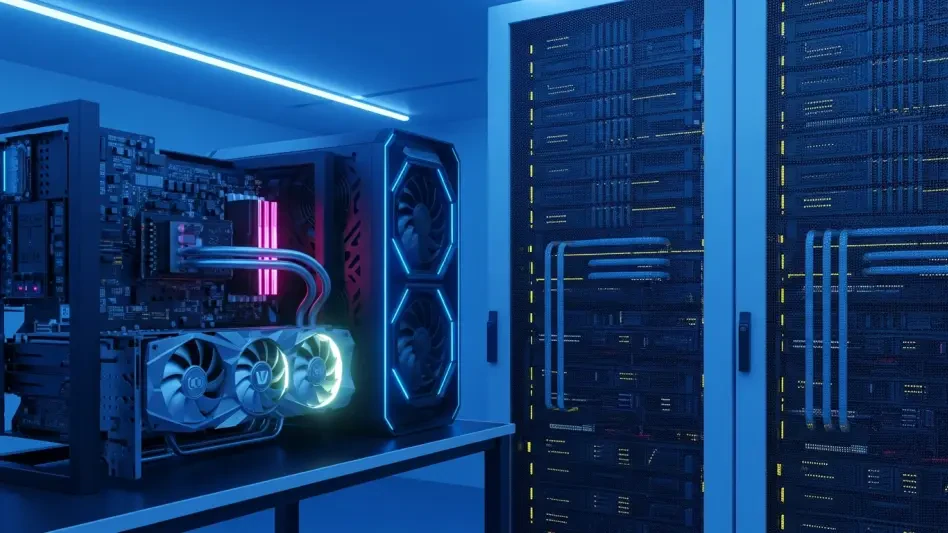
While the price tag of a $30,000 data center processor might suggest unmatched speed across every possible computing task, the reality of modern silicon engineering tells a far more nuanced story of specialization. In the rapidly shifting landscape of hardware development, a clear divide has emerged between massive AI accelerators and consumer-grade gaming components. Specops research recently highlighted this divergence by pitting the industry-leading Nvidia ##00 and AMD Instinct MI300X against the consumer-focused Nvidia GeForce RTX 5090.
This comparison focuses on the Nvidia ##00 and AMD Instinct MI300X, both of which serve as the backbone for large language model training and complex inference. These enterprise units are engineered for high-bandwidth memory and massive throughput in data centers. Conversely, the RTX 5090 represents the pinnacle of the Ada Lovelace and Blackwell lineage, designed primarily for high-fidelity rendering and general-purpose compute tasks.
The intersection of these hardware categories is particularly relevant in cybersecurity. Professionals often look to high-end hardware for password recovery and cryptographic benchmarking. However, as software and hardware become more specialized, the assumption that higher cost equals better performance in every niche is being fundamentally challenged.
Performance Benchmarks in Cryptographic Workloads
Integer Throughput and Hashing Speed
When evaluating raw performance in compute-intensive hashing tasks using algorithms like MD5, NTLM, and SHA-512, the results are surprising. Despite its lower cost, the RTX 5090 exhibited absolute dominance in these specific workloads. Data from recent studies shows that the RTX 5090 performs 63.7% faster than the Nvidia ##00 on average.
The gap becomes even more stark when analyzing SHA-512 tests, where the consumer card outpaced the enterprise chip by 93.5%. This indicates that for pure cryptographic speed, the massive investment required for enterprise silicon does not translate into proportional gains. Instead, the consumer architecture seems better suited for the specific mathematical demands of hashing.
Architectural Specialization and Core Density
The disparity in performance stems from the technical specifications of each chip. The RTX 5090 features a high density of 32-bit integer (INT32) cores, which are essential for the bitwise operations found in most hashing algorithms. In contrast, the ##00 focuses heavily on low-precision Tensor core instructions, such as FP4, FP8, and INT8, which are optimized for machine learning but lack efficiency in standard integer tasks.
This architectural shift creates a significant bottleneck for the ##00 in non-AI applications. Because the ##00 possesses roughly half the INT32 core count relative to its floating-point capacity, it struggles to keep up with the Blackwell-based consumer architecture. The ##00 is essentially a scalpel designed for AI, while the RTX 5090 remains a powerful, versatile hammer for general compute.
Software Optimization and Ecosystem Support
Hardware power is only effective if the software can harness it, and this is where tools like Hashcat play a decisive role. The Nvidia ecosystem benefits from years of CUDA-based maturity, allowing the RTX 5090 to operate at peak efficiency. This optimization is a primary reason why even powerful competitors fall behind in real-world benchmarks.
The AMD Instinct MI300X provides a compelling example of this software gap. While the MI300X boasts superior theoretical INT32 specifications compared to the RTX 5090, it consistently underperformed in testing. The lack of specific Nvidia-based optimizations in common security tools means that the AMD hardware cannot fully leverage its raw power, leaving the consumer Nvidia card as the more practical choice.
Challenges and Considerations for High-End Hardware Implementation
Modern AI hardware suffers from “extreme specialization,” which renders expensive enterprise chips less versatile than many expect. While these chips excel at moving massive datasets for neural networks, they often lack the agility required for cryptographic tasks. Investing in enterprise silicon for password recovery represents a case of diminishing returns, as the hardware is simply not built for that specific purpose.
Technical obstacles also persist within the AMD ROCm platform. Compared to Nvidia’s dominant CUDA architecture, ROCm still faces optimization hurdles in legacy security tools. This makes the implementation of high-end AMD accelerators more complex and less rewarding for researchers who need “out-of-the-box” performance for hashing and general-purpose cryptographic workloads.
Selecting the Right GPU for Performance Requirements
The findings demonstrated that the RTX 5090 surpassed the ##00 and MI300X in hashing efficiency due to its superior 32-bit integer throughput. Security professionals and researchers who need high-speed performance for password recovery should prioritize top-tier consumer GPUs over AI accelerators. This approach not only saves significant capital but also provides a more compatible environment for existing software tools.
Looking forward, the choice between Nvidia and AMD must be governed by specific software requirements and the necessity of integer performance. While AMD continues to close the raw power gap, the software maturity and architecture of Nvidia’s consumer line remained the primary benchmarks for success. Organizations would be wise to evaluate the specific instruction sets required by their workloads before committing to expensive data center hardware that may not provide the desired results.