The silent humming of a modern power grid or the rhythmic pulse of a city’s water treatment facility now exists under a shadow of digital vulnerability that few could have predicted a decade ago. As organizations across the globe have raced toward total digital integration, the systems that manage physical processes—known as Cyber-Physical Systems (CPS)—have become inextricably linked with traditional information technology networks. This convergence has ushered in an era of unprecedented operational efficiency, yet it has simultaneously exposed the literal machinery of modern life to a spectrum of digital threats that can trigger physical consequences. The challenge now facing industrial leaders is no longer just about protecting data but about ensuring the continuous, safe operation of the physical world in the face of persistent cyber hostility.
The Crisis of Critical Infrastructure and the Shift Toward Resilience
The central theme of current research into industrial security is the profound transformation of how Cyber-Physical Systems are defended as the lines between IT and operational technology (OT) environments continue to blur. In the past, industrial control systems were often air-gapped or isolated, but the requirements of real-time data analytics and remote management have mandated a permanent state of connectivity. This shift toward a more open architecture has fundamentally altered the risk profile of critical infrastructure, moving security from a niche engineering concern to a central pillar of corporate governance. The primary struggle for modern operators lies in balancing the undeniable benefits of automation and digital oversight with the rising frequency of physical disruptions that can result from a single compromised access point.
Achieving a state of operational resilience requires a departure from the reactive security postures that defined previous decades. It is no longer sufficient to simply build higher firewalls around industrial assets; instead, organizations must design their environments to withstand and recover from inevitable breaches. This necessity arises from the fact that cyberattacks on CPS are increasingly resulting in financial ruin and safety hazards, rather than mere data loss. As digital connectivity deepens, the potential for a digital intrusion to manifest as a mechanical failure or a chemical imbalance in a public utility has become a primary concern for executive leadership. Consequently, the focus has shifted toward creating a holistic defense strategy that prioritizes the continuity of essential services over the mere protection of static digital assets.
Contextualizing the Modern Threat Landscape in 2026
The landscape of industrial security in 2026 is defined by a level of complexity and risk that has necessitated a massive study of 2,000 business and technology leaders spanning 16 diverse industries and 40 countries. This research underscores a pivotal moment where critical infrastructure has emerged as the primary target for a variety of threat actors, ranging from petty cybercriminals to highly sophisticated state-sponsored groups. The importance of this investigation cannot be overstated, as the stability of healthcare delivery, the reliability of water sanitation, and the availability of electrical power now hinge on the integrity of digital protocols. In an era where a software exploit can effectively shut down a regional hospital or contaminate a municipal water supply, understanding the specific vectors of these threats is essential for survival.
Beyond the immediate technical vulnerabilities, the research highlights a broader societal relevance regarding the protection of essential services from digital exploitation. Threat actors have recognized that the most effective way to exert pressure on a corporation or a nation is to target the systems that sustain daily life. This realization has turned every industrial endpoint—from a programmable logic controller on a factory floor to an automated valve in a gas pipeline—into a potential battlefield. As these systems become more sophisticated, the margin for error narrows, making the findings of global leadership surveys vital for identifying where defenses are failing and where strategic investments must be directed to prevent catastrophic outages.
Research Methodology, Findings, and Implications
Methodology
The research approach utilized a comprehensive global survey designed to capture a statistically significant cross-section of the industrial world, engaging leaders who manage the intersection of business and technology. By gathering data from 2,000 respondents, the study provided a panoramic view of how different sectors—such as energy, manufacturing, and pharmaceuticals—are coping with the evolution of cyber threats. This qualitative data was crucial for understanding the human and organizational factors that influence security decisions, such as budget allocation, risk perception, and the degree of integration between different technical departments within large enterprises.
In addition to the survey data, the “Team82” research group conducted a rigorous technical analysis of 750,000 distinct CPS assets to identify tangible vulnerabilities within the hardware and software used in industrial settings. This dual-layered methodology allowed for a comparison between what leaders believe about their security and the reality of the technical flaws present in their systems. By scanning and analyzing three-quarters of a million devices, the research team was able to pinpoint exactly how attackers move from a non-critical system to a high-value industrial target, providing a grounded, empirical basis for the alarming statistics reported by the surveyed executives.
Findings
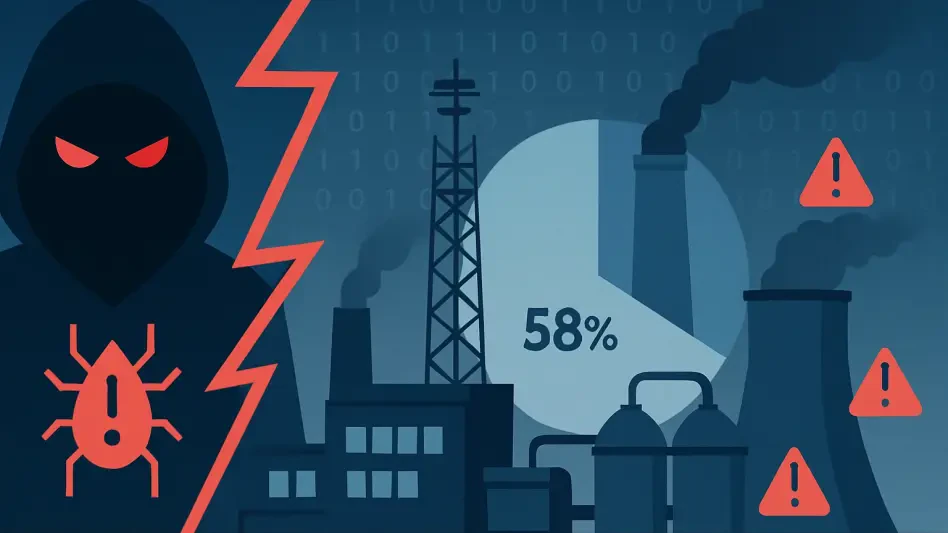
The data revealed a sobering reality: 58% of global operators experienced at least one cyberattack impacting their operational environments within the past year. These incidents were not merely minor glitches but significant events that often resulted in physical downtime, with 43% of affected organizations reporting a complete halt in operations for an average of three days. The financial consequences of these disruptions are staggering, with the average loss exceeding $1 million per incident. This figure scales upward as organizations grow; large enterprises with more than 10,000 employees reported average losses of $2.25 million, demonstrating that the cost of insecurity is directly proportional to the scale of the operation.
External drivers have significantly accelerated the frequency and severity of these attacks, with geopolitical tensions involving actors from Russia and Iran playing a central role in targeting Western infrastructure. Furthermore, the role of “frontier” AI models has changed the speed of exploitation, as these advanced systems allow attackers to identify and weaponize vulnerabilities in a fraction of the time previously required. A particularly critical finding involves the vulnerability of third-party access; approximately 75% of organizations that expressed concern over vendor connections reported at least one major security incident stemming from those very links. This highlights a massive gap in how external credentials and remote maintenance tools are monitored and controlled by industrial operators.
Implications
The research suggests a practical need for a decisive shift from “asset-centric” protection, which focuses on individual devices, toward a holistic model of operational resilience. This new model acknowledges that while an individual sensor or controller may be secure, the system as a whole can still be compromised through “one-hop” exposure. For example, the study found that 41% of power distribution units and 33% of HVAC systems are just one digital step away from an internet-exposed system. A breach in a seemingly innocuous building management system can quickly escalate into a threat to human safety if it allows an attacker to manipulate the environment of a critical facility, such as a laboratory or a data center.
Furthermore, the “AI Paradox” presents a unique challenge for the modern operator, as artificial intelligence serves as both a powerful tool for operational efficiency and a dangerous new attack vector. While AI can help defenders identify anomalies and establish behavioral baselines for machinery, it also enables attackers to automate the discovery of zero-day vulnerabilities. This dual-use nature of AI means that organizations must implement defensive AI measures just to maintain parity with their adversaries. The implications for societal safety are profound, as the speed of automated attacks may soon outpace the ability of human operators to intervene, necessitating the development of more autonomous and intelligent defensive frameworks.
Reflection and Future Directions
Reflection
A significant takeaway from the research is the persistent fragmentation in organizational governance, which continues to hinder effective security responses. Currently, only 16% of organizations have fully integrated their IT and OT security departments, leaving the vast majority to struggle with siloed data and conflicting priorities. This lack of alignment often leads to a situation where the personnel responsible for digital security do not fully understand the physical constraints of the machinery they are protecting, while the plant operators remain unaware of the digital risks introduced by new connectivity features. This governance gap is perhaps the single greatest internal obstacle to achieving true resilience in the industrial sector.
The research also shed light on the challenges of addressing legacy technical debt, specifically the widespread use of insecure protocols in building management and industrial devices. An overwhelming 88% of building management systems and 83% of industrial controllers rely on protocols that were never designed with security in mind, lacking basic features like encryption or authentication. Replacing this aging infrastructure is a monumental task that requires significant capital investment and planned downtime, which many organizations are reluctant to undertake. As a result, many operators are forced to apply digital “band-aids” to inherently insecure systems, creating a precarious environment where a single mistake can have cascading effects.
Future Directions
Moving forward, there is a clear need for further exploration into the development of “operational restoration” frameworks that go beyond traditional data backups. In an industrial context, simply restoring a database is insufficient if the physical machinery has been damaged or if the control logic has been subtly altered. Future strategies must focus on how to safely reboot and recalibrate physical processes after a cyber intrusion, ensuring that the transition back to normal operations does not cause further safety hazards. This will likely involve the creation of isolated, “gold-standard” configurations for industrial logic that can be quickly deployed to replace compromised code in the event of an emergency.
Additionally, future research must prioritize the security of autonomous AI agents and the establishment of global baselines for AI-human oversight in industrial settings. As these agents take on more responsibility for managing complex physical systems, the potential for unintended consequences or malicious redirection increases. Establishing rigorous monitoring of third-party vendor credentials must also become a top priority, as these external connections represent the path of least resistance for many attackers. Developing standardized, high-frequency monitoring protocols for remote access will be essential for closing the visibility gap that currently allows so many third-party breaches to go undetected until the damage is already done.
Securing the Future of Global Industrial Operations
The evidence gathered throughout this research confirmed that cybersecurity has officially transitioned from a technical support function to a core business capability that is essential for enterprise survival. As the data demonstrated, the high frequency of attacks and the substantial financial losses associated with them meant that ignoring the security of Cyber-Physical Systems was no longer a viable option for any serious operator. The research highlighted how the traditional focus on protecting data was replaced by a more urgent need to protect the continuity of physical output and the safety of the workforce. It became apparent that the ability to maintain operational uptime was the primary metric by which the success of modern chief operating officers and chief information officers was measured.
The investigation into the 2026 threat landscape concluded that successful organizations were those that moved away from fragmented governance and embraced a unified approach to risk management. By integrating IT and OT security functions, these leaders were able to close the communication gaps that previously left their systems vulnerable to lateral movement by attackers. The findings also suggested that the modernization of recovery drills, shifting from simple IT restoration to full-scale operational restoration, became a defining characteristic of resilient operators. Ultimately, the research established that the integration of advanced monitoring, the securing of third-party access, and the mitigation of legacy technical debt were the critical steps taken by those who successfully navigated the complexities of the digital age. This proactive stance ensured that the physical systems sustaining global society remained robust and reliable in an increasingly volatile digital environment.