
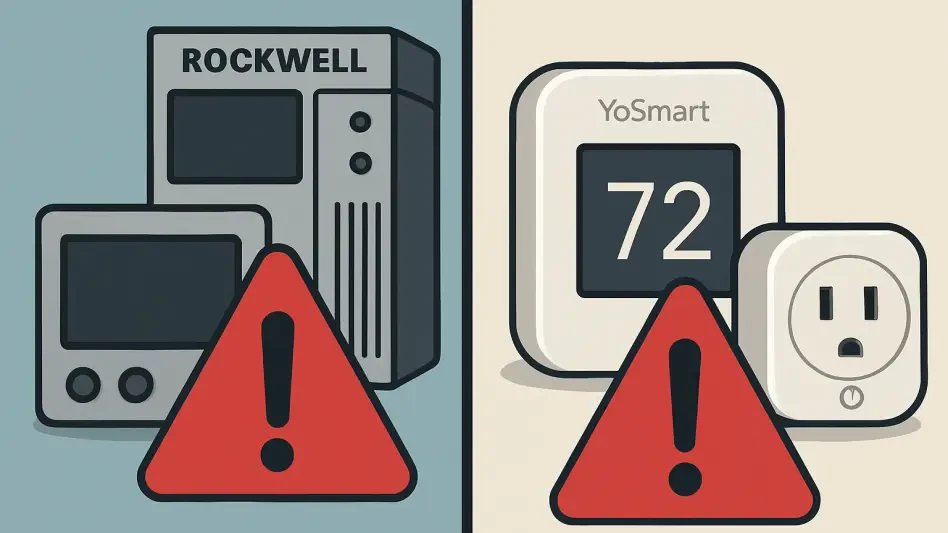
The once-distinct lines separating industrial control systems from consumer smart home devices have blurred significantly, creating an interconnected technological landscape where a vulnerability in one domain can offer critical lessons for the security of another. Recent advisories from the Cybersecurity and Infrastructure Security Agency (CISA) bring this reality into sharp focus, detailing severe security flaws in products from Rockwell Automation and YoSmart. These findings serve as a powerful reminder that whether on a factory floor or in a living room, the foundational principles of cybersecurity are not just recommended—they are essential for safety and operational integrity. This guide breaks down these critical vulnerabilities to establish clear best practices for defending against an evolving threat landscape.
CISA Advisory Overview: Uncovering Systemic Risks in OT and IoT
Recent communications from CISA have cast a spotlight on critical vulnerabilities affecting both industrial operators and everyday consumers. The advisories detail significant security weaknesses in the operational technology (OT) products of Rockwell Automation, a cornerstone of the critical manufacturing sector, and the smart home ecosystem of YoSmart, which is widely used in the global communications sector. The identified risks are not minor bugs but fundamental flaws that could lead to widespread disruption.
The core threats detailed by the agency include denial-of-service (DoS) attacks that can halt industrial processes, data manipulation vulnerabilities that undermine the integrity of operational data, and insecure-by-design IoT ecosystems that expose users to comprehensive account takeovers. These advisories function as more than just a warning; they provide a crucial learning opportunity, illustrating how similar security oversights can manifest in vastly different environments and underscoring the universal need for a proactive, defense-in-depth security posture.
The Critical Impact: Why These Vulnerabilities Demand Immediate Attention
The necessity for proactive security measures in critical manufacturing and communications cannot be overstated, as the consequences of exploitation extend far beyond digital inconvenience. In an industrial setting, the vulnerabilities found in Rockwell Automation products could allow an attacker to trigger a DoS condition, effectively shutting down production lines. Such an interruption results not only in immediate financial loss but can also create unsafe physical conditions and disrupt complex supply chains. Furthermore, the ability to manipulate operational data through flaws like SQL injection could lead to faulty products, undetected equipment failure, or corrupted compliance reporting, eroding the very foundation of trust in the manufacturing process.
In the consumer realm, the systemic failures within the YoSmart ecosystem translate to a severe loss of privacy and physical security. A successful attack could grant a malicious actor complete control over a user’s smart devices, including locks, sensors, and cameras, effectively giving them a key to the victim’s home. This level of intrusion compromises personal safety and deeply undermines consumer confidence in smart technology. The potential for such a comprehensive takeover highlights the responsibility of manufacturers to build security into their products from the ground up, as the impact of failure is measured in more than just data—it is measured in the safety and well-being of users.
In-Depth Vulnerability Analysis: A Breakdown of Key Findings
A detailed examination of the specific flaws discovered in Rockwell Automation and YoSmart products provides actionable context on the nature of these vulnerabilities and their potential real-world impact. By dissecting these cases, organizations and consumers can better understand the types of weaknesses to look for in their own systems and recognize the importance of implementing layered security controls. These examples serve as practical case studies in how seemingly small oversights can create significant security gaps.
High-Severity Flaws in Rockwell Automation’s Industrial Systems
The two critical vulnerabilities affecting Rockwell products, which are widely used in manufacturing, pose significant risks to operational technology environments. These flaws are particularly concerning due to the prevalence of these systems in critical infrastructure, where reliability and integrity are paramount. They demonstrate how both resource management and data handling are critical pillars of OT security that, if compromised, can lead to severe operational consequences.
Case Study: Denial-of-Service Risk in GuardLink EtherNet/IP (CVE-2025-9368)
A high-severity DoS vulnerability was identified in the GuardLink EtherNet/IP interface, a component often used in machine safety applications. The flaw stems from improper resource allocation, meaning the device fails to effectively manage its memory or processing cycles when handling network traffic. Consequently, an attacker could send a flood of specially crafted packets to the device, overwhelming it and causing it to become completely unresponsive.
The most significant operational challenge presented by this vulnerability is the recovery process. Restoring the device to a functional state requires a manual power cycle, an action that is often impractical and time-consuming in a continuously operating industrial facility. This case underscores a critical best practice: safety-critical systems must be designed with resilience in mind, capable of gracefully handling unexpected network conditions without succumbing to a hard failure that demands physical intervention.
Case Study: Critical SQL Injection Flaw in FactoryTalk DataMosaix (CVE-2025-12807)
An even more severe vulnerability was found in Rockwell’s FactoryTalk DataMosaix private cloud platform. The flaw, a classic SQL injection, allows an attacker with low-level privileges to execute arbitrary commands on the underlying database. Because the application fails to properly sanitize input supplied to its API endpoints, a malicious actor could bypass access controls to read, modify, or even delete critical operational data.
This vulnerability serves as a stark reminder of a timeless security lesson: never trust user input. The best practice of rigorous input validation and sanitization is non-negotiable, especially in systems that handle sensitive operational data. Moreover, the principle of least privilege should be strictly enforced to ensure that even if a vulnerability is exploited, the potential for damage is contained. The ability of a low-privilege user to compromise the entire database points to a fundamental weakness in the platform’s security architecture.
Systemic Security Failures in the YoSmart YoLink Smart Home Ecosystem
The interconnected series of vulnerabilities discovered in the YoLink platform illustrates the profound risks associated with an insecure-by-design ecosystem. Rather than a single flaw, the danger arises from multiple poor security choices that compound one another, creating a pathway for a complete takeover of a user’s smart home environment. This case is a powerful argument for a holistic approach to security, where every component is hardened and designed to operate securely, even if other parts of the system are compromised.
Example: Cross-Account Takeover via Predictable IDs and Unencrypted Communications
The foundation of the YoLink attack scenario rests on a combination of fundamental security failures. First, the platform uses predictable, easily guessable identifiers for its smart devices. Second, the central MQTT broker, which handles device communication, lacks proper authorization checks, allowing anyone to send commands to any device if they know its ID.
This architectural flaw is exacerbated by the transmission of data in cleartext over the internet. An attacker can therefore passively monitor network traffic to discover valid device IDs and then send their own malicious commands without any authentication. This highlights the absolute necessity of using strong, unpredictable identifiers for all devices, enforcing strict, per-request authorization, and encrypting all communications by default as core tenets of secure IoT design.
Example: Compounding Risks from Insecure Sessions and Hub Vulnerabilities (CVE-2025-59452)
The risks within the YoSmart ecosystem are amplified by additional poor practices, including the use of session tokens with excessively long lifetimes. This gives an attacker a much larger window of opportunity to steal a valid token and hijack a user’s account, gaining persistent, unauthorized access.
Furthermore, the YoLink Smart Hub itself is plagued with vulnerabilities, including incorrect authorization and cleartext data transmission. This means that even the local device within a user’s home cannot be trusted to enforce security policies. This case demonstrates the critical importance of a defense-in-depth strategy. Best practices dictate that security should be layered, with measures like short-lived session tokens, hardened local hardware, and secure-by-default configurations working in concert to limit the impact of any single point of failure.
CISA’s Recommendations: A Proactive Defense-in-Depth Strategy
In light of these findings, CISA’s universal defensive measures provide a clear and actionable framework for asset owners and consumers. The guidance moves beyond simple patching and advocates for a holistic, proactive security posture built on the principle of defense-in-depth. This strategy acknowledges that no single security control is infallible and instead relies on creating multiple layers of defense to protect critical systems. Adopting these recommendations is a crucial step toward building resilience against both known and future threats.
A cornerstone of this strategy is minimizing the attack surface by ensuring that all control system networks and devices are isolated from business networks and, most importantly, from the public internet. This can be achieved through robust firewalls and strict network segmentation, which limits an attacker’s ability to move laterally across a network if one segment is compromised. When remote access is unavoidable, it must be facilitated through secure and fully updated methods, such as a Virtual Private Network (VPN), with the understanding that the VPN itself is another potential point of failure that requires diligent management.
Finally, a proactive defense requires a disciplined and analytical approach to security management. Before deploying any patches or mitigations, organizations must perform a thorough impact analysis and risk assessment to understand how changes might affect their specific operational environment. This prevents well-intentioned security updates from causing unintended disruptions. This calculated approach, combined with network hardening and secure access protocols, forms the basis of a resilient security strategy capable of defending critical OT and IoT ecosystems.
The vulnerabilities discovered in Rockwell and YoSmart systems were not merely technical oversights; they represented a critical turning point that forced a reevaluation of security paradigms across both operational technology and the Internet of Things. Organizations learned that patching individual flaws was insufficient. The most effective path forward involved a cultural shift toward embedding security into the initial design of every product and network, a principle that ultimately proved far more resilient than reactive measures. This proactive stance, which prioritized network segmentation and zero-trust architectures, became the new standard for mitigating future systemic risks.