
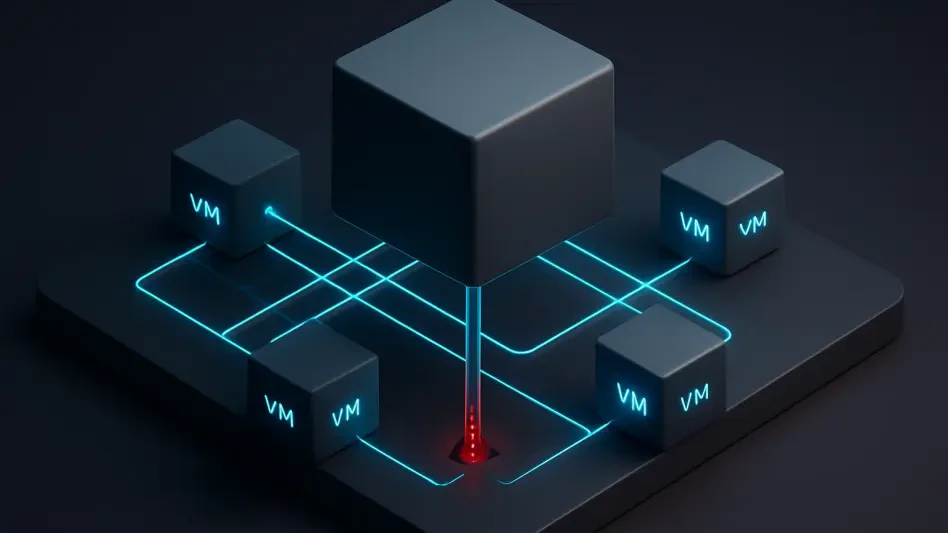
The modern data center relies heavily on virtualization, a technology that isolates workloads into secure virtual machines, with the hypervisor acting as an impenetrable barrier between them. A recent security analysis, however, has unveiled a series of exploitation techniques that challenge this fundamental assumption, particularly within the popular Proxmox Virtual Environment. Dubbed LOLPROX, this research demonstrates how an attacker who gains initial access to a Proxmox host can leverage the system’s own legitimate tools to move laterally, exfiltrate data, and establish persistent control over guest VMs. This “living off the hypervisor” approach is exceptionally dangerous because it allows malicious activities to blend seamlessly with normal administrative tasks, effectively rendering many conventional security monitoring tools blind. By subverting the very platform designed to provide security and isolation, an adversary can turn the trusted hypervisor into a covert command and control center, operating with impunity right under the noses of system administrators.
The Architecture of Invisibility
The core of the vulnerability identified by the LOLPROX analysis stems directly from Proxmox’s unique architectural design, which sets it apart from many proprietary hypervisors. Unlike systems built on specialized microkernels with minimal functionality, Proxmox is based on a full-featured Debian Linux distribution. While this approach offers flexibility and a familiar management environment, it also creates a significantly larger and more complex attack surface. This architectural choice means that an attacker who compromises the host doesn’t just gain control of a limited hypervisor; they gain control of a complete Linux operating system with all its inherent tools and capabilities. This allows them to combine traditional Linux-based privilege escalation techniques with powerful, hypervisor-specific commands. This dual-threat environment is often overlooked by security solutions that are not designed to correlate standard OS-level activities with hypervisor-level actions, creating a critical blind spot that skilled adversaries can exploit to achieve their objectives without raising suspicion.
This fusion of a standard operating system and a hypervisor creates the perfect storm for stealthy exploitation, with the QEMU guest agent emerging as a particularly critical attack vector. When this agent is enabled on a virtual machine to facilitate better host-guest communication and management, it unwittingly opens a powerful and direct channel for compromise. An attacker with control of the Proxmox host can use this channel to execute arbitrary commands directly inside the guest operating system. The execution is remarkably clandestine because it occurs through a dedicated virtual I/O path, completely bypassing the VM’s network stack. As a result, the attack leaves no discernible traces in network logs, firewall entries, or system authentication records, making detection via traditional network-based intrusion detection systems virtually impossible. Furthermore, commands executed through this channel typically run with the highest system-level privileges, giving the attacker immediate and comprehensive control over the compromised virtual machine.
A Fundamental Reassessment of Trust
The findings presented in the LOLPROX analysis necessitated a fundamental reassessment of the trust model applied to virtualized environments. It highlighted that compromising a single Proxmox host could grant an attacker complete and undetected dominion over all the virtual machines it manages, effectively turning a single point of failure into a catastrophic breach. The work, pioneered by security engineer Andy Gill, demonstrated that the hypervisor host should no longer be viewed merely as a foundational platform but as the most critical asset within the infrastructure. This paradigm shift challenged the long-held security practice of focusing primarily on securing the network perimeter of individual VMs. The research concluded that without robust security at the hypervisor level, all guest-level protections could be rendered moot. Organizations were thus urged to consider new defensive strategies, such as disabling the QEMU guest agent where it is not absolutely essential, implementing far stricter access controls and monitoring on the host itself, and exploring advanced security solutions capable of detecting anomalous hypervisor-level activity. This analysis served as a stark reminder that even the most trusted layers of technology require continuous scrutiny and a defense-in-depth approach.