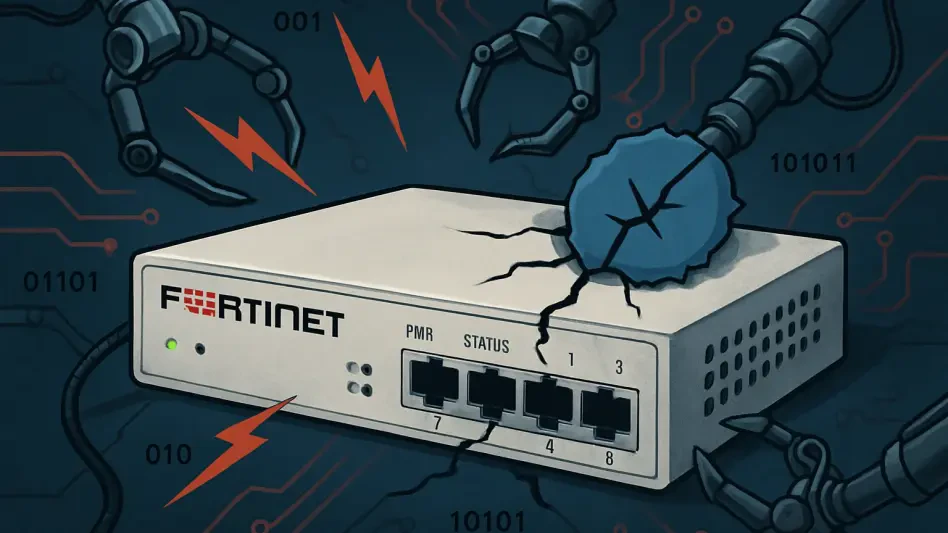
The speed at which cyber threats evolve has fundamentally outpaced traditional defense mechanisms, a reality starkly demonstrated by recent automated campaigns targeting a supposedly patched Fortinet vulnerability. These attacks, which bypass authentication to create rogue accounts and steal firewall configurations, highlight a dangerous escalation in perimeter security threats. This article serves as a crucial frequently asked questions guide, aiming to dissect the nuances of this FortiGate flaw, explain the nature of the automated attacks, and provide clear guidance on how organizations can fortify their defenses against this rapidly emerging threat. Readers can expect to gain a comprehensive understanding of the risks involved and the immediate, actionable steps required to secure their networks.
Key Questions or Key Topics Section
What Is the Core Vulnerability Being Exploited
The central issue is a critical authentication bypass vulnerability identified as CVE-2025-59718, which carries a severity score of 9.8. This flaw resides within Fortinet’s FortiGate firewalls and allows attackers to circumvent security controls without proper credentials. The situation is complicated by the fact that an initial patch was released to address this issue.
However, subsequent investigations and attacks revealed that the first fix, implemented in FortiOS version 7.4.9, did not fully resolve the underlying problem. As a result, even administrators who had applied the patch remained vulnerable. Fortinet has since acknowledged this gap and is preparing to release a new series of updates, including FortiOS 7.4.11, 7.6.6, and 8.0.0, to provide a complete remediation for the security flaw.
How Are Attackers Automating These Breaches
This campaign marks a significant shift from manual hacking efforts toward highly efficient, automated exploitation. Instead of a human operator methodically probing a single target, threat actors are deploying scripts that can scan vast ranges of IP addresses for vulnerable FortiGate devices. Once a target is identified, the automation exploits the flaw, creates a new administrative account, and exfiltrates the entire firewall configuration.
This automated approach dramatically collapses the breach timeline from hours or days down to mere seconds. The sheer speed and scale of these operations mean that human-led response teams are at a fundamental disadvantage, as they often cannot detect and react quickly enough to prevent the initial compromise and data theft. This escalation changes the defensive calculus, demanding automated countermeasures and proactive threat hunting.
Why Is a Stolen Firewall Configuration So Dangerous
A firewall configuration file is far more than just a set of access rules; it is effectively a blueprint of an organization’s entire internal network. Stealing this configuration provides an attacker with an unparalleled strategic advantage, revealing critical intelligence that would otherwise take weeks of reconnaissance to uncover. The configuration details network segmentation, identifies the locations of critical servers, and exposes potential weaknesses in the security architecture.
Moreover, administrators often leave behind descriptive comments, service names, and policy descriptions within these files. This metadata acts as a ready-made map for attackers, pointing them directly toward the most valuable assets, such as financial systems, databases, and domain controllers. With this information, an attacker can plan lateral movement with surgical precision, bypassing defenses and moving silently toward their ultimate objective.
What Are the Immediate Steps for Mitigation
Given the active exploitation, security teams should operate under the assumption that they may have already been compromised and take decisive action. The first priority is to disable FortiCloud SSO, which has been identified as the primary attack vector in this campaign. This should remain off until a fully patched and verified firmware version is installed. Concurrently, teams must actively hunt for known indicators of compromise (IOCs), such as suspicious SSO logins from accounts like [email protected] or the creation of new administrator users with generic names like secadmin or support.
Furthermore, if there is any suspicion that a configuration file was exfiltrated, all credentials stored on the device must be rotated immediately, as attackers can crack exported password hashes offline at their leisure. It is also essential to lock down the management plane by restricting administrative access to internal networks only, eliminating any internet-exposed GUI or API interfaces. Finally, organizations should compare their current configurations against known-good backups to identify any unauthorized changes, such as new rules or modified logging destinations, which could signal attacker persistence.
Summary or Recap
The ongoing attacks against FortiGate devices underscore a critical security reality: a patch is not always a complete solution. The exploitation of the incompletely fixed CVE-2025-59718 vulnerability through high-speed automation presents a formidable challenge. These attacks are not merely about gaining access; they are about stealing the very architectural plans of a network, enabling sophisticated and targeted follow-on intrusions. The danger lies in the speed of the compromise, which effectively neutralizes traditional human-in-the-loop defenses.
Therefore, an effective response requires a multi-layered strategy that goes beyond simple patching. It involves proactively disabling attack surfaces like FortiCloud SSO, diligently hunting for specific indicators of compromise, and hardening management interfaces against external access. The core takeaway is that network defenders must prepare for a landscape where the timeline between vulnerability disclosure and mass exploitation is shrinking, demanding both immediate remediation and a constant state of vigilance.
Conclusion or Final Thoughts
This incident ultimately served as a powerful lesson in the dynamics of modern cybersecurity, where the race between attackers and defenders is measured in minutes, not days. It highlighted that the true measure of security is not just the ability to apply a patch but the capacity to verify its effectiveness and respond decisively when it fails. The attackers’ use of automation to weaponize an incomplete fix demonstrated a tactical agility that many organizations were unprepared to counter.
Organizations were thus compelled to reassess their incident response playbooks and their reliance on vendor assurances. The event reinforced the necessity of a defense-in-depth approach, where configuration integrity monitoring, strict access controls, and proactive threat hunting are not just best practices but essential components of survival. It was a clear signal that in an environment of automated threats, security must be an active, continuous process of adaptation rather than a passive state of compliance.