
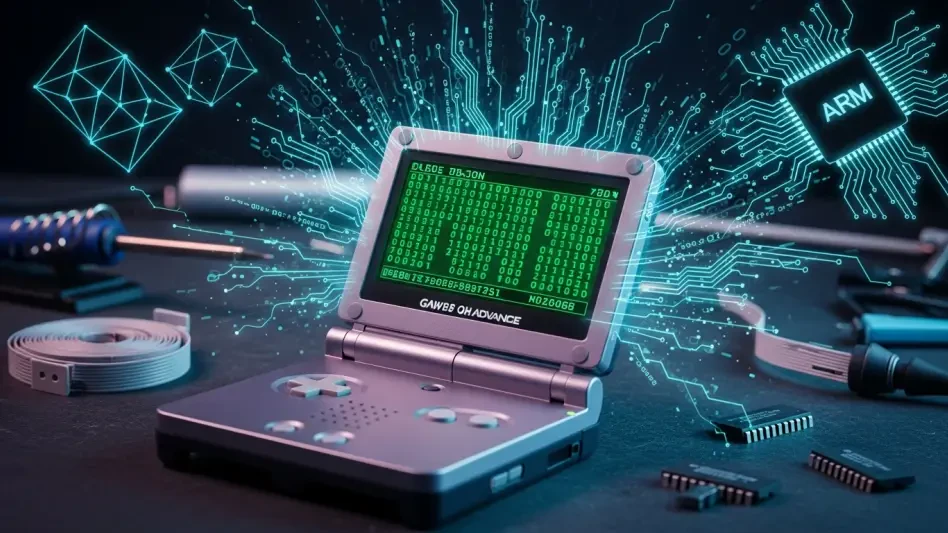
The intersection of vintage gaming hardware and modern cybersecurity tools recently reached a surprising milestone when a dedicated developer successfully ported the industry-standard password recovery utility, Hashcat, to the humble Nintendo Game Boy Advance. While modern iterations of this software typically leverage the massive parallel processing power of high-end graphics cards to crunch billions of hashes per second, this port brings the core functionality to a device released over two decades ago. The project utilized the 32-bit ARM7TDMI processor, which operates at a modest 16.78 MHz, representing a radical departure from the multi-gigahertz environments where Hashcat usually thrives. This endeavor was not merely an exercise in nostalgia but a rigorous exploration of how modern cryptographic algorithms could be stripped down to their most essential mathematical components to function within extremely restricted environments. By targeting the GBA, the developer showcased the inherent versatility of the ARM architecture, which continues to underpin much of the current mobile and embedded landscape even as we navigate the technological advancements of the late 2020s.
Technical Hurdles: Optimizing for the ARM7TDMI Processor
Adapting a codebase designed for high-performance computing to a handheld console required extensive refactoring to accommodate the severe memory and architectural constraints of the Game Boy Advance. The console features only 256 kilobytes of on-board work RAM and 32 kilobytes of internal scratchpad RAM, which meant that the developer had to implement a highly customized version of the hashing algorithms to avoid stack overflows or memory corruption. Furthermore, the absence of a dedicated floating-point unit on the ARM7TDMI meant that all cryptographic operations, such as those used in MD5 or SHA-1, had to be handled using integer arithmetic and bitwise operations. This specific implementation highlighted the importance of low-level optimization, as the developer utilized specialized C compilers and inline assembly code to squeeze every possible cycle out of the aging silicon. These technical choices were necessary to maintain any semblance of performance, as even the simplest hashing tasks required thousands of clock cycles to complete on such limited hardware.
Beyond Novelty: Implications for Embedded Security Research
The completion of this port provided a fascinating case study in the longevity of legacy hardware and its potential utility in unconventional security research scenarios. By successfully running a password recovery tool on a device traditionally used for entertainment, researchers gained valuable insights into how lightweight cryptographic implementations might be deployed on modern ultra-low-power IoT sensors from 2026 through 2028. This experiment proved that even the most resource-constrained chips remained capable of executing complex security tasks if the software was sufficiently tailored to the underlying architecture. The project ultimately served as a blueprint for future endeavors involving the repurposing of discarded electronics for specialized educational tools or decentralized computing nodes. It encouraged a shift toward more sustainable software development practices that prioritized efficiency over raw power, demonstrating that the principles of cryptographic computation remained universal regardless of the age or primary purpose of the processor. This milestone suggested that the boundaries between consumer electronics and professional security auditing tools would continue to blur as developers explored the untapped potential of legacy silicon.