In the intricate and often vulnerable digital ecosystems of higher education, the mere accumulation of advanced security products creates a dangerous illusion of safety. True cyber resilience is not something that can be purchased off a shelf; it is an organizational attribute cultivated through a holistic strategy that intricately weaves together a structured procedural framework, rigorous team practice, and the intelligent optimization of the tools at hand. An effective incident response program is not a static checklist to be completed but rather a dynamic and continuous cycle of meticulous preparation, seamless collaboration, and organizational learning. This approach is what transforms a perpetually reactive defense into a proactive, resilient posture capable of withstanding the sophisticated threats targeting academic institutions today.
The NIST Lifecycle: A Blueprint for Resilience
The Foundation: The Critical Role of Preparation
The foundational bedrock of any successful and mature incident response program is the preparation phase, a concept meticulously outlined within the NIST Incident Response Lifecycle. This critical stage extends far beyond the simple procurement of the latest security software or hardware. It necessitates a deeply strategic investment in the right tools, those specifically tailored to the institution’s unique and often sprawling digital environment, which must then be coupled with comprehensive and continuous training for all members of the response team. A truly vital component of this phase is the execution of thorough tabletop exercises. These are not mere formalities but essential drills that must involve every level of the organization. By bringing individuals from front-line IT staff all the way to executive leadership into the same simulated crisis, an institution ensures that everyone understands their specific roles and responsibilities long before the immense pressure of a real-world incident materializes. This proactive alignment is what separates a chaotic, disjointed reaction from a swift and coordinated defense.
This initial phase is where the hard work is done to make the subsequent response phases manageable, turning potential chaos into a structured, predictable process. Preparation involves a painstaking inventory of all digital assets, a thorough risk assessment to identify the most critical systems and data, and the establishment of clear policies and procedures that govern every potential action. It requires defining clear communication channels, both internally among the technical team, legal counsel, and communications departments, and externally with law enforcement, regulatory bodies, and the public. Furthermore, this stage involves the technical groundwork of hardening systems, implementing robust access controls, and ensuring that security tools like firewalls, intrusion detection systems, and endpoint protection are not only deployed but also properly configured and tuned to the specific network environment. Neglecting this comprehensive preparation is akin to building a fortress without a blueprint; the walls may look strong, but they will inevitably crumble at the first sign of a determined adversary.
From Detection to Improvement: Executing the Response
Once a solid foundation of preparation is in place, the operational cycle of incident response begins with the Detection and Analysis phase. In the complex and high-traffic networks of educational institutions, the primary challenge here is to effectively “separate signal from noise.” This demands the adept use of the institution’s full security toolset—from SIEM platforms to EDR solutions—to sift through a torrent of alerts, logs, and network data to pinpoint genuine threats. The analytical component is crucial; it is not enough to simply detect an anomaly. The response team must rapidly understand the nature and scope of the attack as it unfolds, correlating disparate pieces of information to build a coherent picture of the adversary’s actions. Following this confirmation, the response shifts into the multi-stage process of Containment, Eradication, and Recovery. This is a critical sequence designed first to limit the damage by isolating affected systems, then to completely eliminate the threat from the environment, and finally to restore normal operations while simultaneously mitigating the root vulnerability to prevent a recurrence.
The entire lifecycle culminates in what is arguably its most valuable stage: the Post-Incident Review. This after-action analysis, when conducted properly, is an invaluable learning opportunity that fuels the continuous improvement of the entire security program. The goal is not to assign blame but to conduct an honest, thorough, and transparent analysis of the entire response effort. The team must dissect what went well, what did not, and precisely where processes, tools, or training fell short. Did communication break down between the technical team and leadership? Was a critical system not included in the recovery plan? Were backups validated and found to be viable? The answers to these questions provide the essential insights needed to refine the incident response plan, update security policies, and identify gaps in the technology stack. This iterative nature is the true power of the NIST framework; it transforms every security incident, regardless of its severity, into a lesson that strengthens the preparation for the next inevitable event, making the organization more resilient over time.
Moving from Theory to Reality: People and Technology in Action
Practice Makes Permanent: Building a Coordinated Response Team
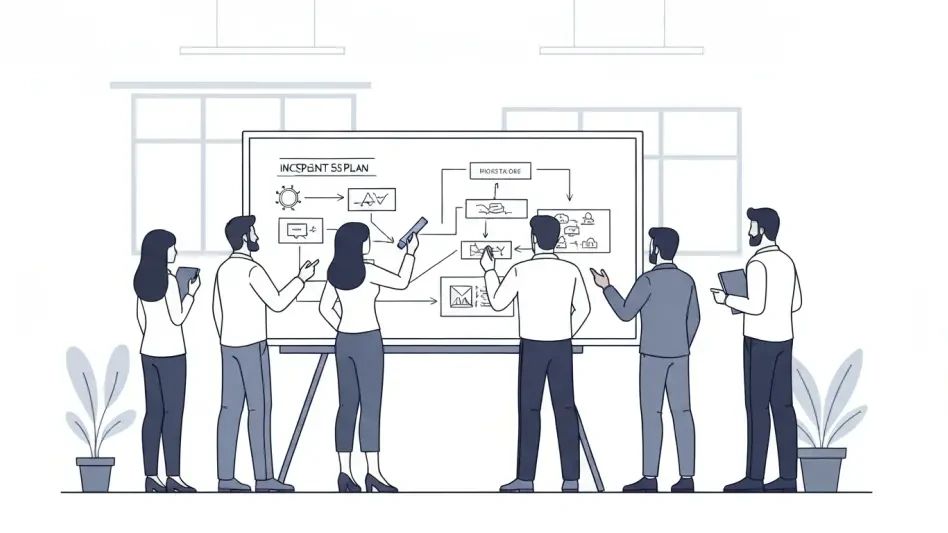
An incident response plan, no matter how detailed or well-written, remains a purely theoretical document until it is tested by the people tasked with executing it under extreme pressure. This is where consistent practice, primarily through realistic tabletop exercises, builds the essential “muscle memory” required for a team to perform effectively during a real crisis. The most impactful of these exercises are those that are highly inclusive, deliberately bringing the technical security team into the same room as key non-technical stakeholders. This includes representatives from legal counsel, who must navigate breach notification laws; communications, who manage the institutional reputation; and executive leadership, who must make critical business decisions. By simulating a high-stakes scenario, such as a widespread ransomware attack that cripples student registration systems during peak enrollment, these disparate groups are forced to confront the complex, interdependent nature of a major cyber incident.
This cross-functional approach to practice serves a vital purpose: it proactively exposes the hidden gaps in communication, coordination, and authority that would otherwise only become devastatingly apparent during a live event. During a simulation, a technical team might discover that their plan to take a critical system offline for containment directly conflicts with the academic mission as understood by the provost’s office. The communications team may realize they lack the technical understanding to accurately convey the situation to the public, while the legal team might identify ambiguities in the response plan regarding when to engage outside counsel. Working through these challenges together in a controlled environment fosters a sense of unified collaboration and builds trust. It allows the entire organization to refine its playbooks, clarify decision-making authority, and ultimately transform the written plan into a reflexive, coordinated, and effective response capability for the whole institution.
Unlocking the Potential of Your Security Arsenal
The mere ownership of advanced security technologies can foster a deceptive and dangerous sense of security within an organization. Experience repeatedly shows that even the most powerful and highly-rated security tools are rendered ineffective if they are not properly configured, meticulously tuned, and actively managed by skilled professionals. A stark and alarmingly common example of this pitfall is the deployment of a sophisticated endpoint detection and response (EDR) solution with its core protective and preventative functions left inactive or in a monitoring-only mode. In such a state, the tool may log malicious activity, but it will not actively block it, making it a passive observer rather than an active defender. This transforms a significant financial investment into little more than an expensive, unused digital asset on the network. This principle applies across the security stack, from misconfigured firewalls to poorly defined data loss prevention policies that are ultimately ignored due to an overwhelming number of false positives.
This imperative for active management becomes even more critical with the integration of artificial intelligence (AI) and machine learning (ML) into modern security operations. While these technologies offer tremendous potential—such as reducing alert fatigue, identifying subtle anomalous behaviors, and automating critical response actions—they come with a non-negotiable prerequisite. AI and ML tools must be painstakingly trained to understand the institution’s unique and constantly shifting baseline of “normal” activity. Without a comprehensive and continuously updated understanding of typical network traffic, application usage, and user behavior patterns, these intelligent systems cannot reliably distinguish between benign and malicious activity. An untrained AI might flag legitimate, large-scale data transfers by a research department as a major exfiltration event or, far worse, a slow and low-profile attack could be incorporated into its understanding of “normal,” effectively rendering the adversary invisible to the very system designed to detect them.
Forging a Culture of Resilience
The institutions that successfully navigated the complex cyber threat landscape had done more than simply acquire technology; they had meticulously invested in building a pervasive culture of continuous improvement. Their success was not rooted in a single product but in the persistent application of a structured framework, a relentless commitment to collaborative practice, and the thoughtful, deliberate leverage of technology as an enabler, not a panacea. This journey toward true cyber resilience was ultimately built upon the solid foundation of comprehensive preparation, the development of cohesive teamwork across departmental silos, and an unwavering organizational commitment to learning from every single experience. It became clear that resilience was not a technological state to be achieved, but an enduring organizational attribute that required constant nurturing.