The cybersecurity landscape recently witnessed a profound escalation in complexity as a massive phishing campaign successfully infiltrated over 13,000 organizations across the globe within a single forty-eight-hour window in April 2026. This operation was not a typical spray-and-pray attempt; it specifically targeted approximately 35,000 users, primarily focusing on corporate entities within the United States but eventually expanding its reach to twenty-six different nations. By utilizing a sophisticated Adversary-in-the-Middle (AiTM) framework, the threat actors demonstrated a high level of technical proficiency that allowed them to circumvent standard multi-factor authentication (MFA) protocols. Unlike traditional phishing that merely steals usernames and passwords, this modern approach intercepts session cookies and authentication tokens in real-time. This effectively permits unauthorized access to sensitive corporate networks without triggering the usual security alerts, leaving security teams struggling to distinguish legitimate logins from fraudulent ones.
The Tactical Evolution of Session Hijacking
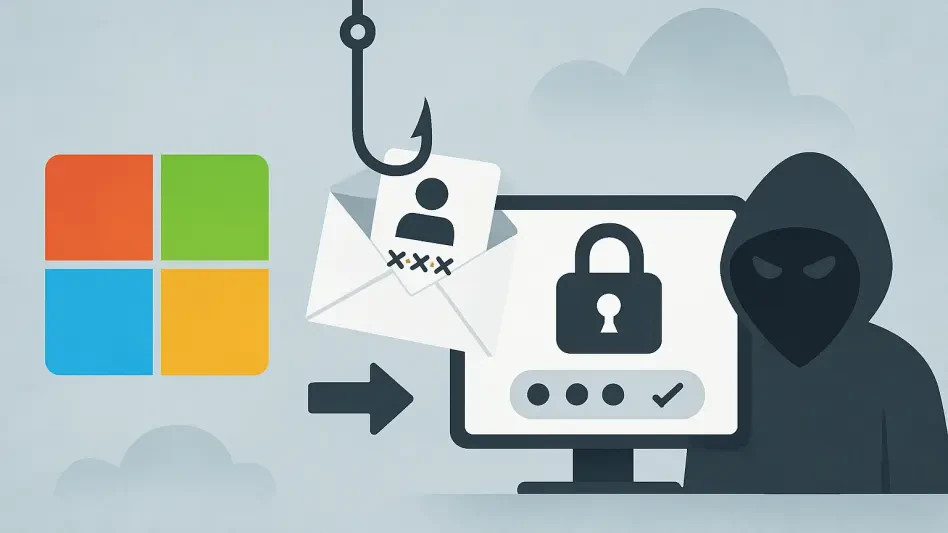
The core of this operation relied on the exploitation of the human-to-server connection through a refined proxy-based architecture that creates a bridge between the victim and the actual service provider. When a user interacts with the fraudulent login page, the attacker’s server acts as a relay, passing the user’s credentials to the legitimate Microsoft portal and simultaneously mirroring the server’s responses back to the user. This bidirectional flow ensures that the victim sees the genuine MFA prompt, enters their code, and successfully completes the login process from their perspective. However, during this exchange, the threat actor captures the session token, which is the digital equivalent of a “golden ticket” that grants persistent access to an account. Because this token represents a validated session, the attacker can then import it into their own browser to impersonate the user, completely bypassing the need for a secondary verification code in subsequent actions within the hijacked environment.
Complementing this technical wizardry was a masterfully crafted psychological layer designed to manipulate the professional instincts of employees at every level of the corporate hierarchy. The campaign utilized highly polished, enterprise-grade HTML templates that mimicked official regulatory and compliance communications, often citing “internal case logs” or “code of conduct reviews.” By framing the messages as urgent legal or HR matters, the attackers induced a state of high-pressure decision-making that often bypassed the critical thinking skills of even seasoned professionals. To further cement this facade of legitimacy, the emails frequently included deceptive security banners and authenticity statements, such as headers falsely claiming encryption via Paubox, a recognized HIPAA-compliant service. This clever integration of established brand trust within a malicious framework significantly lowered the psychological barriers to entry, making the fraudulent emails indistinguishable from legitimate internal administrative notices.
Sophisticated Redirection and Automated Evasion
The operational sequence of this attack featured a multi-stage redirection process specifically engineered to evade modern email security gateways and automated sandboxing technologies. Instead of including a direct link within the email body, which is easily flagged by basic filters, the perpetrators prompted recipients to open a personalized PDF attachment and click a link to “Review Case Materials.” This link directed users to a landing page protected by a Cloudflare CAPTCHA, a defensive tool that paradoxically served the attackers’ interests. By requiring human interaction to solve the challenge, the campaign effectively blocked automated security crawlers and analysis bots from reaching the final payload. For the victim, the presence of a well-known security check like CAPTCHA added a layer of perceived safety, reinforcing the idea that they were entering a secure corporate zone rather than a malicious trap. This inversion of security tools remains one of the most troubling aspects of contemporary phishing designs.
Beyond the initial gateway, the campaign utilized advanced device fingerprinting to tailor the experience based on the victim’s operating system and browser type, ensuring maximum compatibility and realism. Once the user passed the CAPTCHA, they were guided through several staged pages that adjusted dynamically to mimic the specific login environment of their organization. This granular level of detail ensured that the fake Microsoft sign-in portal looked flawless regardless of whether it was viewed on a mobile device or a desktop computer. By capturing login details and session tokens in real-time, the attackers maintained a fluid transition that minimized suspicion. This sophisticated orchestration allowed the threat actors to maintain high conversion rates across diverse technological ecosystems, proving that static defensive perimeters are increasingly insufficient. The ability to adapt the attack surface to the user’s specific context represents a significant leap in the efficacy of credential harvesting operations globally.
Implementing Resilient Security Protocols for the Future
To address these persistent vulnerabilities, security professionals turned toward more robust authentication methods that do not rely solely on interceptable tokens or codes. Transitioning to password-less authentication and hardware-backed keys became the primary defense against session hijacking, as these methods bind the authentication event to a physical device or biometric signature that cannot be easily proxied by a middleman. Many organizations began prioritizing the Microsoft Authenticator app with number matching and location-based alerts to provide users with more context during the sign-in process. Furthermore, refining Exchange Online Protection settings to include aggressive “Safe Links” and “Safe Attachments” policies became essential for catching malicious redirects before they reached the end-user. By integrating these layers, companies moved away from a reliance on human vigilance alone, creating a technical environment where the fundamental mechanics of AiTM attacks were neutralized at the architectural level.
The resolution of this crisis required an integrated approach that combined automated threat disruption with comprehensive employee training programs. Security teams implemented Microsoft Defender XDR to identify and isolate compromised accounts automatically the moment an anomalous session token was used from a foreign IP address. These automated systems successfully terminated suspicious sessions and forced password resets, effectively limiting the window of opportunity for data exfiltration. Simultaneously, organizations conducted realistic phishing simulations that specifically modeled the AiTM techniques observed in the April campaign to sharpen the defensive intuition of their staff. By analyzing the forensic data gathered from these incidents, IT administrators were able to harden their cloud environments against similar incursions. This proactive stance transformed a potential catastrophe into a catalyst for significant security upgrades, ensuring that the lessons learned from this massive phishing operation strengthened the overall resilience of the global digital infrastructure.