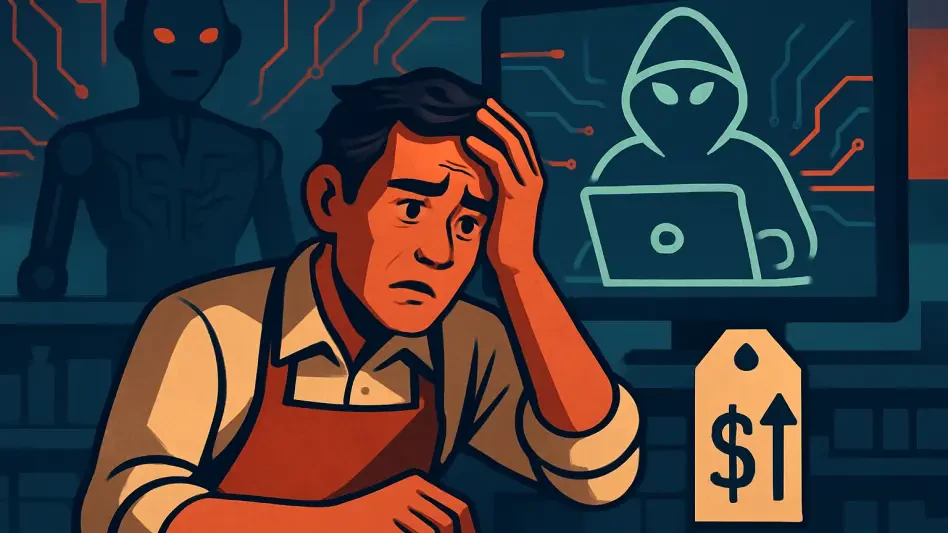
The seemingly unrelated price hike at a local bakery or favorite online shop may actually be a direct consequence of an increasingly sophisticated digital war being waged against small enterprises, creating a hidden tax on consumers. This new economic pressure stems not from supply chain issues or inflation alone, but from the escalating costs of defending against and recovering from advanced cyberattacks, fundamentally altering the financial landscape for Main Street businesses.
Is the Rising Cost of Your Morning Coffee a Hidden Sign of Cybercrime
A recent surge in security incidents has created a direct financial link between digital threats and consumer wallets. When a small business falls victim to a data breach, the recovery costs can be substantial, encompassing everything from system repairs to legal fees. To remain solvent, nearly 38% of businesses that experience a breach have been forced to increase the prices of their goods and services, passing the financial burden of the attack onto their customer base.
This phenomenon illustrates how cybersecurity is no longer a niche IT concern but a significant economic factor impacting everyone. The financial fallout from a single incident can ripple through a local economy, making everyday items more expensive as businesses scramble to cover unforeseen expenses and invest in better defenses.
The New Battlefield Why Small Businesses Are the Primary Target
Contrary to the popular belief that cybercriminals exclusively target large corporations, small businesses have become the new frontline. These enterprises are often seen as softer targets due to having fewer resources dedicated to cybersecurity, yet they possess valuable customer data and financial information. This combination of vulnerability and value makes them an attractive and lucrative target for malicious actors.
The scale of this issue is staggering, with a reported 81% of small businesses experiencing a security or data breach within the last year. Historically, threats often originated from disgruntled insiders, but the landscape has shifted dramatically. External hackers are now the most common cause of these incidents, leveraging powerful new tools to infiltrate networks from the outside.
Deception on Demand How AI Has Become the Hacker’s Most Powerful Weapon
Artificial intelligence is now the weapon of choice for modern cybercriminals, dramatically lowering the barrier to entry for sophisticated attacks. Generative AI tools empower hackers to create hyper-realistic phishing emails, deepfake audio and video, and adaptive malware with unprecedented ease and scale. This technology allows them to replicate the intimate knowledge of internal processes once held only by insiders.
The effectiveness of these methods is alarming, as AI was cited as the root cause in over 41% of successful social engineering attacks. Traditional tell-tale signs of a scam, like poor grammar or awkward phrasing, are now obsolete. AI can craft perfectly tailored, context-aware messages that are nearly indistinguishable from legitimate communications, making deception more potent than ever.
From Data Breach to Your Wallet The Direct Line Between Cyberattacks and Higher Prices
The path from a cyberattack to a price increase is direct and damaging. Following a breach, a business faces a cascade of costs, including forensic investigations, system restoration, potential regulatory fines, and customer notification expenses. Moreover, the long-term reputational damage can lead to lost sales and a diminished customer base, further straining financial resources.
To absorb these crippling financial shocks, raising prices often becomes a matter of survival. These increased operational costs are not abstract figures on a balance sheet; they translate directly into higher price tags for consumers. The cost of cybersecurity failure is ultimately paid by the customer at the checkout counter.
The Human Firewall Redefining Security Training for the AI Era
In this new era, the first line of defense is a well-informed employee. However, traditional security training focused on spotting obvious errors is no longer sufficient. Businesses must now educate their staff to recognize the subtle indicators of AI-generated content, such as visual artifacts in deepfake videos or the lack of emotional nuance in cloned voices.
Fostering a culture of healthy skepticism has become a critical defense strategy. Employees must be empowered and encouraged to verify unusual or urgent requests through secondary channels before taking action. This shift from passive awareness to active verification is essential in building a resilient human firewall capable of withstanding AI-driven deception.