Every business, regardless of size or industry, depends on one thing above all others: the ability to keep operating. When a cyberattack forces systems offline, that ability vanishes, and the financial damage begins accumulating almost immediately. Understanding the true scope of what breach-driven downtime costs is one of the most powerful arguments for taking cybersecurity seriously, not as an IT formality, but as a core business priority.
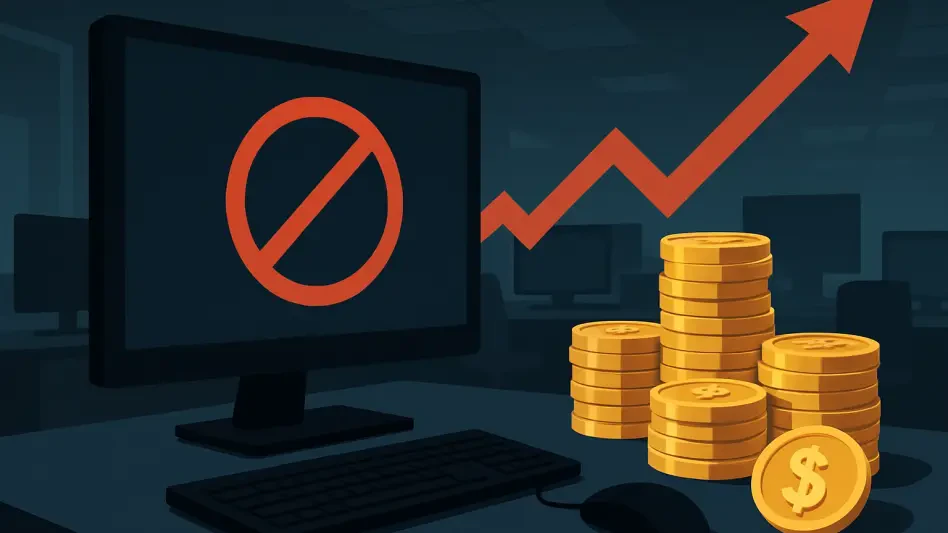
The numbers are striking. Studies tracking downtime across industries have found that operational outages caused by cyberattacks can cost organizations anywhere from $5,600 to over $9,000 per minute. A single afternoon of disruption could easily translate into seven figures of losses before a single remediation bill arrives.
Breach Costs Are Climbing and the U.S. Bears the Brunt
IBM’s annual Cost of a Data Breach Report has tracked this issue for nearly two decades, and its findings paint an increasingly sobering picture. In 2024, the global average cost of a data breach reached an all-time high of $4.88 million, a 10% jump from the prior year. By 2025, that global figure is adjusted to $4.44 million, driven largely by faster detection and containment. But that modest improvement masks a more troubling regional trend.
For U.S.-based organizations, the cost of a breach surged to $10.22 million in 2025. Aggressive regulatory fines, complex state-level notification laws, and escalating class action litigation all drive this premium. For American businesses, a breach is not just a technology problem. It is a legal, financial, and reputational event that can define the trajectory of a company for years.
The broader cybercrime economy provides additional context. The FBI’s Internet Crime Complaint Center recorded over 859,000 cybercrime complaints in 2024. Reported losses exceeded $16 billion, a 33% increase from the prior year. Global cybercrime costs are projected to reach $10.5 trillion annually by 2025, a figure that dwarfs the GDP of most individual nations.
Breaking Down What Downtime Actually Costs
The term “downtime cost” can feel abstract, but it reflects a very concrete set of business losses. When systems go offline, businesses stop generating revenue, serving customers, and operating efficiently. Each of those failures carries a price tag.
Lost revenue is the most immediate impact. During downtime, sales cannot be processed, services cannot be delivered, and transactions that would have occurred simply do not. For e-commerce operations, this can be catastrophic within hours. For industrial firms, research has found that unplanned downtime alone can run as high as $125,000 per hour.
Labor costs add up quickly when employees cannot access the systems they need to do their jobs — from email and internal platforms to customer databases and order processing tools. The Ponemon Institute found that disruption and downtime represent roughly 24% of the total cost of an insider incident, with direct and indirect labor accounting for an additional 18%.
Detection and escalation costs, including forensic investigations, legal consultations, and breach notification processes, averaged $1.63 million per incident in recent studies. Post-breach response activities, such as setting up customer service helplines and providing credit monitoring for affected individuals, added another $1.35 million on average. These figures do not even include the cost of lost business, which averaged $1.47 million separately.
Hidden costs extend the damage further still. Businesses that experience a breach often see their cyber insurance premiums spike in subsequent years. Credit ratings can drop. Regulatory fines and legal settlements may take years to resolve. And the reputational harm can drive customers to competitors in ways that permanently alter a company’s market position.
Real-World Consequences: When Downtime Makes Headlines
High-profile breaches offer a window into what these costs look like in practice. The 2023 MGM Resorts cyberattack generated over $100 million in estimated losses. Nearly $10 million was spent on one-time consulting and cleanup alone, with additional millions lost in revenue during operational downtime across its casino and hotel properties.
In 2024, a ransomware attack on Change Healthcare, a subsidiary of UnitedHealth Group, paralyzed billing and claims processing for hospitals and pharmacies across the United States. UnitedHealth paid a $22 million ransom and has since reported over $1.6 billion in breach-related costs. The attack forced federal intervention and became a defining example of how a breach at one node in a supply chain can ripple across an entire industry.
Healthcare, as a sector, consistently bears the highest per-breach costs of any industry. IBM placed the average healthcare breach at $7.42 million in 2025. This cost is driven by lengthy investigations, steep HIPAA penalties, and the critical nature of hospital operations, where downtime affects not just finances but patient safety. Financial services followed at $5.56 million per breach, with industrial and manufacturing sectors also seeing costs rise sharply, up 18% year-over-year in 2024.
The Detection Gap: Time Is Money
One underappreciated dimension of breach costs is how profoundly the speed of detection affects the final bill. IBM’s research found that breaches with a lifecycle exceeding 200 days cost an average of $5.46 million. Breaches resolved within 200 days cost $4.07 million. That $1.39 million gap reflects the compounding damage of an undetected intrusion: more data exfiltrated, deeper system compromise, and larger remediation efforts.
The good news is that detection is improving. The average breach lifecycle fell from 277 days in 2023 to 258 days in 2024, and further to 241 days in 2025, a nine-year low. Organizations deploying AI-powered security tools are driving much of this improvement. IBM found that companies using security AI and automation identified and contained breaches 80 days faster than those without such tools, achieving cost savings of nearly $1.9 million per incident. This is one of the clearest data-driven cases for investing in modern security infrastructure.
The Human Factor: Your Biggest Vulnerability
Technology alone cannot seal every gap in a security posture. According to Verizon’s breach research, 74% of all data breaches involve some element of human error. This includes stolen credentials, privilege misuse, or social engineering. IBM’s 2024 data confirmed that phishing accounts for nearly 30% of all global breaches, while stolen or compromised credentials featured in approximately 34% of incidents.
This makes employee awareness training not just an HR initiative but a direct financial protection measure. Workers who can recognize phishing attempts, understand proper credential hygiene, and know how to respond when they suspect an incident are a genuine layer of organizational defense. Attackers continue to target human behavior precisely because it often offers an easier entry point than technical vulnerabilities.
Building a Defense That Limits Downtime
The most effective way to manage breach-related downtime costs is to reduce both the likelihood of a successful attack and the time it takes to detect and contain one when it does occur. This is the principle behind a layered cybersecurity strategy. It involves stacking multiple defensive controls so that the failure of any single layer does not create a catastrophic exposure.
Backup and disaster recovery planning is foundational. Ransomware depends on its victims being unable to restore systems without paying. Organizations with tested, current backups and clearly documented recovery procedures can restore operations far faster. This dramatically reduces the revenue impact of an attack.
Continuous network monitoring shortens the detection gap that inflates costs. Real-time visibility into traffic patterns, user behavior, and system health allows security teams to catch anomalies early, before an intrusion becomes a full-scale breach.
Next-generation endpoint protection uses behavioral analysis and machine learning to identify and block threats that traditional signature-based antivirus would miss. As attackers grow more sophisticated, so must the tools used to stop them.
Regular security audits conducted by qualified professionals surface vulnerabilities before attackers do. It is an investment that costs a fraction of what post-breach remediation typically demands.
The Cost of Inaction
Cybersecurity spending can feel like you are spending money on preventing something that may never happen. But the data tells a different story. The average U.S. organization now faces over $10 million in potential losses from a single breach. The Hiscox Cyber Readiness Report found that 43% of businesses lost existing customers following a cyberattack. Consumer trust, once broken by a data exposure, is extraordinarily difficult to rebuild.
Meanwhile, organizations that have invested in security AI and automation are spending nearly $1.9 million less per incident than those without it. Such a number exceeds the entire annual cost of a robust cybersecurity program for many businesses.
The question for business leaders is not whether cybersecurity is worth the investment. The question is whether the cost of prevention is preferable to the far higher cost of a breach. Such a breach can lead to lost revenue, damaged reputation, legal exposure, and operational chaos when systems go dark. The numbers make the answer clear.
Conclusion
The constraint is not awareness of breach costs. Most organizations understand that U.S. breaches average over $10 million and that detection speed drives the cost gap between incidents. The constraint is organizational. It depends on the willingness to fund security infrastructure and backup discipline against other capital priorities
Organizations with detection lifecycles under 200 days save an average of $1.39 million per incident compared to those exceeding that threshold. The gap is not in technology availability, because AI-powered security tools and automated backup solutions are widely accessible. The gap lies in whether security operations report to budget-authorizing leadership and if recovery testing is conducted quarterly or just theoretically. It also depends on whether phishing resistance is actively measured or merely treated as annual compliance training.
Organizations that contain breaches quickly track faster detection, higher employee security compliance, and disaster recovery plans that run smoothly without executive intervention. The market penalizes slow detection through higher insurance premiums, customer churn, and regulatory fines that compound the direct costs of remediation.