
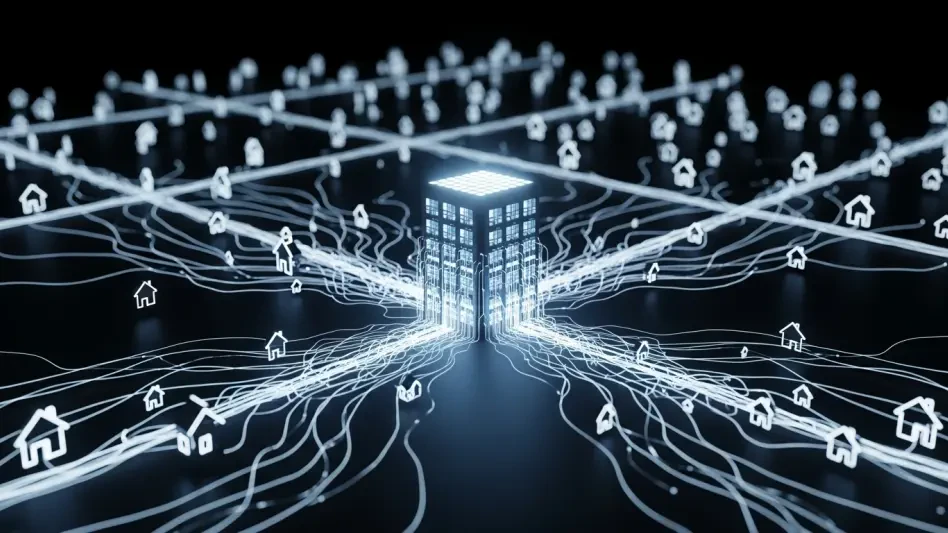
In a digital landscape where anonymity is a commodity, the covert hijacking of millions of everyday internet connections has become the backbone of a sprawling, dual-use industry fueling both legitimate business intelligence and sophisticated cybercrime. Residential Proxy Networks represent a significant advancement in internet anonymity and data access. This review will explore the evolution of this technology, its key features, performance metrics, and the impact it has had on both legitimate and malicious applications. The purpose of this review is to provide a thorough understanding of how these networks operate, their current capabilities, and their potential future development in the face of growing cybersecurity countermeasures.
An Introduction to Residential Proxy Technology
Residential proxy networks operate on a simple yet powerful principle: routing internet traffic through the devices of real, everyday users. Unlike datacenter proxies, which use IP addresses from commercial servers and are easily identifiable, residential proxies leverage the genuine IP addresses assigned to home internet connections. This makes their traffic nearly indistinguishable from that of a legitimate user, allowing them to bypass many security measures designed to block automated activity.
The core of this technology relies on a vast, distributed network of devices—often numbering in the millions—that have been co-opted to act as exit nodes. An intricate back-end infrastructure manages this pool of IPs, rotating them frequently to maintain anonymity and avoid being blacklisted. This model has proven to be a critical tool for any activity requiring a high degree of stealth, fundamentally altering the dynamics of web scraping, market analysis, and, most notably, cybercrime.
Deep Dive into Key Network Components
The IP Sourcing and Hijacking Mechanism
The foundation of any large-scale residential proxy network is its method for acquiring IP addresses. The predominant technique involves embedding Software Development Kits (SDKs) into free mobile or desktop applications. Developers are often paid to include this code, which, once an unsuspecting user installs the application, quietly turns their device into a proxy node. Consent is typically buried deep within lengthy terms of service agreements, making it technically legal but ethically dubious.
This mechanism allows proxy providers to build a massive and geographically diverse pool of IP addresses without owning any physical infrastructure themselves. The user, meanwhile, is often unaware that their device’s bandwidth and digital identity are being rented out. This parasitic relationship raises significant ethical questions about informed consent and the exploitation of user resources for commercial gain.
Command and Control Infrastructure
The Command and Control (C2) infrastructure serves as the central nervous system for the entire proxy network. This complex system of servers is responsible for managing the millions of individual proxy “bots,” handling tasks such as assigning IPs to customers, routing their traffic through the appropriate nodes, and maintaining communication across the network. The C2 architecture is designed for resilience, often distributed globally to avoid a single point of failure.
Because of its critical role, the C2 infrastructure has become the primary target for security researchers and law enforcement agencies aiming to disrupt these networks. By severing the connection between the C2 servers and the proxy bots, security teams can effectively dismantle large portions of a network, as seen in recent high-profile operations. This makes the C2 the most vital and vulnerable component of any residential proxy service.
Emerging Trends and Recent Disruptions
The residential proxy industry has seen explosive growth, driven largely by its adoption among malicious actors. This has triggered a strategic shift within the cybersecurity community, moving from pursuing individual criminals to dismantling the underlying infrastructure that enables their campaigns. Instead of a reactive defense, threat intelligence groups are now proactively collaborating to take down entire networks.
A prime example of this new approach is the recent collaborative operation against the IPIDEA network. By combining legal action with technical disruption of its domain infrastructure, the effort successfully severed a significant portion of its command-and-control capabilities. This marks a turning point, demonstrating that coordinated attacks on the core operational components of proxy networks can inflict substantial and lasting damage.
Applications and Widespread Use Cases
Legitimate Commercial Applications
Despite their notoriety, residential proxy networks serve a range of legitimate commercial purposes. Businesses use them for large-scale web scraping to gather market intelligence, monitor competitor pricing, and analyze consumer trends without being blocked. Similarly, they are essential for search engine optimization (SEO) professionals who need to check search rankings from different geographic locations as a local user would.
Furthermore, companies rely on these networks for ad verification to ensure their advertisements are being displayed correctly and to combat fraudulent clicks that waste marketing budgets. Accessing geo-restricted content for competitive analysis is another key use case. In all these scenarios, the ability to mimic genuine user behavior is paramount, and residential IPs provide a level of authenticity that datacenter proxies cannot match.
Malicious Use by Threat Actors
The overwhelming majority of residential proxy network usage, however, is malicious. Recent intelligence reveals that these networks are a cornerstone of modern cybercrime and state-sponsored espionage. During one seven-day monitoring period of a major network, for instance, traffic from over 550 distinct threat groups was identified, including state-backed actors from several nations.
These threat actors leverage the anonymity of residential IPs to launch large-scale attacks while evading detection. Common malicious applications include password-spraying attacks, where criminals attempt to brute-force access to countless accounts, and obfuscating the origin of intrusions into sensitive cloud and on-premises corporate environments. The proxies act as a cloaking device, making attribution incredibly difficult for defenders.
The Challenges and Limitations of Proxy Networks
The Constant Threat of Takedowns
The primary operational challenge for residential proxy providers is the growing and coordinated opposition from the cybersecurity community and law enforcement. Targeted actions that combine legal injunctions with technical disruptions can effectively cripple a network’s C2 infrastructure and take its domains offline. Such takedowns not only degrade the service but also impose significant, hard-to-recover financial and reputational costs on the operators.
These disruptions ripple throughout the cybercrime ecosystem, affecting every threat actor who relies on that particular proxy service for their campaigns. By attacking the foundational tools, security firms can negate the significant investments made by proxy providers in building their infrastructure and brand, creating a powerful deterrent.
Resilience and the Anonymity Arms Race
Despite these efforts, the residential proxy ecosystem has proven to be remarkably resilient. When one network is disrupted, its customers often migrate to another. The decentralized nature of the proxy bots means that even if C2 servers are taken down, the devices themselves remain available to be co-opted by a new or rebuilt network.
Moreover, the operators of these networks often hide behind complex corporate structures and numerous shell companies, making permanent legal action difficult. This has created a continuous cat-and-mouse game between threat hunters and proxy operators. After a disruption, networks quickly adapt, employing more sophisticated techniques to hide their infrastructure and rebuild their operations, perpetuating the arms race for anonymity.
Future Outlook for the Proxy Industry
The future of the residential proxy industry will be defined by the escalating battle between its operators and the global cybersecurity community. The clear trend is a strategic focus on dismantling the core infrastructure rather than chasing its end-users. This sustained pressure will likely force proxy networks to evolve, becoming more covert, decentralized, and resilient to takedown attempts.
Alongside these technical developments, there will be increasing pressure for new legal and regulatory frameworks. The ethical gray area of IP sourcing through SDKs is a fundamental weakness that could be targeted by consumer protection laws and app store policies. Addressing the root of how these networks acquire their IPs may prove to be a more effective long-term strategy than the current cycle of disruption and adaptation.
Conclusion: An Evolving Threat and a New Defense Strategy
Residential proxy networks are a powerful, dual-use technology whose immense growth has been largely captured and weaponized by malicious actors. The successful, albeit partial, disruption of a major network like IPIDEA marks a significant milestone. It validates a new strategic approach in cybersecurity that prioritizes dismantling foundational criminal infrastructure over pursuing individual perpetrators. The key takeaway is that while these networks are resilient and adaptable, collaborative and sustained efforts to disrupt their core components can inflict meaningful damage. This signals not an end to the fight but the beginning of a long and continuous campaign to raise the cost and complexity for those who abuse these systems.