
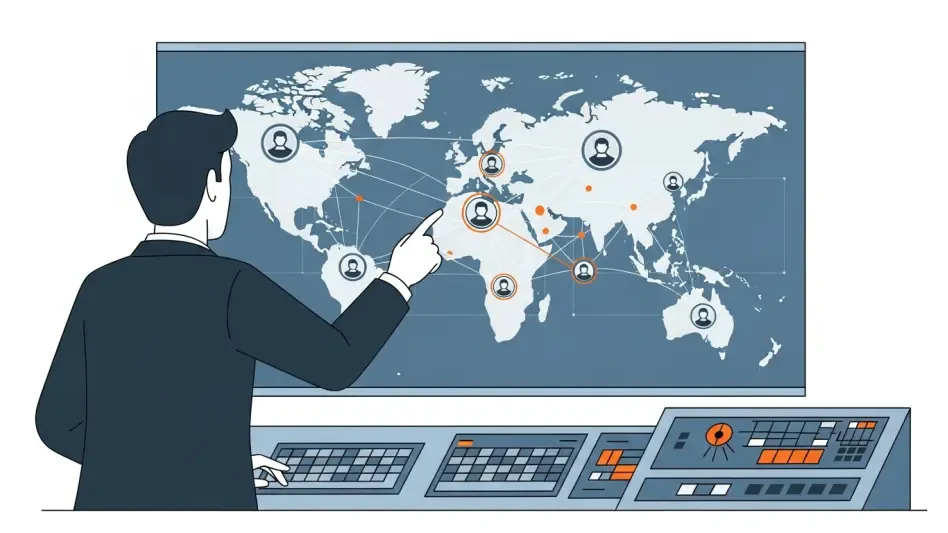
The pervasive shift to remote work has inadvertently opened a new and insidious gateway for foreign adversaries, allowing them to embed operatives within American corporations from thousands of miles away. This is not a theoretical threat but the stark reality of a complex international scheme that saw North Korean IT workers, masquerading as U.S. citizens, gain employment at dozens of tech companies. At the heart of this operation was Oleksandr Didenko, a Ukrainian national recently sentenced to five years in federal prison for masterminding the entire enterprise. The U.S. Department of Justice emphasized that his actions constituted a grave matter of national security, not just a case of elaborate financial fraud. The operation ran for six years, successfully funneling hundreds of thousands of dollars to the North Korean regime. This case serves as a chilling example of how digital anonymity can be weaponized, turning corporate infrastructure into a clandestine source of revenue for a hostile government and placing sensitive information at risk.
The Anatomy of a Sophisticated Fraud Network
The operation masterminded by Oleksandr Didenko was a meticulously constructed web of deceit designed to exploit the trust inherent in the U.S. freelance job market. Through his website, upworksell.com, Didenko sold complete fraudulent identities to North Korean IT specialists. This wasn’t just a matter of creating fake names; Didenko went to great lengths to steal the identities of real U.S. citizens, using them to establish over 2,500 counterfeit accounts on popular IT job platforms, social media sites, and money transfer services. To maintain the illusion that these workers were based in the United States, he managed sophisticated “laptop farms” located in Virginia, Tennessee, and California. These facilities housed computers logged into the fraudulent accounts, effectively spoofing their location and allowing the North Korean operatives to appear as if they were working domestically. At its peak, this network managed as many as 871 active identities simultaneously, successfully placing operatives in roles at approximately 40 U.S. companies and generating a significant stream of income for the DPRK.
From Cybercrime to a National Security Threat
The unraveling of Didenko’s operation began not with a sophisticated cyber-investigation but with a simple package. He sent a computer to a co-conspirator, Christina Chapman, who was running a similar laptop farm in Arizona. Her arrest in May 2024 was the critical break that led authorities directly to Didenko’s digital doorstep and the subsequent seizure of his website. Didenko himself was apprehended in Poland later that year and extradited to the United States to face justice. In November 2025, he pleaded guilty to charges of wire fraud conspiracy and aggravated identity theft. His sentence included the five-year prison term, the forfeiture of over $1.4 million in illicit gains, and nearly $47,000 in restitution. U.S. Attorney Jeanine Pirro starkly defined the stakes, stating the money earned was funneled directly into North Korea’s munitions programs. She described the operatives as “an enemy within,” who were not just earning a salary but actively working to steal sensitive information. This case underscored the persistent and evolving threat posed by North Korea’s use of skilled IT workers as a tool for generating revenue and conducting espionage abroad.