
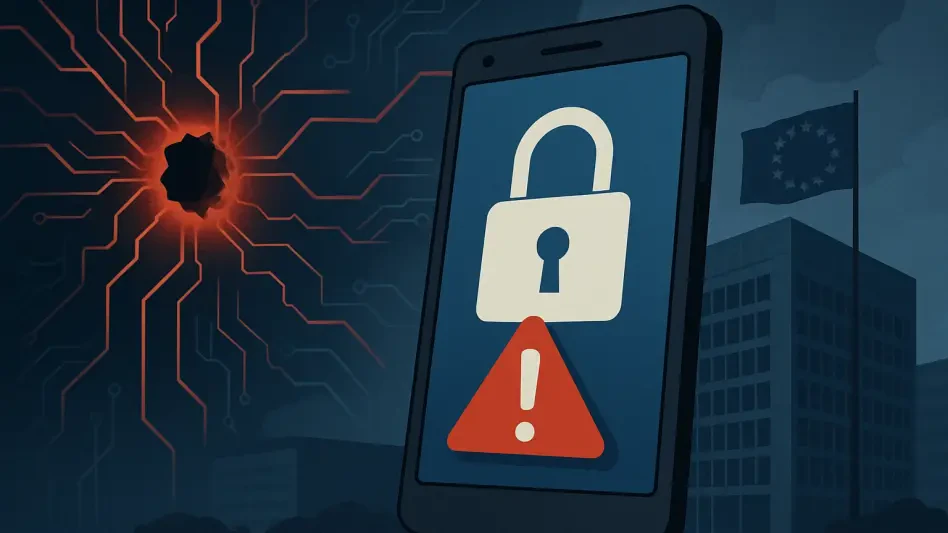
The very software designed to fortify thousands of government mobile devices against intrusion became the unlocked door through which attackers compromised the European Commission’s central command, revealing a critical vulnerability at the heart of its digital infrastructure. This comprehensive analysis of the cyber attack detected on January 30, 2026, reveals a highly targeted intrusion into the Commission’s systems responsible for managing the mobile phones and tablets of its staff. The incident not only potentially exposed sensitive personal details but also laid bare the systemic risks inherent in widely used enterprise software, highlighting the persistent and evolving digital threats faced by major governmental institutions.
When the Watchdog Becomes the Weak Point
At the core of this security incident lies a profound paradox: a tool intended to be a digital guardian became a gateway for malicious actors. The European Commission relies on sophisticated enterprise software to manage and secure the thousands of mobile devices used by its staff, ensuring data integrity and protecting against external threats. This trust in third-party security solutions is a cornerstone of modern IT infrastructure for large organizations. However, when a flaw appears within such a critical component, the entire security posture is jeopardized from the inside out.
The breach stemmed from an unexpected vulnerability within Ivanti’s Endpoint Manager Mobile (EPMM), the platform used to oversee the Commission’s mobile fleet. The timing was critical, with the attack occurring just one day after Ivanti issued a public warning about the flaws. This transformed the software from a protective shield into the single greatest point of failure, allowing threat actors to bypass defenses and strike at the nerve center of the Commission’s mobile operations. This turn of events serves as a stark reminder that even the most robust security strategies can be undermined by a single, exploitable software flaw.
The Digital Frontline
The European Commission is not just another organization; it is a high-value target for a wide range of threat actors, from state-sponsored groups to cybercriminals, due to the sensitive political and economic information it handles. An attack on its infrastructure is an attack on the stability and security of the European Union itself. A compromise of its mobile device management system could expose internal communications, strategic documents, and the personal information of key officials, making the potential for espionage or disruption immense.
This breach occurred with a striking sense of irony, just ten days after the Commission introduced its ambitious new Cybersecurity Act 2.0. This legislative initiative was specifically designed to bolster the EU’s collective resilience against large-scale cyber attacks, demonstrating a high-level political commitment to digital defense. The incident, therefore, became an immediate, real-world test of the EU’s incident response capabilities. It put agencies like the Computer Emergency Response Team for the European Union (CERT-EU) on the frontline, forcing them to react swiftly to a live threat against the very institution they are mandated to protect.
Anatomy of the Breach
The attackers gained entry by exploiting two critical flaws in Ivanti’s EPMM software, identified as CVE-2026-1281 and CVE-2026-1340. These were not minor bugs but severe code injection vulnerabilities, which are among the most dangerous types of software flaws. They allowed a remote, unauthenticated attacker to send a maliciously crafted command to the EPMM server. The system, unable to distinguish the hostile instruction from a legitimate one, processed it, effectively granting the attacker full administrative control without needing credentials. This provided a direct, unobstructed path into the Commission’s mobile device management infrastructure.
In the wake of the intrusion, the Commission and CERT-EU launched a rapid and decisive containment effort. Within a remarkable nine-hour window, the compromised systems were secured and remediated, a testament to the efficiency of their response protocol. Crucially, the investigation determined that while the central management server was breached, the attack did not spread to the individual mobile devices of staff members. This distinction was critical, as it meant the personal phones and tablets remained secure, and the primary damage was limited to the potential exposure of personally identifiable information stored on the central server. The incident was part of a much wider campaign, with government agencies in Finland and the Netherlands reporting similar compromises, and the security watchdog Shadowserver identifying dozens of other vulnerable servers globally.
Expert Voices
Security experts have raised significant concerns, not with the Commission’s response, but with the software vendor’s patch management strategy. David Neeson, Deputy SOC Team Lead at Barrier Networks, criticized what he termed a “fragmented approach” to fixing the vulnerabilities. Instead of a single, comprehensive update, Ivanti issued temporary, version-specific patches while a permanent solution was developed. Neeson warned that such temporary fixes carry inherent risks, as they can be inadvertently reverted during subsequent software updates, leaving systems exposed once again. For flaws of this severity, a more immediate and all-encompassing solution is expected.
The speed and precision of the attack suggest it was a targeted, politically motivated strike. Neeson speculated that the threat actors moved quickly to exploit the vulnerability before the Commission could fully apply the available patches. The fact that only a limited number of high-profile governmental bodies were hit, rather than a wide-scale, indiscriminate attack, points toward a sophisticated adversary with specific objectives. This pattern of targeting prominent institutions underscores the geopolitical dimension of cybersecurity, where governmental agencies are prime targets for espionage and disruption.
Fortifying the Defenses
In the aftermath of this breach, the immediate imperative for all at-risk organizations is clear: patch vulnerable systems without delay. Government agencies across the European Union and globally that utilize Ivanti EPMM must prioritize the application of the vendor’s security updates to close this critical entry point. Procrastination is not an option when facing active exploitation by sophisticated threat actors who are systematically scanning for unpatched servers.
Beyond immediate patching, organizations must engage in proactive threat hunting to search for signs of a prior compromise. To aid this effort, Ivanti released a specific detection tool designed to help customers identify signs of exploitation on their EPMM systems. This tool, used in conjunction with standard security protocols, provides a vital layer of verification. Ultimately, this incident should have prompted a full review of security architecture to identify and remediate any other potential gaps. Relying solely on a single vendor for a critical security function without sufficient oversight and redundancy proved to be a significant risk. This breach was a powerful lesson in the necessity of a defense-in-depth strategy, where multiple layers of security work together to protect an organization’s most valuable digital assets.