
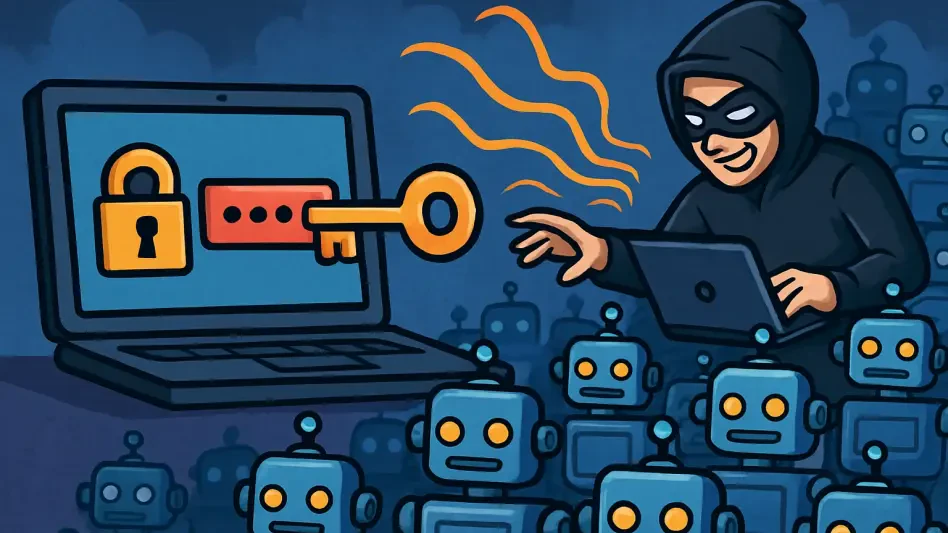
The seemingly insignificant act of choosing a simple, guessable password for a server can inadvertently hand over the keys to an entire digital infrastructure, transforming a trusted asset into a clandestine operative working for a sophisticated cybercrime syndicate. This exact scenario unfolded at a UK construction firm in January, when security experts from the eSentire Threat Response Unit (TRU) uncovered a deeply embedded botnet that had turned the company’s server into a pawn in a global criminal enterprise. The breach highlights a critical reality: the most complex cyber threats often exploit the most basic human errors.
What if the Key to Your Entire Digital Kingdom Was a Single, Easily Guessed Word, and the Thief Who Found it Was Not Just Stealing Your Valuables, but Changing the Locks to Keep Everyone Else out?
The initial point of entry for this sophisticated attack was shockingly simple. Attackers gained access to the firm’s Windows Server through the Remote Desktop Protocol (RDP), a common tool for remote administration. They did not need to deploy a cutting-edge exploit; instead, they likely just guessed weak or default login credentials. This trivial oversight acted as an open invitation, allowing the malicious actors to walk straight through the front door.
Once inside, the threat actors did not just pilfer data. They began a methodical process of fortification, ensuring their newfound access was both persistent and exclusive. The incident serves as a stark reminder that in cybersecurity, the strength of an entire network is often determined by its most vulnerable access point. A single weak password can negate millions of dollars invested in advanced security hardware and software, proving that the human element remains a crucial line of defense.
The New Currency of Cybercrime Why Your Computers Power is a Prime Target
The primary objective of the botnet, identified as Prometei, was not traditional data theft but the hijacking of computational resources. Active since 2016 and linked to Russian-speaking actors, Prometei’s main function is the covert mining of the cryptocurrency Monero. Unlike overt ransomware attacks, this type of malware operates in the shadows, quietly siphoning a system’s processing power to generate revenue for its operators.
This strategy represents a significant shift in cybercriminal motives. By harnessing the collective power of thousands of infected machines, botnet operators can create a distributed supercomputer dedicated to profitable, and often untraceable, cryptocurrency mining. The compromised systems suffer from degraded performance and increased operational costs, while the owners remain oblivious that their hardware is funding a criminal network. Consequently, every server and computer with an internet connection becomes a potential revenue source, and therefore, a target.
Anatomy of an Intrusion Deconstructing the Prometei Botnet
Upon gaining entry, Prometei deploys a multifaceted toolkit designed for stealth and persistence. It first installs a service named UPlugPlay and a file, sqhost.exe, to ensure it automatically launches whenever the system reboots. The malware then downloads its main encrypted payload, zsvc.exe, which contains the core components for its malicious operations, including password theft and remote control capabilities.
To expand its foothold, the botnet utilizes a modified version of the credential-stealing tool Mimikatz, disguised as miWalk, to harvest passwords from the compromised machine and spread across the network. To conceal its command-and-control communications, Prometei cleverly routes all its traffic through the TOR network, making its activities exceptionally difficult to trace. This layered approach demonstrates a high level of sophistication aimed at maintaining long-term control over the infected asset.
A Jealous Tenant Expert Analysis on a Botnet That Defends Its Turf
A unique characteristic of the Prometei botnet is its territorial nature. Security researchers have described it as a “jealous tenant” because it actively works to secure the compromised system against other potential attackers. It deploys a tool named netdefender.exe that blocks common ports and patches vulnerabilities that other malware might exploit, effectively locking the door behind it.
This defensive behavior is a shrewd tactic. By hardening the system, the botnet ensures its exclusive access to the machine’s resources for its cryptocurrency mining operations, eliminating competition from other cybercriminals. Moreover, Prometei employs clever evasion techniques, such as searching for a specific file (mshlpda32.dll) before unpacking its malicious code. If the file is absent, a sign it might be in a security analyst’s sandbox, it executes harmless decoy tasks to mislead investigators, further cementing its resilient and crafty design.
Bolting the Digital Door Practical Steps to Prevent a Takeover
The investigation into the Prometei infection revealed that while the malware is complex, its initial success hinged on a preventable security lapse. The most effective defense against such threats begins with fundamental security hygiene. Replacing all default and weak passwords with long, complex, and unique alternatives is the single most critical step an organization can take.
Furthermore, implementing multi-factor authentication (MFA) provides a vital additional layer of security, requiring a second form of verification beyond just a password. This measure can thwart unauthorized access attempts even if credentials are stolen or guessed. Finally, maintaining up-to-date software and applying security patches promptly closes the vulnerabilities that malware often exploits to enter or move across a network. These foundational practices form a robust defense, proving that proactive security is the best strategy against opportunistic threats.