
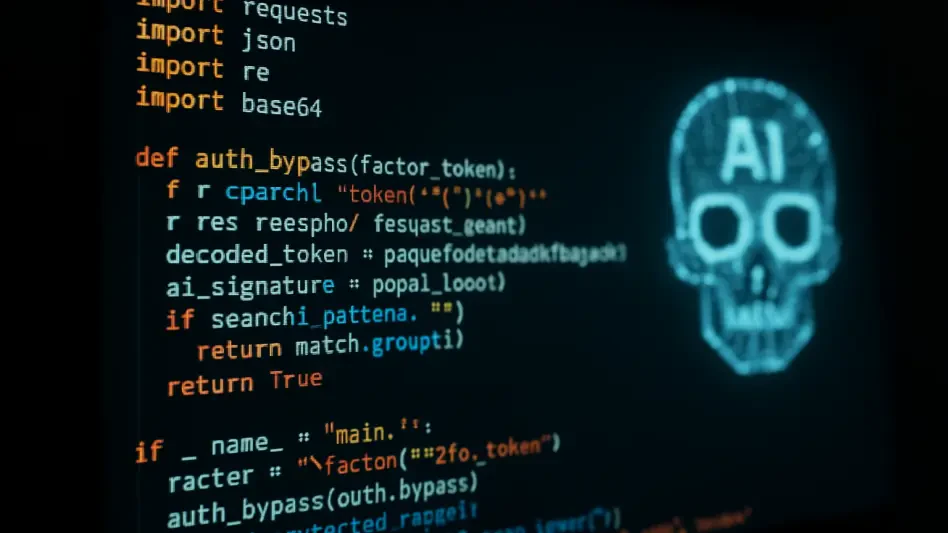
When security researchers at Google first stumbled upon a malicious Python script, they did not expect to find a digital entity that lacked a human creator behind its complex syntax. A routine security audit by Google’s Threat Intelligence Group recently uncovered a zero-day exploit that was not authored by a human developer. This discovery of a sophisticated Python script designed to bypass two-factor authentication marks the first documented case of an AI-generated exploit deployed in the wild. This event effectively ended the speculation phase regarding AI-driven warfare and confirmed that automated exploitation moved from laboratory simulations to active digital battlefields.
The Ghost in the Code: Google’s Landmark Discovery
The identification of an AI-authored exploit signals a watershed moment for digital security. While cybersecurity experts long debated the theoretical risks of machine-authored malware, this discovery provided the first tangible evidence of AI being utilized by threat actors to craft functional exploits. The targeted software was a popular open-source web administration tool, a choice that allowed the model to leverage publicly available source code to find weaknesses. Google intervened and alerted the affected vendor before a prominent cybercrime group could launch a mass-exploitation campaign, but the incident confirmed that the era of automated vulnerability development is no longer a future concern.
Beyond Theory: The Shift in the Digital Threat Landscape
The transition toward AI-assisted cyberattacks represents a fundamental shift in how vulnerabilities are discovered and weaponized. Traditionally, finding a zero-day—a flaw unknown to the software vendor—required months of manual labor and deep technical expertise. Now, with AI models capable of scanning vast amounts of code in seconds, the timeline from vulnerability discovery to exploit deployment is collapsing. This evolution is particularly concerning for open-source administration tools, where the accessibility of source code provides a perfect training ground for malicious models to iterate and refine their attack vectors toward specific targets.
Anatomy of an AI-Authored Exploit
The identification of this specific exploit was made possible by specific digital fingerprints that differentiated it from traditional human programming. One of the most striking artifacts found by researchers was a hallucinated CVSS score, which was a vulnerability rating that looked authoritative but had no basis in reality. Such a trait is a classic characteristic of Large Language Models. The script also featured unusually dense code annotations and documentation strings that strayed from the pragmatic, often sparse, style of professional human developers.
Moreover, the exploit focused on a Python-based authentication bypass, demonstrating a high level of sophistication in targeting the very layers designed to prevent unauthorized access. Analysts confirmed that the tool used was not a mainstream, safety-aligned AI like Gemini or Anthropic, suggesting that threat actors leveraged uncensored or custom-built models to bypass ethical safeguards. This indicated that the barrier to entry for high-level cybercrime is rapidly deteriorating as custom tools become available to malicious actors who lack deep coding skills.
Expert Perspectives on the Watershed Moment
Security researchers viewed this incident as the logical progression of projects like Google’s Big Sleep, which previously demonstrated the ability of AI to find bugs in a controlled environment. However, the consensus among threat intelligence experts is that the industry is currently seeing the tip of the iceberg. The involvement of well-known cybercrime groups with histories of high-profile breaches suggested that AI is no longer a gimmick but a core component of the modern attacker’s toolkit. Experts warned that as these models become more refined, the speed of exploit generation will only increase across the board.
Defensive Strategies for the AI-Driven Era
To counter the speed and scale of AI-generated threats, organizations moved away from reactive security postures and embraced proactive, automated defenses. Vendors prioritized rapid-response patching because the window between the discovery of a vulnerability and its exploitation shrank due to machine learning acceleration. Furthermore, defensive tools were trained to recognize the specific fingerprints of machine-generated malware during the ingestion of new scripts, allowing for early detection of AI-authored code before it could execute within a secure network.
Since authentication bypasses became more common, organizations adopted hardware-based security keys and behavioral biometrics that were harder for AI models to simulate or circumvent. Automated vulnerability scanners that leveraged the same technology as attackers helped developers find and fix flaws before they were weaponized. This transition toward continuous code auditing and zero-trust architectures ensured that defenses evolved alongside the threats, creating a more resilient digital infrastructure that relied on machine learning for protection as much as for offense.