
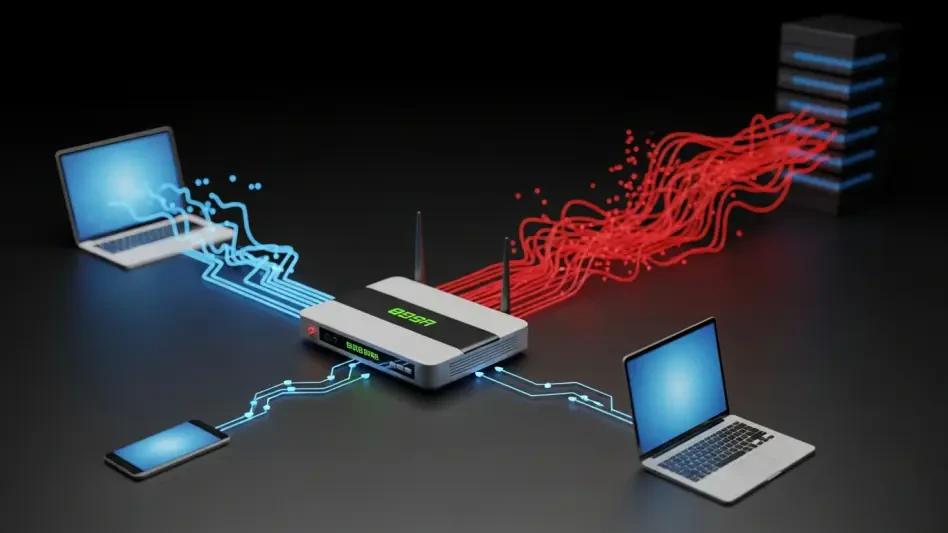
An insidious threat is quietly turning millions of home networks into unwitting participants in a global scheme, redirecting personal web traffic through a shadowy infrastructure for criminal profit. This research illuminates a widespread Domain Name System (DNS) hijacking campaign that compromises outdated home routers, a foundational piece of technology often overlooked by consumers. The study confronts the challenge of how threat actors exploit these consumer hardware vulnerabilities at the network level, impacting every connected device—from smartphones to laptops—entirely without the user’s knowledge.
The campaign’s success hinges on a silent, fundamental compromise. By targeting routers that no longer receive security updates, attackers gain a persistent foothold inside the home network. This access allows them to alter the router’s DNS settings, effectively seizing control over how the internet is accessed by everyone in the household. Consequently, what appears to be normal web browsing is, in reality, a carefully manipulated journey designed to generate revenue for the attackers.
The Critical Vulnerability of Consumer Networking Hardware
The Domain Name System acts as the internet’s phonebook, translating human-readable website names like “example.com” into machine-readable IP addresses. Control over this process grants an attacker immense power to dictate where a user’s traffic goes. Older routers, often left unpatched and forgotten after installation, represent a significant security blind spot. Their outdated firmware contains known vulnerabilities that cybercriminals can easily exploit, making them low-hanging fruit for large-scale attacks.
This research gains importance by exposing the sophisticated and widespread attack infrastructure operated by a sanctioned entity. The findings reveal a direct link between compromised home routers and servers hosted by Aeza International, a Russian bulletproof hosting provider. This connection highlights not only the technical execution of the attack but also its geopolitical implications, underscoring the urgent need for consumer awareness and the critical task of replacing obsolete hardware.
Research Methodology, Findings, and Implications
Methodology
The investigation to uncover this campaign involved a multi-faceted approach. Researchers began by employing extensive network traffic analysis to detect anomalous patterns indicative of DNS manipulation. This process included the careful tracking of malicious DNS queries originating from compromised devices.
Subsequent steps focused on mapping the attackers’ complex infrastructure. This effort traced the path of the hijacked traffic from the initial point of compromise—the home router—all the way to its final malicious destinations. By connecting these digital dots, the study successfully reverse-engineered the entire monetization scheme.
Findings
The primary discovery is the systematic method attackers use to seize and monetize traffic. After gaining control of a vulnerable router, they reconfigure its DNS settings to point to servers under their command, specifically those hosted by Aeza International. From there, all web traffic is funneled into a two-stage Traffic Distribution System (TDS).
This TDS first verifies that the incoming request is from a genuinely compromised device before routing it through a labyrinth of advertising and affiliate networks. The ultimate goal is to redirect the user to deceptive websites, including phishing pages and malware droppers, which generates illicit revenue for the operators at every step.
Implications
For the victims, the consequences of this compromise are severe and varied. Users are unknowingly exposed to a host of digital threats, ranging from deceptive advertising and phishing schemes to potential malware infections and financial fraud. The attack preys on the trust users place in their own home networks.
These findings also underscore a systemic risk posed by the proliferation of insecure Internet of Things (IoT) devices. Because the compromise occurs at the network’s core, it is exceptionally difficult for non-technical users to detect or mitigate. This highlights a fundamental gap in consumer cybersecurity defenses, where the router—the gateway to the internet—is often the weakest link.
Reflection and Future Directions
Reflection
Uncovering a network-level attack of this nature presented significant challenges, largely because its execution is designed to be invisible to the end-user. From the victim’s perspective, web browsing appears normal, with no obvious signs of interference. This stealthiness illustrates a major blind spot in consumer cybersecurity: the pervasive and incorrect assumption that a home router is a “set it and forget it” device that is inherently secure and requires no ongoing maintenance.
The study serves as a powerful reminder that the foundation of a secure home network rests on modern, supported hardware. The quiet and persistent nature of this DNS hijacking campaign demonstrates that attackers are actively exploiting the long lifecycle of consumer electronics, turning a device meant to provide connectivity into a tool for mass exploitation.
Future Directions
Further investigation is needed to identify other threat actors who may be employing similar tactics to hijack consumer-grade networking equipment. The development of simplified, user-friendly tools that allow consumers to easily check the integrity of their router’s DNS settings would also be a valuable step toward mitigation.
Moreover, this research points to a broader industry problem. There is a pressing need for manufacturers to establish new standards for longer-term security update support for networking hardware. Extending the security lifecycle of these essential devices is crucial to protect consumers from becoming easy targets for years after their purchase.
The Imperative of Modernizing Home Security
The key takeaway from this research is unequivocal: outdated and unpatched home routers are a primary and actively exploited gateway for cybercriminals. The silent and pervasive nature of DNS hijacking makes it a formidable threat, as it compromises the very foundation of a user’s internet access without raising obvious alarms. The campaign detailed in this study is not an isolated incident but a symptom of a larger, systemic vulnerability within millions of homes.
Ultimately, the findings confirm that the only truly effective mitigation for consumers is the replacement of obsolete hardware with modern devices that receive regular security updates from the manufacturer. This research serves as a critical warning, reframing the home router not as a simple utility but as an essential piece of security infrastructure. It is a clear call for greater consumer vigilance and increased manufacturer responsibility in securing the digital home.