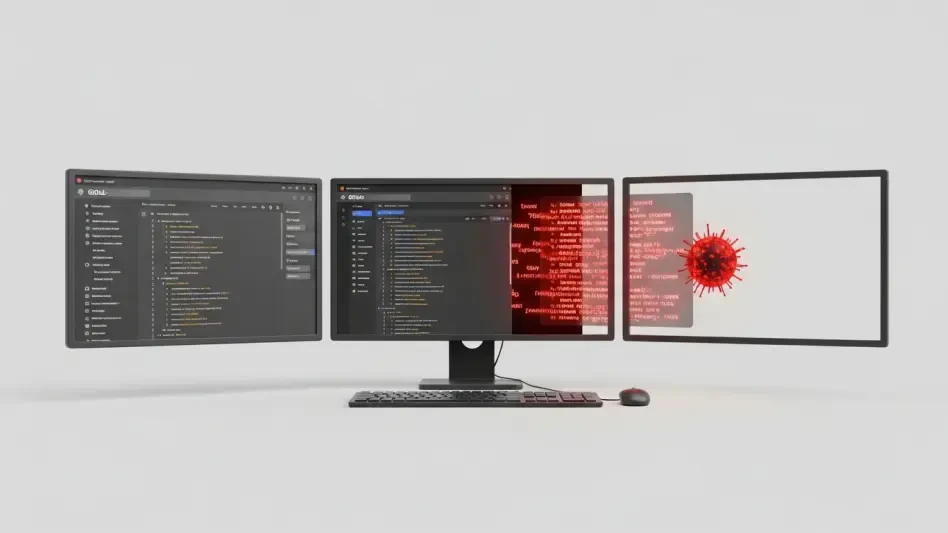

The modern threat landscape is witnessing the emergence of highly specialized malware that eschews rapid financial returns in favor of establishing an unbreakable presence within sensitive network environments. CrySome RAT, a sophisticated tool developed using the .NET framework in C#, exemplifies this shift by prioritizing deep system infiltration and long-term surveillance over immediate data exfiltration. Unlike conventional Remote Access Trojans that often rely on standard installation paths, this malware creates a robust command-and-control (C2) channel via TCP, granting attackers invisible, real-time management capabilities over infected Windows machines. The appearance of such a threat highlights a dangerous trend toward modularity and resilience, where the primary objective is to maintain a persistent foothold that can survive even the most rigorous security audits and remediation efforts.
Architectural Overview and Host Profiling
Initial Infection and Automated Data Gathering
The architectural design of CrySome follows a highly modular philosophy that allows the initial payload to maintain a surprisingly small footprint, thereby reducing the likelihood of immediate detection by automated security monitors. During the initial bootstrap phase, the malware loads its primary configuration settings and initiates a secure handshake with its remote C2 server to receive further instructions or specialized plugins. This strategy ensures that the threat actors do not expose their full arsenal of tools during the first stage of the infection; instead, they can deploy specific capabilities only when the target is deemed valuable enough to warrant higher risk. By remaining lightweight and adaptable, the malware can easily bypass many traditional perimeter defenses that are tuned to look for larger, more complex executable files during the ingress phase of a cyberattack.
Once the connection to the command-and-control infrastructure is successfully established, the RAT immediately pivots to a comprehensive profiling stage to provide the attacker with situational awareness. It gathers a detailed telemetry packet that includes standard system identifiers, geographic location markers based on IP data, and system uptime to gauge the stability of the infection. A particularly intrusive feature is its ability to capture the title of the currently active window, which allows the remote operator to understand the victim’s current activities and priorities in real-time. This level of contextual intelligence is crucial for post-exploitation activities, as it enables the attacker to wait for the perfect moment to execute sensitive commands, such as when a user is logged into a corporate database or a financial portal.
Technical Persistence Through Partition Manipulation
What truly distinguishes CrySome from contemporary malware is its technical ability to subvert the standard Windows recovery process to ensure its own survival. While most malicious software resides in standard directories or temporary folders that are wiped during a factory reset, CrySome specifically targets the Windows recovery partition located at C:\Recovery\OEM. By embedding its binary into this protected area and modifying the offline registry hives used during the restoration process, the malware effectively turns the operating system’s own hygiene tools into a delivery mechanism. When a user or an IT professional attempts to “clean” the system by performing a factory reset, the recovery environment pulls the infected files from the OEM partition, essentially reinstalling the malware alongside the fresh operating system.
This level of engineering sophistication places CrySome in a category of threats typically associated with advanced persistent threats (APTs) rather than common cybercrime. The manipulation of the offline registry is a particularly clever tactic, as it allows the malware to set its own execution triggers before the primary operating system is even fully booted for the first time after a reset. For organizations relying on the “wipe and reload” strategy as a standard response to compromise, this capability presents a nightmare scenario where traditional remediation proves completely ineffective. To combat this, security teams must move beyond surface-level cleaning and begin incorporating deep forensic audits of recovery partitions and hidden system volumes into their standard incident response protocols to ensure a truly clean state.
Defensive Neutralization and Operational Reach
The AVKiller Module and Advanced Evasion Techniques
To protect its presence on the host, CrySome employs an aggressive defense evasion suite known as the AVKiller module, which is designed to hunt and dismantle security software. This module utilizes parallel execution threads to constantly monitor the system for processes belonging to major security vendors, including Windows Defender, CrowdStrike, and Kaspersky. As soon as a recognized security process attempts to initialize, the malware terminates it, preventing the defensive software from ever reaching a functional state or alerting the user. This “search and destroy” approach is far more proactive than simple obfuscation, as it seeks to create a vacuum where the malware can operate without any local oversight, effectively blinding the endpoint’s primary lines of defense.
Beyond simple process termination, CrySome hijacks the Image File Execution Options (IFEO) within the Windows registry to create a more permanent form of software suppression. By assigning a fake “debugger” to the executables of various security tools, the malware ensures that any attempt to launch these applications redirects the execution to a harmless command that does nothing. Furthermore, the RAT poisons the local Windows hosts file by redirecting antivirus update domains to a loopback address, which prevents any remaining security components from downloading the latest threat signatures or connecting to cloud-based detection engines. These multi-layered evasion techniques ensure that the system remains vulnerable even if the user notices suspicious behavior and tries to manually run a scan or install new protective software.
Operational Capabilities and Data Exfiltration Framework
With the host’s defenses thoroughly neutralized, CrySome functions as a comprehensive operational framework that provides attackers with an array of tools for long-term espionage. One of its most potent features is Hidden Virtual Network Computing (HVNC), which allows a remote operator to open a completely invisible desktop session. Within this hidden environment, the attacker can navigate files, open web browsers, and execute commands without any visual indicators appearing on the victim’s physical monitor. This capability is particularly dangerous because it allows for the manipulation of the system while the user is actively working, making it nearly impossible to detect through visual observation of system behavior or desktop anomalies.
In addition to its stealthy remote access, the RAT includes specialized modules for harvesting sensitive data, such as credentials stored in Chromium-based browsers and detailed keystroke logs. It also supports SOCKS proxy functionality, which enables the attacker to use the infected machine as a pivot point to tunnel deeper into the victim’s internal network. This lateral movement capability transforms a single compromised workstation into a gateway for attacking internal servers, databases, and other high-value assets that are not directly exposed to the internet. Because the malware can maintain this level of control indefinitely through its recovery partition persistence, it represents a significant long-term risk to the integrity of the entire corporate infrastructure, requiring a fundamental shift in how organizations perceive and mitigate persistent threats.
The discovery of CrySome RAT necessitated a significant departure from traditional “wipe and reload” remediation strategies that have long been the industry standard. Effective defense against this level of sophistication required the implementation of platform-level tamper protection and the use of behavioral endpoint detection and response (EDR) tools that monitor registry and partition modifications in real-time. Security professionals realized that simply checking for file signatures was no longer sufficient when the malware was capable of blinding the very tools designed to find it. Moving forward, the industry adopted more rigorous forensic auditing of system recovery environments and isolated recovery partitions as a mandatory step in the cleanup process. This proactive approach, combined with strict application control policies and network-level filtering of known command-and-control domains, provided the necessary framework to neutralize the threat. The shift toward securing the foundational elements of the operating system, rather than just the active user environment, became the cornerstone of modern endpoint security architecture.