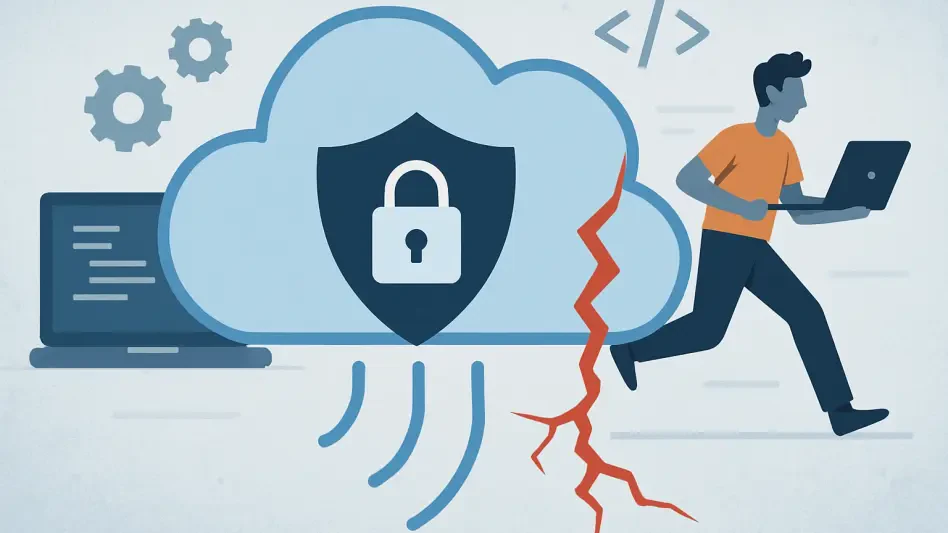
A critical disconnect has emerged within modern enterprise technology, where the blistering speed of cloud-native development is consistently outpacing the capabilities of the security frameworks designed to protect it. This growing chasm places security teams in a perpetually reactive posture, constantly struggling to contend with the sheer velocity of innovation, the increasing intricacy of cloud architectures, and the escalating sophistication of malicious actors. As organizations embrace complex multi-cloud and hybrid infrastructures as the new standard, security controls are frequently seen as impediments to be bypassed rather than essential guardrails, leading to a landscape where vulnerabilities are deployed into production at an alarming rate. The core of the issue lies not in a lack of tools, but in the fundamental misalignment between the agile, continuous nature of development and the often rigid, slower-paced processes of traditional security, creating a significant and widening gap between operational speed and effective protective measures.
The Widening Chasm Between Development and Defense
The modern production environment has become a complex tapestry of virtual machines, containers, and serverless functions spread across multiple cloud providers and on-premise data centers, creating an operational labyrinth that has become a primary source of risk. This architectural complexity is compounded by a dramatic acceleration in software development cycles, with weekly or even daily deployments becoming the norm. The rise of AI-powered development tools further fuels this pace, generating vast quantities of machine-written code that can introduce subtle but significant security flaws. Security teams find their existing controls are simply not built for this cadence. Pre-deployment security scans and manual reviews, once reliable checkpoints, are now too slow and poorly integrated with automated CI/CD pipelines. As a result, they are often bypassed in the name of speed, allowing high-severity vulnerabilities to slip through and reach live production environments where they pose an immediate threat to the organization.
Once a vulnerability makes its way into a production system, the challenges for security teams are far from over, as the remediation process itself is fraught with delays and a critical lack of context. Most organizations report taking over a week to deploy a fix for a known production flaw, a timeframe that provides ample opportunity for attackers to discover and exploit the weakness. A significant part of this delay stems from an inability to effectively prioritize threats. Without deep runtime context, security analysts struggle to determine which vulnerabilities are actually exploitable and pose the most immediate danger versus those that are theoretically present but inaccessible. This forces teams to work through a noisy backlog of alerts, often addressing lower-priority issues while critical exposures remain unpatched. The result is a defensive strategy that is not only slow but also inefficient, reacting to the sheer volume of alerts rather than focusing on the most pressing risks to the business.
Data Exposure in an Interconnected Cloud
The pervasive risk of data exposure in the cloud is intrinsically linked to the uncontrolled sprawl of both infrastructure and identities. Key concerns for security leaders consistently revolve around fragmented cloud environments, overly permissive identity and access management (IAM) policies, and poor secrets management practices. In these sprawling ecosystems, manually identifying and tracking sensitive data has become an impossible task. As data moves fluidly between different services, storage systems, and applications, it often lacks the proper inventorying or tagging required for effective governance. This creates critical blind spots for security teams, who are unable to maintain a consistent understanding of where their most valuable information resides and who has access to it. Consequently, vast repositories of sensitive data can exist without adequate protection, simply because the organization is unaware of their location or classification, leaving them vulnerable to both internal and external threats.
Contrary to the common image of a hacker breaching a public-facing database, data exfiltration in modern cloud environments often occurs through more subtle and insidious means. Attackers are increasingly exploiting the misuse of everyday business tools, compromised user credentials, and the oversharing of information enabled by excessively permissive access policies. Instead of a direct assault, they leverage legitimate pathways, using compromised accounts to access shared documents, collaboration platforms, or internal APIs that were never intended to be threat vectors. This method is particularly effective because it bypasses many traditional perimeter defenses and can be difficult to detect amidst the noise of normal business activity. The root cause is a failure to implement the principle of least privilege, where a proliferation of broad permissions creates a vast internal attack surface that can be easily exploited once an attacker gains an initial foothold within the network.
The Strain on Incident Response
Incident response teams are showing clear signs of strain, caught between the speed of automated attacks and the friction of their own disconnected toolsets. While initial threat detection and containment can often be achieved within a day, the complete process of investigating, remediating, and closing an incident is becoming dangerously prolonged. The primary bottleneck is the excessive time analysts must spend manually correlating data from a disparate array of security solutions. Cloud security platforms, application security scanners, and Security Operations Center (SOC) dashboards frequently operate in silos, each with its own data formats, workflows, and alerting mechanisms. This fragmentation prevents the creation of a single, unified timeline of an attack, forcing analysts to piece together clues from multiple sources. This time-consuming effort significantly delays their ability to understand how an attack unfolded, which systems were compromised, and the full extent of the damage.
This operational friction is especially perilous as API-related attacks are now increasing faster than any other threat category, a trend fueled by the explosive growth of automation and the sprawling web of interconnected services. APIs are the connective tissue of the modern cloud, but their proliferation creates a vast and often poorly documented attack surface. Attackers exploit this by targeting weak or exposed APIs to move laterally across an environment, escalate privileges, and exfiltrate data. For an incident response team working with siloed tools, tracing an attack that weaves through a series of complex API calls across different cloud services is a monumental challenge. The lack of a unified view obscures the attacker’s path, making it nearly impossible to quickly understand the chain of events and implement an effective response, thereby allowing adversaries more time to achieve their objectives.
A Mandate for Integrated Security
The comprehensive analysis of these challenges concluded that a fundamental paradigm shift was required, moving away from reactive, siloed security toward a deeply integrated and proactive posture. The most successful organizations discovered that the solution was not to inhibit the speed of development but to embed security seamlessly within it. This was achieved by implementing automated security guardrails directly into CI/CD pipelines and providing developers with tools that offered immediate feedback. A critical focus was placed on achieving unified visibility across all cloud and on-premise environments, which allowed for the use of runtime context to accurately prioritize vulnerabilities based on real-world risk. Ultimately, it became evident that robustly managing identity, access, and secrets—particularly for APIs and emerging AI systems—formed the bedrock of any resilient cloud security strategy. The organizations that thrived were those that successfully dismantled the walls between security, development, and operations, cultivating a shared responsibility for security that transformed it from a final gate into a continuous, collaborative process.