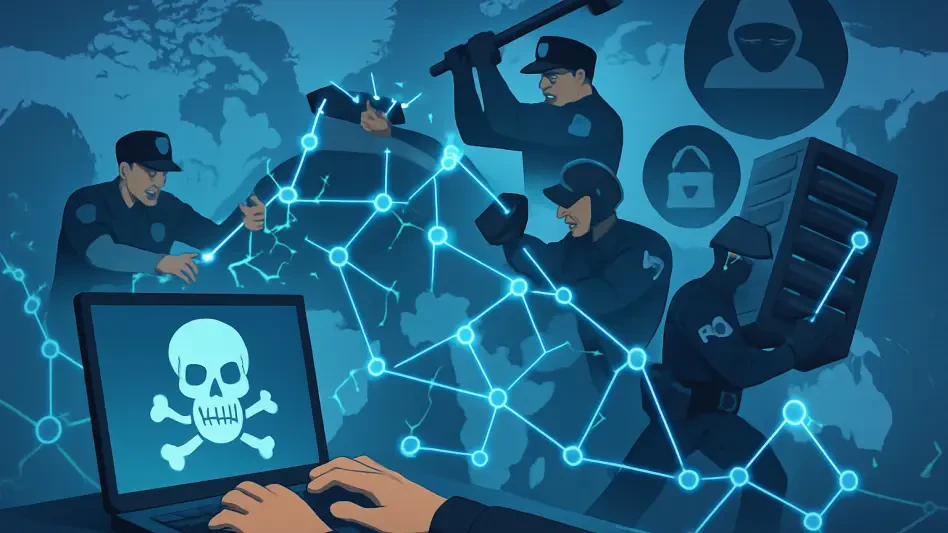
A sweeping, continent-wide dragnet involving 19 nations has culminated in over 574 arrests, signaling a potential shift in the high-stakes battle against Africa’s burgeoning cybercrime syndicates. The dramatic success of “Operation Sentinel,” a month-long, Interpol-coordinated initiative, provides a tangible testament to the power of a unified international response. However, this impressive result immediately raises a critical question: does this operation represent a genuine turning point in the fight against a pervasive continental threat, or is it merely a temporary victory in an ongoing war?
When a Coordinated Strike Changes the Game
The sheer scale of Operation Sentinel sets it apart from previous efforts. By dismantling criminal networks engaged in sophisticated schemes like business email compromise (BEC), ransomware, and digital extortion, the initiative struck a significant blow. The operation resulted in the recovery of $3 million in illicit funds, the takedown of 6,000 malicious digital links, and the successful decryption of six ransomware variants, demonstrating a comprehensive approach to disrupting criminal activities from multiple angles.
This coordinated action serves as a powerful proof of concept. For years, cybercriminals have exploited jurisdictional boundaries, operating with a degree of impunity that isolated national law enforcement agencies struggled to counter. By synchronizing efforts across nearly two dozen countries, investigators were able to trace digital footprints and financial flows that would otherwise have vanished across borders, proving that a united front can effectively challenge the borderless nature of digital crime.
The Soaring Cost of Digital Crime
The necessity of such a large-scale operation is underscored by the escalating economic damage inflicted by cybercrime across the continent. In some African regions, digital crime now constitutes up to 30% of all reported criminal activity, making it a primary threat to economic stability and public safety. The financial losses are staggering, with the cases investigated during Operation Sentinel alone linked to over $21 million in damages, a figure that only scratches the surface of the total impact.
This threat extends beyond individual financial loss, posing a direct danger to the continent’s critical infrastructure. The finance and energy sectors have become prime targets for sophisticated attacks, jeopardizing essential services and national security. As African economies become increasingly digitized, their vulnerability grows, making the establishment of robust, collaborative defense mechanisms a matter of urgent national interest for countries across the region.
On the Front Lines of Operation Sentinel
The operation’s success is best understood through its specific, high-impact victories, which serve as compelling case studies in effective cross-border law enforcement. These tactical wins highlight the diverse nature of the threats and the tailored responses required to neutralize them.
In Senegal, investigators thwarted a massive $7.9 million fraudulent wire transfer, a classic BEC scheme where criminals impersonated company executives to redirect funds. In Ghana, a ransomware attack on a major financial institution could have been catastrophic, but the intervention led to the recovery of 30TB of critical data and the arrest of key suspects. A separate joint investigation between Ghana and Nigeria dismantled a complex fraud network that used fake fast-food apps to defraud over 200 victims of more than $400,000. Meanwhile, in Benin, authorities took down a sprawling extortion and scam infrastructure, which included over 4,300 malicious social media accounts and dozens of fraudulent domains.
The Power of a Unified Coalition
There is a clear consensus among security experts that international and public-private collaboration is the cornerstone of any effective defense against modern cyber threats. Operation Sentinel embodied this principle, bringing together a diverse and powerful alliance. The initiative was spearheaded by the African Joint Operation against Cybercrime (AFJOC), with crucial funding provided by the United Kingdom and the European Union.
This public-sector framework was critically enhanced by support from several private cybersecurity firms, which provided the technical expertise and threat intelligence necessary to track and dismantle the criminal networks. This model of cooperation is increasingly seen as essential. Experts reinforce the view that such unified approaches are no longer optional but are a fundamental requirement for protecting citizens’ livelihoods, safeguarding sensitive data, and securing the integrity of national infrastructure against an enemy that recognizes no borders.
A Blueprint for Future Global Action
The operational framework of Operation Sentinel offers more than just a single victory; it provides a replicable blueprint for future global initiatives. The success of the mission was not accidental but the result of a deliberate strategy centered on intelligence sharing, coordinated enforcement, and a shared commitment to a common goal. This model proves that with the right structure and resources, significant headway can be made.
To sustain this momentum, several practical steps are necessary. This includes the establishment of permanent, multi-national task forces dedicated to cross-border enforcement, allowing for continuous and rapid response. Formalizing intelligence-sharing protocols between government agencies and private sector experts is equally vital to stay ahead of evolving threats. Finally, securing long-term international funding is crucial to ensure these operations are not one-off events but part of a consistent, relentless effort to shift the focus from making individual arrests to achieving the complete and lasting disruption of entire criminal ecosystems.