
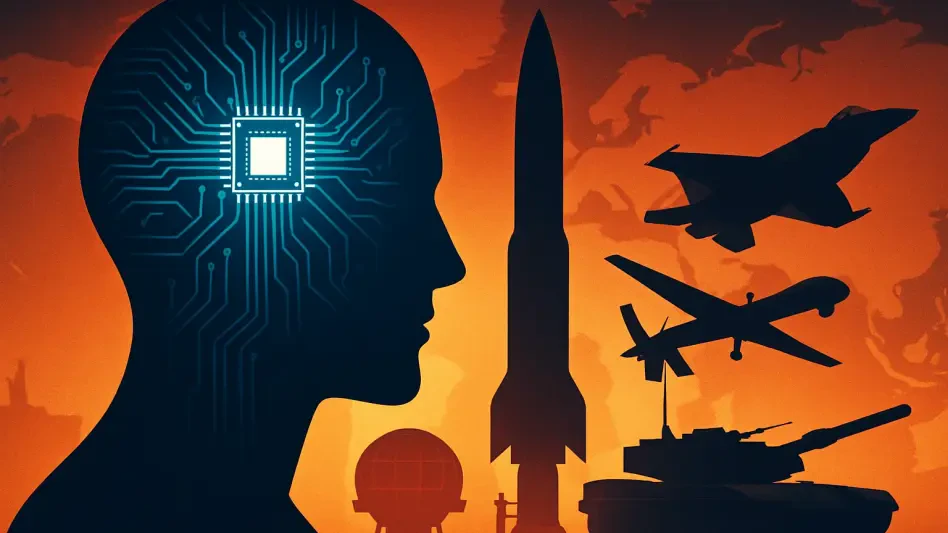
Artificial intelligence is rapidly becoming the most transformative and disruptive force in modern global security, catalyzing a paradigm shift comparable in scale and consequence to the dawn of the nuclear age. This technological revolution has ignited a new and complex arms race, one fought not only on physical battlefields but across the sprawling, interconnected digital landscape. As AI capabilities become more powerful and widely accessible, they are fundamentally reshaping the age-old dynamic between offense and defense. The barrier to entry for launching sophisticated attacks is plummeting, forcing nations, corporations, and individuals to completely rethink traditional security strategies. We are now locked in a perpetual cycle of escalating conflict, where nearly every defensive advancement forged with AI can be mirrored, adapted, and weaponized by adversaries, creating a volatile and unpredictable future for international stability.
The Dual Frontiers of AI Warfare
The tangible impact of artificial intelligence is most visible on the modern battlefield, where it has sparked a profound “revolution in military affairs.” The ongoing conflict in Ukraine serves as a stark case study, demonstrating how AI-driven systems have become central to kinetic warfare. Unmanned Aerial Vehicles (UAVs) are the vanguard of this change, with a spectrum of systems being deployed. These range from small, nimble quadcopters repurposed as disposable “kamikaze” munitions to highly sophisticated, autonomous platforms that can launch multiple strikes and return to base for rearmament, mirroring the operational flexibility of piloted aircraft. This rapid evolution has turned what was once the realm of science fiction—robotically enhanced soldiers operating alongside coordinated swarms of autonomous drones—into an emerging and decisive probability, heralding a future where AI will play an increasingly central role in determining the outcome of physical conflicts.
While its effects on physical combat are significant, AI’s influence on cyber warfare is proving to be even more profound and is evolving at a dramatically accelerated pace. For more than a decade, discriminative and predictive AI models have been foundational tools for cybersecurity, enabling firms to analyze billions of data points daily to generate actionable threat intelligence. These established forms of AI remain critical for defense. However, the recent explosion in the power and accessibility of generative AI (GenAI), fueled by concurrent breakthroughs in processing capabilities and deep learning, has created a “rising tide” that lifts the capabilities of all actors. This is not merely an incremental improvement but a fundamental game-changer, creating a far more dangerous and unpredictable cyber threat landscape where the advantage can shift from defender to attacker in an instant.
The Democratization of Digital Threats
The defining feature of generative AI is its capacity to synthesize entirely novel content, a capability that becomes a formidable weapon when applied to computer code. This ability is set to “democratize” software development and, by extension, the creation of malicious exploits. By drastically lowering the technical skill required to write functional and effective malware, GenAI is dramatically expanding the pool of potential attackers and increasing the diversity of threats. More alarmingly, it can generate this code at a speed that far surpasses human programmers. This collapses the critical window of opportunity between the public disclosure of a new software vulnerability and the development of an exploit. Where security teams historically had days or even weeks to apply patches, the GenAI era may soon see functional malware appearing in the wild within hours or minutes, placing immense pressure on defense and remediation timelines.
Beyond its power to generate code, generative AI is a potent tool for amplifying the effectiveness of reconnaissance and social engineering, the crucial preparatory stages of a cyberattack. Malicious actors can now leverage this technology to craft highly convincing and personalized phishing emails at scale, generate realistic synthetic voice interactions to bypass security protocols, and even produce deep-fake videos to deceive unsuspecting victims. During the reconnaissance phase, AI can automate and enhance the process of identifying lucrative targets and mapping their network infrastructures with unparalleled efficiency. This leads to a significant increase in the breadth, speed, and accuracy of pre-attack intelligence gathering, allowing adversaries to pinpoint weaknesses and plan their assaults with a level of precision that was previously unattainable for all but the most sophisticated state-sponsored actors.
Forging an Intelligent Defense in the AI Era
In direct response to the rise of AI-powered threats, the only viable path forward is the development of an equally sophisticated AI-powered defense. The same capabilities that empower attackers can be harnessed to proactively identify software bugs, mitigate security flaws, and manage the immense complexity of modern enterprise environments, which often rely on vast and opaque open-source and third-party software supply chains. A growing number of cybersecurity solutions already incorporate AI to help identify and prioritize the remediation of these vulnerabilities. Furthermore, as organizations grapple with a global cybersecurity skills shortage and the unmanageable volume of security data generated by a proliferating number of connected devices, AI-driven automation has become an absolute necessity. These intelligent systems can interpret the deluge of raw data, identify anomalous activities, and automatically execute the most appropriate responses across the network.
This integrated approach stands in stark contrast to traditional, siloed cybersecurity products, which are typically designed to protect against specific threat vectors and often struggle to counter sophisticated, multi-stage attacks. An effective defense against AI-powered assaults requires an AI-driven security fabric capable of correlating indicators of compromise from multiple disparate sources—from endpoints to the cloud—and orchestrating defensive actions in a coordinated manner. However, even with these advanced technologies, a more fundamental and insidious challenge persists: the human and procedural element of security. The “N-day vulnerability”—a known flaw for which a patch is available but has not been applied—remains a critical and widely exploited weakness. Attackers often do not need to develop complex “Zero Day” exploits when they can simply target organizations that have failed to perform basic security hygiene, rendering even the most advanced AI defenses ineffective.
Charting a Collaborative Path Forward
It became clear that the “AI genie was out of the bottle” and its impact on global security would be permanent. To navigate this new reality, organizations found that optimizing autonomy and automation through a robust, adaptive cybersecurity posture was paramount. However, the sheer scale and complexity of the AI-powered threat landscape proved that no single entity could manage this challenge alone. The situation demanded a collaborative effort between industry innovators, governments, and other public bodies. A new strategic division of labor was forged, where innovative commercial companies focused on developing and deploying the cutting-edge, AI-enhanced security solutions needed for defense. This allowed governments to concentrate on the complex national security implications and policy challenges posed by this new era of automation. The key to success rested upon selecting technology partners with a proven track record in both generative and predictive AI and a steadfast commitment to “Secure by Design” principles, which ensured strong security was an integral component throughout the entire lifecycle of IT products and services.